
Walter Benjamin’s view of revolution, as an emergency break on a runaway train, is increasingly relevant in an era of war and climate breakdown.
Chris Bambery is an author, political activist and commentator. His books include A People’s History of Scotland and The Second World War: A Marxist Analysis.
Cross-posted from Counterfire
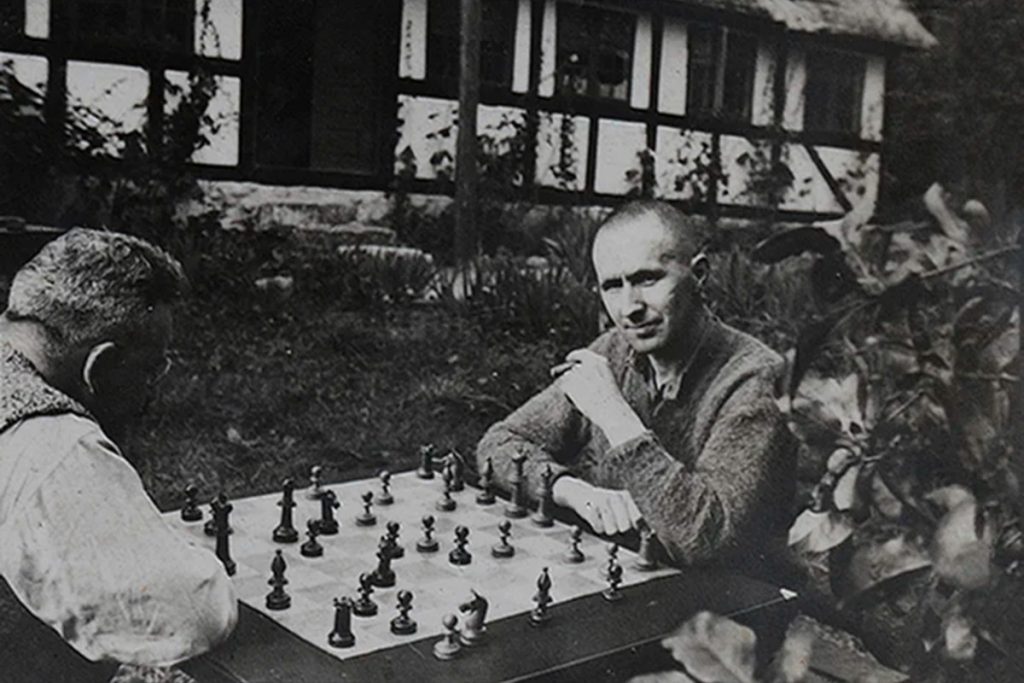
Walter Benjamin was a rather erratic Marxist who, for example, never joined any organisation and lived the majority of his adult life in the Weimar Republic in Germany and, after Hitler came to power, in exile.
He would re-emerge long after his death in the 1960s and 1970s in part through his association with the Frankfurt School of Theodor W. Adorno, Max Horkheimer and Herbert Marcuse. Unlike them he was never an academic and he had other influences such as the rough and ready Marxism of his friend, Bertolt Brecht. That meant he looked to class struggle unlike those in the Frankfurt School.
In the wake of the German Social Democratic Party’s support for the war in 1914, Benjamin would strongly criticise its mechanical Marxism which saw the progress of history as carrying society inevitably to socialism. Consequently, the revolution was rather a matter of waiting for that historic moment to arrive.
In this essay I wish to concentrate on the final writing of Walter Benjamin – On the Concept of History. I also look at Michael Löwy’s 2005 book, Fire Alarm: On Reading Walter Benjamin’s “On the Concept of History,” a commentary on Benjamin’s essay but one which develops his ideas further to deal with the contemporary world.
It is also worth saying Benjamin claimed he did not want his essay published because it was an unfinished draft because it: ‘… would leave the door wide open to enthusiastic misunderstanding.’[i]
Walter Benjamin was, among many other things, a brilliant cultural critic, one of the pioneers of the Marxist study of mass culture and the avant garde.
Background
He grew up in an assimilated upper class Jewish family in Berlin. His first venture into radical politics saw him become, from 1912 to 1914 a leader and spokesperson for the German Youth Movement, an independent, back-to-nature cultural revolt by young people rejecting modern industrial society. Post-war anti-Semitism saw him blocked from gaining an academic post so he became an itinerant literary critic, one of the most prominent of the Weimar years.
His grounding was in German romanticism. This had a strong anti-capitalist strand which criticised modern industrial, particularly industrial production, on the basis of championing pre-capitalist cultural values. From around 1924 he would begin to shift from a romantic anti-capitalism towards Marxism. A key influence was his reading of Georg Lukács’s History and Class Consciousness.
Benjamin would write that what he found in the book was the certainty ‘with which it captured, in the critical situation of philosophy the critical situation of class struggle, and in the overdue concrete revolution, the absolute presupposition, indeed the absolute exercise and the last word of theoretical cognition.’[ii]
The denunciation of Lukács’s book by the by Abram Deborin, a Russian theorist, and László Rudas, of the Hungarian Communist Party, claiming that his stress on “subjective” factors like class consciousness meant that he downplayed the centrality of Lenin’s notion of a “vanguard party,” would mark Benjamin’s suspicion of the direction the Communist movement was heading in.
During his stay on the island of Capri in the autumn of 1924, Benjamin would disseminate those ‘communist signals’ to which he remained committed throughout the rest of his life. His turn to political thought was also influenced by the Latvian Bolshevik, actress and theatre director, Asja Lācis, with whom Benjamin would have an intermittent affair for the next two years. Lācis offered Benjamin what he himself defined as ‘an insight into radical communism.’
Lācis re-called her conversations with Benjamin on Capri:
‘I told about my Children’s Theater in Orel. About my work in Riga and Moscow. Benjamin immediately supported the idea of a proletarian children’s theater and became inflamed for Moscow.’ Lācis also told him about ‘the new socialist customs, the new writers and poets.’ Among those she named were Isaac Babel and Vladimir Mayakovsky plus she talked about Alexandra Kollontai and about Larissa Reissner.[iii]
Lācis and Benjamin wrote Porous Naples together but posthumously, the curators of the Benjamin estate, and editors of the first edition of Complete Writings, Gershom Scholem and Theodor W. Adorno, decided to remove Asja’s name as a co-author of work.
Benjamin also moved in Zionist circles. One of his best friends was Gershom Scholem, a Zionist, and a well known historian of Jewish mysticism, who urged Benjamin to emigrate to Palestine. It was his love of German culture which made him reject it. Scholem would also recall Benjamin had told him that Zionism would have to abandon, its “racist ideology” and its “blood and experience’ arguments.[iv]
Influences
Michael Löwy argues that Benjamin’s thought had three main sources: Jewish mysticism, German Romanticism and historical materialism.[v]
Benjamin was very much involved in the culture of the Weimar Republic. For him modernism, which included French and works from the early years of revolutionary Russia, ‘helped shape a new way of seeing.’[vi]
A friend of Bertolt Brecht, Theodor Adomo, and Hannah Arendt (who would smuggle On the Concept of History out of Vichy France to the USA.) He wrote his first books on the concept of art criticism in German romanticism and on German baroque drama. A sympathiser of the communist movement, he visited the Soviet Union in the autumn and winter of 1926-1927 but never joined the German Communist Party.
After Hitler took power in January 1933 he was forced into exile. On 28 February 1933, he wrote to Gershom Scholem stating: ‘The little composure that people in my circles were able to muster in the face of the new regime was rapidly spent and one realises that the air is hardly fit to breathe any more – a condition of course which loses all significance as one is being strangled. This above all economically.’[vii]
In seven years of exile in different parts of Europe he had 28 changes of address. he wrote to Scholem saying: ‘There are places where I could earn a minimal income, and places when I could live on a minimal income, but not a single place where these two conditions coincide.’[viii]Eventually he settled in Paris.
Benjamin and Stalinism
Benjamin would be critical of the role the USSR and the Spanish Communist Party played in strangling the revolution in Catalonia which had followed the uprising against the Spanish Republic.
In 1937 in a letter Benjamin expressed his anger that the French Popular Front government of Leon Blum, backed totally by the Communist Party, succeeded in ‘robbing the working-class of the gut basis of instinctive action, the unerring sense for when and under what circumstances legal action must pass over into an illegal one, an illegal action into a violent one.’[ix]
Though never a supporter of Trotsky he read his books avidly. In 1926 he read Trotskyʼs essay Where is Britain Going? and later, in 1932-33, Trotsky’s My Life and The History of the Russian Revolution, with great enthusiasm: “I think it is the most interesting book I have read in many years,” he wrote to Adorno’s wife, Gretel Karplus.[x]
Michael Löwy argues that his final writings stand within the real Marxist tradition and that his essays between 1936 and 1940: ‘… are also Marxist, but constitute a new and original reinterpretation of historical materialism (nourished by Romantic culture and Jewish theology), radically different from the orthodoxy of the Second and Third Internationals. They should be considered as an attempt to deepen and radicalize the opposition between Marxism and bourgeois ideology, to heighten its revolutionary potential and sharpen its critical content.’[xi]
For me the reservation here is that Benjamin never developed a serious analysis or strategy for actually opposing the rise of the Nazis or an effective overhaul of historical materialism. ‘On the Concept of History‘ offers powerful warnings and pointers, but not a coherent theory beyond a way of looking at history and a poetic rejection of Stalinist faith in inevitable historical progress.
Benjamin would write: ‘The idea of progress necessarily ran counter to the critical theory of history, since it could no longer measure specific historical changes but rather the tension between a legendary beginning and a legendary end of history.’[xii]
Benjamin as art critic
Let us briefly look at Benjamin as the art critic. He would write: ‘The transformation of the superstructure, which takes place far more slowly than that of the substructure, has taken more than half a century to manifest in all areas of culture the change in the conditions of production.’[xiii]
Weimar Germany saw the rise the rise of photography and film as types of mechanical reproduction. Benjamin saw the possibility (not the certainty) that these could advance society to a higher stage than capitalism. Benjamin uses dialectics to show how things develop – that things undergo both quantitative and qualitative changes.
His Art in the Age of Mechanical Reproduction, celebrates the democratic possibilities of new technologies. In it he argues that mass reproduction strips artworks of the aura of originality and uniqueness that mystify them. ‘For the first time in world history, mechanical reproduction emancipates the work of art from its parasitical dependence on ritual. To an ever greater degree the work of art reproduced becomes the work of art designed for reproducibility…the instant the criterion of authenticity ceases to be applicable to artistic production, the total function of art is reversed. Instead of being based on ritual, it begins to be based on another practice – politics.’[xiv]
For Benjamin the freeing of art from ritual opened up two possibilities. One was the democratisation of art but the other was that it could simply become spectacle with potentially dreadful results: ‘Self alienation has reached such a degree that it (mankind) can experience its own destruction as a pleasure of the first order.’[xv] Benjamin was writing this three years after the triumph of Hitler in January 1933.
Benjamin had to come to terms with Hitler’s victory and explained how it could have happened:
‘Fascism attempts to organize the newly created proletarian masses without affecting the property structure which the masses strive to eliminate. Fascism sees its salvation in giving these masses not their right, but instead a chance to express themselves.’
Benjamin argued that fascism gave these masses while preserving property, going on to write: ‘… Fascism, with its Fuhrer cult, forces to their knees, has its counterpart in the violation of an apparatus which is pressed into the production of ritual values.[xvi]
Michael Löwy notes that Benjamin saw fascism, particularly Nazism as, ‘deeply rooted in modem industrial and technical ‘progress’ and was, ultimately, possible only in the twentieth century.’[xvii]
Think of Goebbels exploitation of new technology, the Hugo Boss designed SS uniforms or Leni Riefenstahl’s Triumph of the Will.
Nazism exploited the basic principles of art, design and photography’s reproducibility. It attacked and persecuted modernism because it wanted to return to European classical art and its representation of ancient civilisation, Rome in particular, with all its violence, expansionism and the horrors of slavery.
Benjamin criticises the Italian futurists, and fascists, who had celebrated Italy’s entry into World War One: ‘Imperialistic war is a rebellion of technology which collects, in the form of “human material,” the claims to which society has denied its natural material. Instead of draining rivers, society directs a human stream into a bed of trenches; instead of dropping seeds from airplanes, it drops incendiary bombs over cities; and through gas warfare the aura is abolished in a new way.’
Benjamin concludes this essay thus: ‘Fascism is rendering aesthetic. Communism responds by politicizing art.’[xviii]
His championing of modernism flew in the face of Stalinist, social realist orthodoxy. As Eiland and Jennings write: ‘Benjamin’s advocacy of avant garde practice, its nascent populism, and its Brechtian materialism, flew in the face of the then current Soviet Arts policy.[xix]
With the rise of fascism and the onset of world war Benjamin confronted a new barbarism. Already in 1928 he had warned: ‘… if the abolition of the bourgeoisie is not completed before an almost calculable moment in economic and technical development (a moment signalled by inflation and (poison-gas warfare), all is lost. Before the spark reaches the dynamite, the lighted fuse must be cut.[xx]
On Marx
A major influence on him was Karl Korsch’s Karl Marx, published in 1936, which led him to return to Marx himself (Korsch would have been beyond the pale for the German and Soviet Communist Parties).
One of the critical insights directly inspired by Marx and Engels is Benjamin’s analysis of the workers’ loss of experience and their transformation into automatons (in both the Arcades Project (Passagenwerk) and his essay on Baudelaire he quotes a passage from Das Kapital in which the workers are described as having to coordinate their movements ‘with the uniform continuous movement of an automaton.’
For Benjamin the proletarian lives in a kind of hell where they are forced to repeat the same task day after day. He quotes Engels comparing the assembly line worker to Sisyphus.[xxi]
On the Concept of History
In his final work, written as the Nazis were set to conquer France and Western Europe, Benjamin writes: ‘Those who currently rule are however the heirs of all those who have ever been victorious… For what he surveys as the cultural heritage is part and parcel of a lineage [Abkunft: descent] which he cannot contemplate without horror.’
He then adds: ‘It owes its existence not only to the toil of the great geniuses, who created it, but also to the nameless drudgery of its contemporaries. There has never been a document of culture, which is not simultaneously one of barbarism. And just as it is itself not free from barbarism, neither is it free from the process of transmission, in which it falls from one set of hands into another. The historical materialist thus moves as far away from this as measurably possible. He regards it as his task to brush history against the grain.’ [xxii]
For Benjamin history is not a locomotive of progress, carrying us to the final station – socialism, with stops at classical civilisation, feudalism and capitalism. That is a mechanical misreading of what Marx and Engels wrote. Benjamin would write: ‘Marx says that revolutions are the locomotive of world history. But perhaps it is quite otherwise. Perhaps revolutions are an attempt by the passengers on this train – namely, the human race – to activate the emergency brake.’[xxiii]
Benjamin summed up this way of thinking thus: ‘Social democratic theory, and still more the praxis, was determined by a concept of progress which did not hold to reality… It counted… as something essentially unstoppable (as something self-activating, pursuing a straight or spiral path).’[xxiv]
Such a mechanical Marxism had been dominant in the Second International prior to 1914, and Benjamin had rejected that. The inevitability of the victory of socialism was, by the late 1930s, the doctrine of Stalinism and the world’s Communist Parties, and Benjamin was alienated from that.
He wrote of the German Social Democrat Party, in terms which could apply to the German Communist Party: ‘The conformism which has dwelt within social democracy from the very beginning rests not merely on its political tactics, but also on its economic conceptions. It is a fundamental cause of the later collapse. There is nothing which has corrupted the German working-class so much as the opinion that they were swimming with the tide.’[xxv]
Benjamin ridicules what he calls ‘the illusion that the factory-labor set forth by the path of technological progress represented a political achievement.’
So, in Thesis XI he writes: ‘Nothing has so corrupted the German working class as the notion that it was moving with the current. It regarded technological development as the driving force of the stream with which it thought it was moving.’[xxvi]
The SPD’s 1875 Gotha Programme had stated that labour was ‘the source of all wealth and all culture.’ That earned this document the ire of Frederick Engels. Benjamin would write:
‘This vulgar-Marxist concept of what labor is, does not bother to ask the question of how its products affect workers, so long as these are no longer at their disposal. It wishes to perceive only the progression of the exploitation of nature, not the regression of society.’[xxvii]
Benjamin addresses how the Communist Parties in Germany, France and Spain had failed to stop fascism, with a terrible price being inflicted on humanity. He writes clearly with the experience of the Popular Front government in France that: ‘… the opponents of Fascism had placed their hopes have been knocked supine, and have sealed their downfall by the betrayal of their own cause, of freeing the political child of the world from the nets in which they have ensnared it.’ He writes of ‘the stubborn faith in progress of these politicians.[xxviii]
Here Benjamin is criticising the French Communist Party which had in June 1936 insisted that the mass strikes and factory occupations that followed the Popular Front’s election win had to be ended because they would scare the Radical Party, part of that alliance. In sharp contrast to mechanical Marxism Benjamin writes: ‘The tradition of the oppressed teaches us that the ‘emergency situation’ in which we live is the rule.’[xxix]
The locomotive of history was thundering not to the station of progress but to that of barbarism. The task of revolutionaries was not to sit back and stare out of the window but to pull the emergency brake so the working class can get off. So, he writes: ‘The awareness that they are about to make the continuum of history explode is characteristic of the revolutionary classes at the moment of their action. The great revolution introduced a new calendar.’[xxx]
A belief in the inevitability of progress is not just an illusion, but it harms the ability of the working class to resist: ‘The subject of historical cognition is the battling, oppressed class itself. In Marx it steps forwards as the final enslaved and avenging class, which carries out the work of emancipation in the name of generations of downtrodden to its conclusion.’[xxxi]
The Social Democratic Party, ‘… thereby severed the sinews of its greatest power. Through this schooling the class forgot its hate as much as its spirit of sacrifice. For both nourish themselves on the picture of enslaved forebears, not on the ideal of the emancipated heirs.’[xxxii]In every attack he makes on the SPD and the tradition of the Second International Benjamin is also attacking Stalinism.
For Benjamin, historical materialism ‘carries along with it an immanent critique of the concept of progress.’[xxxiii] Revolution is not guaranteed to succeed. Rather it is a wager.
When Rosa Luxemburg warned humanity in 1915 that the choice was between socialism or barbarism she was putting a wager before us. Benjamin would have been familiar with Luxemburg’s Junius Pamphlet.[xxxiv] He took from the French surrealist and future Trotskyist, Pierre Naville, the idea that pessimism forms a point of convergence between surrealism and communism
Benjamin wrote in 1929: ‘…. pessimism all along the line. Absolutely. Mistrust in the fate of literature, mistrust in the fate of freedom, mistrust in the fate of European humanity, but three times mistrust in all reconciliation: between classes, between nations, between individuals. And unlimited trust only in IG Farben and the peaceful perfecting of the air force.’[xxxv] His reference to IG Farben is striking given their central role in the Holocaust.
War and tragedy
Benjamin seemed to have retained some hope that the Soviet Union could be a barrier to the spread of fascism; that vanished with the Hitler-Stalin Pact of August 1939. In 1939, as the Second World War began, Benjamin was interned as an ‘enemy alien’ by the French government. Pressure from high profile friends secured his release from the camp, but while there he wrote On the Concept of History.
By the summer of 1940 with the fall of France in June 1940 he was on the run, knowing what he could expect at the hands of the Nazis, Benjamin fled Paris. Having reached Marseilles and finding no way to leave France he knew that if the Vichy French authorities handed him over to the Gestapo, as was likely, he was finished. He would, despite his ill health, cross the Pyrenees on foot, a trek which took nine hours to cover 15 miles before reaching Portbou in Catalonia.
There on 26 September 1940, believing the Franco dictatorship was about to hand him over to the Gestapo and weakened by illness, he chose to commit suicide. Tragically, his travelling companions would be allowed to continue across Spain to Lisbon and then to cross the Atlantic to safety.
[i] Jasiel Cesar, Walter Benjamin on Experience and History: Profane Illumination, Edwin Mellen Press, 1992, P108
[ii] Cited in Uwe Steiner, The True Politician: Walter Benjamin’s Concept of the Political, New German Critique, No. 83, Special Issue on Walter Benjamin (Spring – Summer, 2001), P80
[iii] Andris Brinkmanis, Constellation Asja, e-flux Journal, Issue 110, June, 2020
[iv] Gershom Scholem, Walter Benjamin: The Story of a Friendship, Faber and Faber, 1982, P28-9
[v] Michael Löwy, Fire Alarm: On Reading Walter Benjamin’s “On the Concept of History,” Verso, 2005, P4
[vi] Howard Eiland and Michael W. Jennings, Walter Benjamin: A Critical Life, Harvard University Press, 2016, P1
[vii] Howard Eiland and Michael W. Jennings, Walter Benjamin: A Critical Life, Harvard University Press, 2016, P392
[viii] Ibid
[ix] Cited in H. D. Kittsteiner, Walter Benjamin’s Historicism, New German Critique, No. 39, Second Special Issue on Walter Benjamin (Autumn, 1986), P197
[x] Cited in Helmut Dahmer, Trotsky and the Frankfurt School, Platypus Review #80 | October 2015
Platypus Review #80 | October 2015
[xi] Michael Löwy, Walter Benjamin and Marxism, February, 1995
[xii] Cited in H.D. Kittsteiner, Walter Benjamin’s Historicism, in Peter Osborne (editor), Walter Benjamin: Critical Evaluations in Cultural Theory, Volume 1, Routledge, 2004, P276
[xiii] https://web.mit.edu/al
[xv] https://web.mit.edu/al
[xvi] Cited in Lawrence Rainey (editor), Modernism: An Anthology, Wiley-Blackwell, 2005,, P1108
[xvii] Michael Löwy, Fire Alarm: On Reading Walter Benjamin’s “On the Concept of History,” Verso, 2005, P59
[xviii] https://web.mit.edu/al
[xix] Howard Eiland and Michael W. Jennings, Walter Benjamin: A Critical Life, Harvard University Press, 2016, P144
[xx] Walter Benjamin, One-Way Street: And Other Writings, Verso, 2021, P84
[xxi] Cited in Michael Löwy, Walter Benjamin and Marxism
[xxii] https://www.marxists.org/reference/archive/benjamin/1940/history.htm
[xxiii] Walter Benjamin, Walter Benjamin: 1938-1940 volume 4: Selected Writings, edited by
Michael W Jennings and Howard Eiland, Harvard University Press, 2006, P402
[xxiv] https://www.marxists.org/reference/archive/benjamin/1940/history.htm
[xxv] Ibid
[xxvi] Ibid
[xxvii] Ibid
[xxviii] Ibid
[xxix] Ibid
[xxx] Ibid
[xxxi] Ibid
[xxxii] Ibid
[xxxiii] Cited in Rolf J. Goebel (Editor), A Companion to the Works of Walter Benjamin, Camden House, 2009, P164
[xxxiv] https://www.marxists.org/archive/luxemburg/1915/junius/ch01.htm
[xxxv] Cited in Lawrence Rainey (editor), Modernism: An Anthology, Wiley-Blackwell, 2005, P1094


Be the first to comment