
Book Review by Branko Milanović
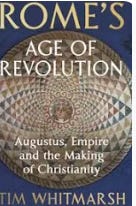
The recently published book Rome’s Age of Revolution by British historian Tim Whitmarsh takes the three well-known ingredients in the origin and rise of Christianity (Jewish theological roots, Greek language, Roman political unification) and shakes them up like in a new cocktail to produce a book where the first (Jewish element) becomes the least important and the other two become indispensable. Without Paul’s early decision to appreal to non-Jews and to do so by using the lingua franca of the time (the koiné Greek) and without Augustan political unification of the empire, including through the construction of an excellent road network, Christianity simply would not have developed. Paul and the apostles were, in Whitmarsh’s terms, extraordinarily apt political “entrepreneurs”.
No one would have believed at the end of (what we now call) the first century that small bands of Jesus’s followers (Whitmarsh is reluctant to use the term of “church” or Christianity until the late Antiquity when Christianity became the official religion of the Empire) would out-maneuver other religions (pagan, Mithriadic, Manichean) and other philosophical schools (neo-Platonists, Cynics) to become hundred and odd years later the official religion, a Church, and a ruling philosophy.
In this reweighting of different ingredients, language and roads become key. Not only had early Christians decided to move to Greek in order to be understood (including by many who were not native Greek speakers), but they also began gradually to move from the narrative to the books. Whimarsh dedicates a whole chapter to the bibliophilic decision that was post-Pauline in time (since at first Jesus’ followers relied much more on oral persuasion and direct canvassing) and created a written body of works. These works appealed to the upwardly mobile middling classes of the Empire who were enthralled by books and private libraries. Books were, as Whitmarsh writes, luxury objects: they were expensive (because time-demanding to produce) and their ownership carried the cachet of erudition. “Their [Jesus’ followers] target market was the upwardly mobile: the middling, aspirational classes who possessed some means but lacked the lustre that attached to aristocracy” (p. 138).
Christians skillfully moved from narrative to writing and, when they achieved power, began a massive reinvention and falsification of history. Whitmarsh is (like other historians) very skeptical of the story of almost uninterrupted conflict between the new sect and the Empire. In effect, for most of the first three centuries Christians lived like everybody else: their religion was neither forbidden nor encouraged. It was generally ignored. Only when, at times, Jesus’ followers produced what in modern Chinese judiciary language is called “trouble-makers” and were “picking up fights”, they were summarily judged and occasionally executed or martyred by local authorities. But this was not a fate uniquely meted out to Jesus’ followers. Many others suffered from similar random judgments. After Christianity became “officialized” by Constantine, Whitmarsh writes, its followers engaged not only in the embellishment, and multiplication, of the stories of martyrdom, but also (possibly) in the falsification of the then-extant ancient literature. It is remarkable that Whitmarsh, basing himself on the work of other historians and modern forensic evidence, believes, or allows for the possibility, that the two most famous references to Christians in the ancient literature (Tacitus in Annals, and the correspondence between Pliny the Younger and Emperor Trajan) might have been counterfeited by late Antiquity Christian scribes. One is not altogether convinced by this allegation –especially so in the case of Tacitus, since if indeed Christian copyists intentionally replaced “Chrestos” by “Christos”, why would they have kept Tacitus’ most negative statements about Christian religion, calling it “exitiabilis superstitio” (pernicious superstition), and its followers “haters of the human race”, intact?
However, whether this particular falsification took place or not is dwarfed by the overall falsification (“[t]he idea of a grand re-editing project…is not as outlandish as it might seem at first sight”, p. 99) that exaggerated the martyrdom of early Christians and sought to create the impression of permanently antagonistic relations between them and the Empire. In fact, the Empire served as a useful foil in this re-invented history: there was on one side hierarchical, corrupt and evil secular power, and on the other side egalitarian, self-abnegating, and virtuous Way of Life. But, Whitmarsh argues, without that evil empire’s political unification and the road network that it built there would have been no Christianity. Augustan age thus plays the key role in Whitmarsh’s narrative, even to the extent that many parallels are drawn between Augustus and Jesus: having at least temporally overlapped for at least a decade and a half, and being seen as ultimate embodiments of a long and venerable tradition: Augustus through the means of Virgil’s Aeneid was connected to Homer and Troy, and Jesus though the means of the Gospels, to God himself.
The story of the rise of Christianity has many modern analogs. Whitmarsh is not shy about mentioning some, but does not go overboard. The globalizing aspect of the newly expanded Augustan empire, that covered an area equal to almost 4 million square kilometers (roughly, the current size of the European Union) and included 50 to 60 million people, is sufficiently close to today’s world that Whitmarsh can speak of Roman “glocalization”. We can however go further and compare Christianity, no longer as a religion but as a system of thought, to today’s neoliberalism. (Whitmarsh is quite clear in stating that the success of Christianity owed a lot to its becoming a philosophy, that is, overcoming—not to say transcending—the limits of traditional religions. Consequently, it is, one might think, appropriate to compare it with other philosophic schools.)
Thus, had the book been published some fifteen years earlier, the analogy would have been obvious. The world was then, as it was under Augustus, unified: it was, to use an expression made at the time famous, “flat”. To such a flat Augustan world, with readily accessible means of communication, “belongs” one single unifying ideology. La pensée unique of neoliberalism fulfilled exactly the role that Christianity did in Augustan era. It appealed not so much to the traditional top classes but to the upwardly-mobile, educated and aspiring middle classes. It is not accidental that in the West, the heyday of neoliberal ideology was achieved during the rule of moderate socialists and of the Third Way: Gonzalez in Spain, Mitterrand in France and of course Clinton-Blair in the Anglo world. In Fukuyama, Thomas Friedman and similar writers, the ideology found its prophets. It had a wide following not only in the English-language West which plays there the role that the Greek-speaking eastern Mediterranean played in the ascension of Christianity but elsewhere too: in China, Russia, and India.
So, what went wrong? Perhaps two things. Neoliberalism (like Communism, to use another modern ideology that can be easily compared to early Christianity) had to deliver its fruits down here, in real practice. The advantage that a transcendental eschatological school would always have over a secular ideology (Stoicism, neoliberalism or Communism) is that it is based on the trust of its followers: the delivery of the goods cannot be verified but has to be believed.
The second reason may be a factor to which Whitmarsh gives quite a lot of attention: early Christianity was based on charismatic power, whether Jesus’ or even Paul’s (who also seemed to have been able to enthrall his audiences). But, following Max Weber, such charismatic power, if it is to be extended in time, needs to be institutionalized. Paul himself laid the groundwork for it. However –and this is the rub—institutionalization and routinization take away the aura. Things become boring and humdrum. How did Christianity escape the trap? By creating whole batteries of self-sacrificing zealots. It became non-boring, exciting and great again. For some reason, neoliberalism never created nor brought about such self-sacrificing zealots nor produced influential and exciting philosophers who would defend its cause. In fact, it lost at the hands of those who presented themselves as the charismatic leaders, bearers of a new vaguely-defined ideology. Perhaps it was inevitable that a philosophy whose dream is a very rational, risk-free and boring existence, was unable to provide the excitement of the charisma. The religion that kept on producing martyrs, hermits and monks did that job much better, and in different forms from the Evangelicals in Brazil to the Old Believers in Russia it still does it to this very day.
_____________________________________
NB. Tacitus’ passage on Christians.
“Consequently, to get rid of the report, Nero fastened the guilt and inflicted the most exquisite tortures on a class hated for their abominations, called Christians by the populace. Christus, from whom the name had its origin, suffered the extreme penalty during the reign of Tiberius at the hands of one of our procurators, Pontius Pilatus, and a most mischievous superstition, thus checked for the moment, again broke out not only in Judæa, the first source of the evil, but even in Rome, where all things hideous and shameful from every part of the world find their centre and become popular” (Annals, 15.44).
Rome’s Age of Revolution: Augustus, Empire and the Making of Christianity by Tim Whitmarsh
Publisher : Bodley Head
ISBN-13 : 978-1847925343


Be the first to comment