
Millions have rightly turned to John Mearsheimer for compelling critique of US foreign policy, but it’s also important to recognise the limits of his ‘realist’ worldview.
Gerald Sussman is professor emeritus of urban studies and international studies at Portland State University. He is the author or editor of seven books, including the most recent (2025), British and American Electoral Politics in the Age of Neoliberalism: Parallel Trajectories (Routledge). This article is an abbreviated version of a forthcoming article in the journal New Political Science. Professor Sussman can be reached at: sussmag@pdx.edu
Cross-posted from Counterpunch
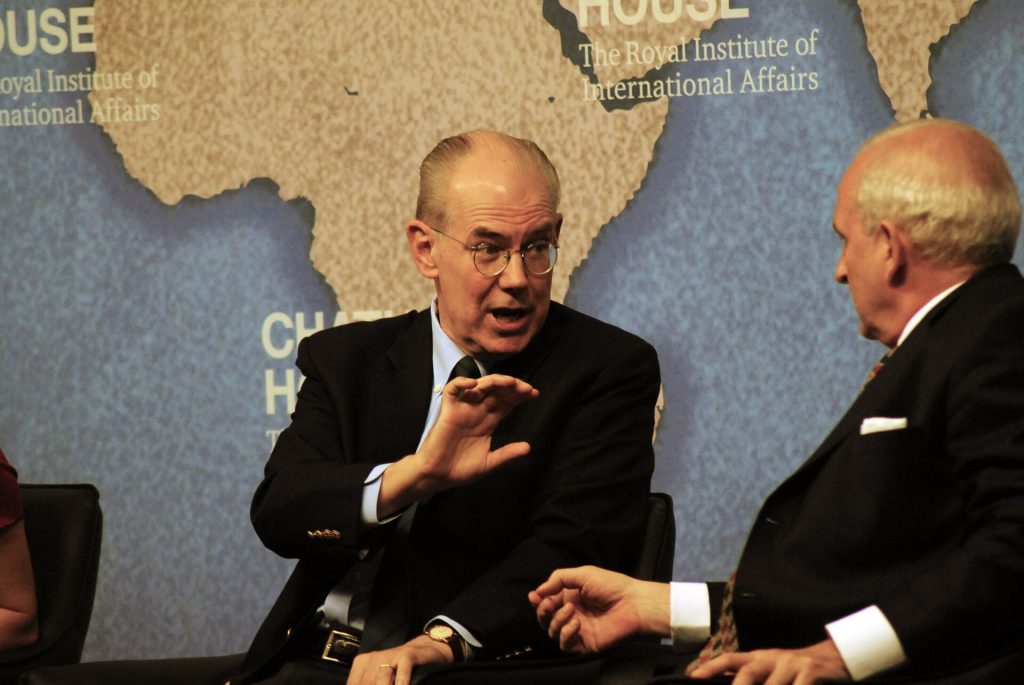
One of the most persuasive critics of US foreign policy and perhaps the best-known contemporary exponent of international relations (IR) theory is John Mearsheimer, a professor at the University of Chicago. But despite his fame and massive audiences on YouTube, the mainstream media organizations (MSM) will have nothing to do with him.
The reason is obvious. The MSM do not platform serious and erudite critics of US foreign policy. Edward Herman and Noam Chomsky explained this in their epic work, Manufacturing Consent (first published in 1988), on the MSM and US foreign policy, which, they argued, institutionally function not as a proverbial free press but rather as organs of propaganda in the service of state legitimacy. Without a compliant mass media system, the days of any government would be numbered.
Mearsheimer’s methodical analysis of the crises in Ukraine and the Middle East and the US role in these conflicts has swayed large numbers of people, as revealed in the growing audience size each time he makes a public appearance in lecture halls or on social media platforms. Audiences around the world see him as a leading IR expert, particularly younger sections of the population who side with anti-imperialism and anti-colonialism. The left (radical realism) has several overlaps with Mearsheimer’s claim to a realist perspective, albeit with a more complex political-economic analysis than he offers.
Mearsheimer’s 2007 book with Harvard professor Stephen Walt on the power of the Israel lobby in the US was a courageous effort to challenge the extraterritorial influence that the Israeli state and its in-country minions exert over the American political process, particularly with respect to foreign policy in the Middle East. While they were initially treated with loud choruses of condemnation and frequently accused of being antisemites by legacy media pundits, that charge has somewhat receded since the book first appeared (together with a journal article version of it published the year prior). A number of other political analysts have since taken up a similar exposé of Israeli penetration of American politics.
In their book and on the speakers circuit, Mearsheimer and Walt do not specifically focus on Israel’s apartheid policies or the violence enacted against the Palestine population as much as seeing these acts as a strategic blunder that is not in Israel’s long-term interest as a state. Indeed, they bend over backward to express their defense of Israel’s “right to exist,” clearly cowed by the antisemitic charges lodged against them by Israeli and pro-Israel elements. They further argue that Israel’s behavior is damaging to the maintenance of America’s sphere of influence in the region and its survival as a great power, a status they in fact endorse.
On strategic grounds, Mearsheimer in particular has been very critical of America’s past forays in the Third World (Global South): its outright military defeats or complete policy failures in Vietnam, Iraq, North Korea, Afghanistan, Cuba, Nicaragua, Russia, Ukraine, Iran, Yemen, Lebanon, and still other countries. As Mearsheimer and several other political analysts have pointed out, the Israel lobby uses its considerable leverage in the US to actively shut down debate on the Palestine question in the media, foundations, Congress, and academia, treating criticism of the US-Israel alliance or the violence carried out against Palestinians as baseless or simply antisemitic. The lobby has no qualms about weaponizing the memory of the Holocaust for the purpose of enacting another holocaust upon the Palestinian people. And this time it’s been televised.
Groups such as AIPAC and the Foundation for Defense of Democracies are engaged, Mearsheimer notes, in extensive lobbying, campaign contributions, and the use of secondary pressure groups and influencers to secure legislation and economic assistance on behalf of Israel. He has also argued that as a discursive tactic, these groups and individuals exploit the memory of the Holocaust to bludgeon critics of Israel, including large numbers of Jews, an abuse of Jewish history and culture bitterly attacked by political scientist Norman Finkelstein, whose parents suffered in Nazi-run concentration camps.
The privileged and unique position the US accords Israel amounts to reparations paid to an apartheid state that uses American tax money, weapons, and political backing to mass murder Palestinian men, women, and children, a genocidal strategy now extended to Lebanon. The lobby, Mearsheimer argues, continues to function as the most powerful foreign influence on US Middle East policy.
One of his most poignant critiques of US foreign policy, especially of the Trump and Biden administrations, is the foreign policy establishment’s refusal to engage in serious diplomacy with adversaries. Mearsheimer sees this kind of behavior as an “irrational” act of the state.
A radical understanding, however, would instead depict US behavior as big power chauvinism and militarism driven by the insatiable demands of top-of-the-pyramid interests – the corporate monopolies and billionaire class that dominate foreign policy decision-making and are its primary beneficiaries – with the full buy-in of both coopted political parties and the MSM.
To the military-industrial complex, the high-tech industries, the energy industry, and the Zionist alliance of Christians and Jews, America’s chaotic invasions and mass destruction in the Middle East are indeed perfectly rational and consistent with a history of US attempts to wholly destroy civilizations – Japan, Korea, Vietnam.
Moving further against the grain, Mearsheimer also recognizes that the Russian invasion of Ukraine stemmed from US and NATO efforts to bring that country (and Georgia) into the military pact, and that the proxy war that followed was designed to turn it into an anti-Russian instrument of destabilization at the gates of Moscow, thus creating an existential threat to the Federation. At the same time, the war has deepened the client state dependence of the EU and NATO on the US.
Mearsheimer cites Lenin’s “Imperialism as the Highest Stage of Capitalism” as a great work of “realpolitik,” though he himself ignores the force of US imperialism or capitalism throughout his 2001 555-page magnum opus on international relations theory, The Tragedy of Great Power Politics, and in his subsequent writings. Nor does his main treatise bring in such concepts as class and class struggle or analysis of the mode of production. The state, including certain non-state actors, functions, in his view, as a unified political unit of foreign policy decision-making.
Despite certain shared views of US foreign policy with that of the Marxist left, there are other significant shortcomings and inconsistencies in his “offensive realism” approach, which he describes as the natural quest of major powers for hegemony in a lawless, anarchic world. For example, he regards Israel as the dominant partner of the US in establishing regional domination, which, he says, works against US interests. In other words, the lobby is the tail wagging the American dog.
To be sure, the Israel lobby is a powerful influence on foreign policy decision-makers responsible for West Asia, including the president, but it would be mistaken to believe that US aggression in Iraq and Afghanistan, which led to the assaults on Iran, occurred mainly because of Zionist leverage over the American political system.
The late Scottish international relations professor Peter Gowan praised Mearsheimer for breaking apart the liberal foreign policy shibboleths of the Clinton administration as a great demystification of how America operates in the world – not in the service of “democracy promotion” but in the realpolitik of great power projection. But Gowan challenges Mearsheimer with the question: what is the composition of a great power, and how did great powers in history get to be great?
For the US, it quite clearly involved conquest of America and an economy built on slavery and Jim Crow repression, which gave rise to powerful banking and industrial monopolies, robber barons, and the cruel suppression of labor. In regard to more recent decades, Mearsheimer should have consulted the work of G. William Domhoff, Who Rules America? and its eponymous website. Are working class interests simply subsumed under the “national interest,” as Mearsheimer assumes?
A West Point graduate and former Air Force commissioned officer, Mearsheimer continues to think like a military strategist: “I emphasize that great powers seek to maximize their share of world power” (The Tragedy…, p. xiii). Other core questions he fails to ask are why the US has been at war all but 16 of its 250-year history and what internal forces make great powers (the US primarily) so prone to violence?
He starts from the premise that great powers are constituted by size and wealth, which, as matters of survival, necessarily develop strong militaries. Mearsheimer’s realism treats war is an inevitable and permanent condition of the state. He doesn’t mind being called a pessimist.
But relatively small size and wealth compared to the US, as he’ll readily admit, did not eclipse the communist and nationalist resistance in Vietnam or anti-colonial resistance in Afghanistan and Iran. Any prediction, therefore, that an indisputable power like the United States will prevail over economically and militarily weaker countries is not something to bet on. Iran is the latest case study.
And how does he explain a major power like Israel, a country about the size of New Jersey and 26th in national GDP, being among the top ten militaries in the world? It is not wealth and population that drive Israel to act as an imperialist or sub-imperialist state but rather its commitment to extreme nationalism, ethno-fascism. If, as likely, Iran ends up defeating the US, decided in terms of the latter’s stated objectives, it will not be the military or wealth factors that won the day but the economic strategy of shutting down the flow of oil to the wealthy countries in the world on which their existence depends.
The main weakness in Mearsheimer’s otherwise impressive arguments is his failure to recognize and discuss the expansionist nature of corporate capitalism and overlooking, on a broader canvas, the reality that national and international politics is the articulation of economics. Where the US cannot bully countries into compliance with the overhanging economic leverage of US-dominated international institutions such as the World Bank, IMF, and WTO or the use of economic and financial sanctions, it uses war toward the same ends.
Mearsheimer imagines a unified state, and while it is true, as he sees it, that the Democrats and Republicans are like lips and teeth when it comes to military and global economic objectives, there remains the countervailing latent power of those who fight the wars but fail to benefit from imperialism, the working class. Every ruling class fears the working class, because they understand that the state can quickly lose its legitimacy, which may follow with their heads.
To his credit, Mearsheimer has not lent his intelligence to the service of the deep state, and he has used the social media platform to discredit US-Israel aggression and genocidal policies. His brand of “realism,” under-theorized as it is, nonetheless provides cover for a well-argued attack on overall US foreign policy even if it doesn’t acknowledge and help to explain the materialist, economic, and class roots of American superpower politics.


Be the first to comment