
Book Review by Mathew D. Rose
With the exception of the Epstein Class and the Professional and Managerial Caste in Britain there is now a broad consensus that neo-liberalism has failed the nation. It has left a legacy of death and destruction in the United Kingdom behind it. Among most Britons there is a feeling that something has to change. That is why so many voted for Keir Starmer and Labour in the previous general election. It seemed a forlorn hope, but it was the only hope available to them to stop the decline of the nation, society, and their own fortunes.
At the same time many British citizens have disparate ideas of what is needed to turn the nation around economically and socially: renationalising public services such as water, the railways, energy; removing private corporations from the NHS; the government building new, affordable homes; creating well paid jobs; energy efficiency; to name a few. All of these together are a massive task, and since most political parties are set on continuing neo-liberal polices, solutions are not sought. To be sure, they would not be simple singly, much less altogether.
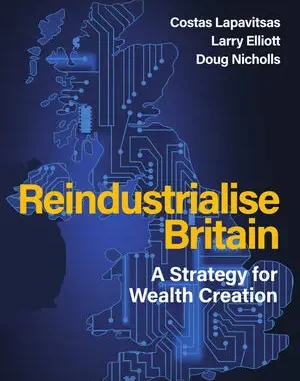
In “Reindustrialise Britain – A Strategy for Wealth Creation” three authors, Costas Lapavitsas, Larry Elliot, and Doug Nicholls join together to propose a well crafted universal solution to Britain’s current malaise, better said the Full Monty. All three approach the problematic from different backgrounds. Lapavitsas is Professor for Economics at SOAS at the University of London. He also has, to put it mildly, experience in the vicissitudes of practical politics having been a parliamentarian in Greece for Syriza during the unfortunate Tsirpas government. Elliot was a highly regarded Economics Editor at the Guardian for almost 30 years until his retirement in 2024. In addition he was one of the founding members in 2007 of the eminent “Green New Deal Group”, that has played a worldwide role in our thinking about solutions for the climate emergency. Nicholls was General Secretary of the General Federation of Trade Unions from 2012 to 2023. He has been active in a number of movements from the Miner’s Strike, opposing the EU, and today in support of Palestinian self determination. In short, all three not only have a strong theoretical background, but also extensive experience in pragmatic politics. This also gives the authors the advantage that their book is written in an easily accessible manner, explaining in simple terms what are often considered recondite topics.
The book is without a doubt radical, but at the same time conservative, as the solutions it offers were common practice in Britain and the world before the neo-liberal era embodied by Margaret Thatcher in the UK. They have simply been eradicated from common knowledge by almost half a century of neo-liberal narratives. The authors’ goal is “to rebuild wealth creation based on skilled work”. Easily said, but the path to this goal will be long and surely tortuous. Undoing fifty years of iniquity is no simple task.
The book is divided in three parts. In the first, “Damaged Goods – A Diagnosis” it analyses how the British economy and social fabric was systematically destroyed be neo-liberalism. One should not underestimate the importance of this section of the book. Thatcher was elected in 1979. That means Britons under the age of 55 have only known neo-liberalism and have little knowledge of what preceded it, except the establishment trope that everything before Thatcher was “bad”. Nor do they realise that the post World II policies of British governments were a reaction to the same economic and social injustices that reign in Britain today.
The second part, “A Strategy For Wealth Creation – What To Do” is dedicated to presenting how reindustrialisation can be achieved. It is detailed and well thought through. As would be expected it includes a number of radical (earlier normal) elements such as nationalisation of utilities and some industries, tariffs, and something that has completely disappeared from Western economics: capital controls.
In the third section of the book entitled “Making It Happen – Who And How To Do It” the authors describe the ways and means of converting the plans presented in the second section. Unions would play a central role in adopting the necessary policies, but just as important would be building a broad political coalition, much like after World War II, to provide the popular support for such a programme.
The authors believe that a wealth creation model can be achieved:
“by restructuring the economy’s supply side. This will require, at the very least: a wave of public investment, a green new deal, a coherent industrial strategy, active regional policy, a more progressive tax system, a sensible and fitting policy on immigration, controls over trade and capital flows, and the return of key utilities and industries to the public sector.”
This of course contradicts neo-liberal ideology, but while Western nations are economically in the doldrums, the most successful economy in the world, China, which has “a state led industrial policy, large public corporations, protected domestic markets, and tight control over capital and the exchange rate” is thriving. While the incomes of working people in Britain have been stagnant or have declined for years, in China they have inexorably risen. Massive state investment China has created an infrastructure that is the envy of any Western nation and the world. These are all facts that are ignored in the West, which instead claims that China’s success story is the result of illicit means and an economic collapse is round the corner.
The authors provide a plethora of convincing facts and numbers to illustrate the decline of the British economy. The key causes for this in their opinion are globalisation and financialisation, both serving the interests of large international corporations and the financial sector. To start with, both of these will have to be brought under control, something that only the state is capable of doing, just as it made both of these possible in the first place. One result of these two forces is clear, the destruction of much of Britain’s industrial base while bloating the financial sector. The latter is more interested in asset stripping and speculation, than investing in the British economy or people. As long as the government places its priorities on serving the interests of the financial sector, instead of resurrecting Britain’s industrial base, there will be no improvement.
The authors believe that investment by the public and private sectors needed to rebuild Britain’s industrial base will have to be designed around a Green New Deal. Although written a short while ago this necessity has only become more urgent as the climate crisis rapidly worsens. The increasing number of destructive climate events are no longer an anomaly, but have a clear upward trajectory. Every future economic decision will have to be made with this in mind. This will not be a hindrance to wealth creation for a broad swath of society. Renewable energy, recycling, building affordable housing and making homes energy efficient, improving and expanding the public transport sector, all these will demand skilled, well paid labour. These will require investments that will remain in Britain and can be regulated by the state so that they are not brought under control of the financial sector resulting in profits being siphoned off to tax havens.
According to the authors their programme will cost 1.41 trillion pounds over a ten year period. This investment will come three-fifths from the public sector and two-fifths from the private sector. Much of this will be provided by a Public Investment Bank and “pensions redirected to UK assets”.
At the same time Britain will have to wrest control of its economy back from foreign investors and financial capital. Part of the neo-liberal programme has been the sell off the national infrastructure. Although the government has a small degree of control over these, it is hardly used. The massive pumping of sewage into British rivers and the sea as well as some of the most expensive prices for trains and electricity in Europe are proof of this.
On the other hand, thanks to Brexit, the UK government is no longer prohibited by EU laws from introducing many of the necessary measures to revitalise its economy and reinstate social justice. The EU was the means to strip member states of their sovereignty, especially in economic matters. In the EU Britain was damned to decline without any means to stop it. As a sovereign nation nothing stands in its way from refurbishing its economy.
Well not completely. Such a programme will face bitter resistance by financial capital, the political class, corporate media (the BBC will probably work against such reforms as well), the propertied, and the Managerial and Professional Caste, to name a few. Those who have profited from neo-liberalism. This is all about the British people taking back power.
To counter this the authors believe that mass support can be mobilised within communities and unions. They however know that one cannot only offer blood, sweat, and tears over years, so benefits will have to start accruing at an early stage. This may sound idealistic, but it was the method of the Labour party after the war enabling it to build an economy and society – that did not look much different from what the authors are striving for – which served a broad British society, and not the few. If it has been done in Britain after the war and China today, then it should be possible in Britain today.
The authors are clear that this is not “The Programme” that needs to be adopted, but see it as a framework from which British society can rebuild its economy and society. God knows Britain needs it.
____________________________
Reindustrialise Britain – A Strategy for Wealth Creation by Costas Lapavitsas, Larry Elliot, and Doug Nicholls
Publisher: Polity
ISBN-13: 978-1509574759

Be the first to comment