
What kind of future does France offer its young people?
Vijay Prashad is the Director of Tricontinental: Institute for Social Research. His most recent book (with Grieve Chelwa) is How the International Monetary Fund Suffocates Africa (from Inkani Books).
Cross-posted from Counterpunch
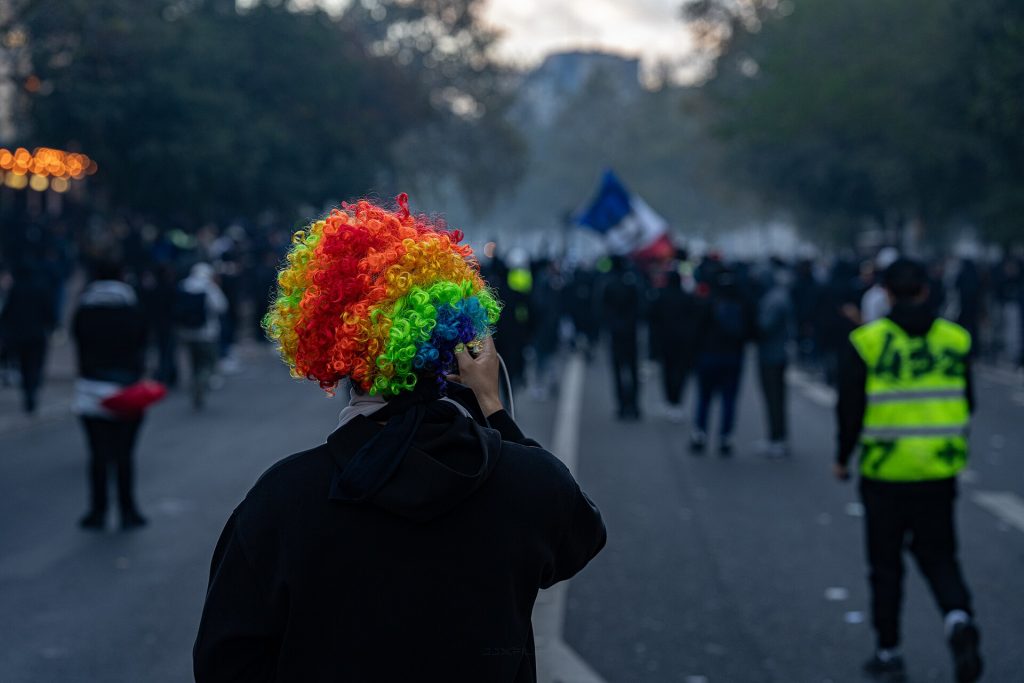
Students in the Paris suburbs came onto the streets merely to get teachers into their classrooms, to have enough desks for their classmates, and to have the state build school buildings fit for the educational experience. These suburbs, or banlieues, are the warehouses of France’s working poor, mainly non-white communities that had come to France from its colonies. The French establishment does not want to talk about racism, self-righteous in its official ideology of universalisme (republican universalism). But racism from the state (particularly the police) and the far right parties is real, and the degradation of services in the banlieues proves to the non-white French that their rights are being systematically denied. Thus, every few years, young people in the banlieues emerge onto the streets to demand justice.
The spur from the banlieues spread across France, drawing strength from wider anger against the French establishment’s attitude toward the deflation of wages and the inflation of prices, the Israeli genocide against the Palestinians, the rising French military support for Ukraine, and finally the decay of public services. Behind this range of demands stands an immense question: what kind of future does the French Republic offer its young people?
Deflation of Wages, Inflation of Prices
On 17 October, the CGT trade union confederation counted nearly 800,000 people, sections of them from trade unions, in the demonstrations across France. Their demands included higher wages and pensions, lower prices, and public services adequate to people’s needs. Images of burning buildings and looted shops have dominated international media coverage and is typically used to discredit the protests. But these images do not explain why hundreds of thousands of people, led by the working class, have participated across France. Schools are overcrowded, livelihoods are insecure, and households are exhausted – none of this can be dismissed by the French government, which wants to allege that this protest is not representative of the French people in total. The broken shop window is not as significant to the protests as the broken social promise that brought people onto the streets.
In 2018, an increase in taxes on fuel ignited anger among people dependent on cars to reach work. This uprising was known as the Mouvement des gilets jaunes(Movement of the Yellow Vests) because those who came to the protest wore the yellow vests that are worn during automobile emergencies. When French President Emmanuel Macron lessened the wealth tax, the yellow vests took this as a direct insult. People gathered at roundabouts across France, their common grievances bringing them together against the French establishment. The government retreated on the fuel tax increase, which strengthened the yellow vests. The embers of the yellow vests remained even after people went home, and it came back on the streets in 2023 when Macron used an article in the Constitution to advance his pension legislation without a vote in the National Assembly. He wanted to raise the retirement age from 62 to 64 to prevent paying pension for two years to older workers, many of whom sympathised with the yellow vest demands. Again, in 2025, Prime Minister François Bayrou proposed a €43.8 billion budget squeeze, including the elimination of two public holidays. To the French public, it became clear that the leisure time of workers and the social protections afforded to them had become available to settle the state’s accounts, while the wealth of the billionaires was untouchable.
Betrayal of the French workers impacted their children, and now it is these children who are on the streets because of the betrayal that they have personally experienced. An entire generation has been educated in the distance between republican language and social reality. That promise has deteriorated for years, as France’s national statistical institute (Insee) found that 9.8 million people live below the poverty threshold in 2023 with the poverty rate (15.4%) the highest since the series began in 1996. Particularly impacted are children and single-parent families. In the banlieues, poverty is the natural state, and this poverty is intertwined with everyday racism. France’s Black Lives Matter mobilisation begins during the campaign for justice for Adama Traoré (a 24-year old of Malian descent) who died in gendarmerie custody in July 2016, which grew to demonstrations of tens of thousands of people in June 2020 when Traoré’s sister, Assa, led a march to the Paris courthouse. The protest brought together working-class Black and Arab experiences of police violence in the banlieues. The young people on the streets were too young to be part of the Yellow Vest movement, but they had already experienced – through their parents – the tear gas and the police batons, and they had experienced the protests for racial justice.
Palestine
Underneath the current protests in France is the repression of the French establishment against those who wanted to stand against the genocide of the Palestinians. On 12 October 2023, less than a week after the new violence began against the Palestinians in Gaza, Interior Minister Gérald Darmanin instructed the prefects to ban demonstrations in support of Palestine. That night, people gathered at Paris’s Place de la République with Palestinian flags, before the police dispersed them with tear gas and water cannons. On 18 October, the Conseil d’État clarified that the prefects could not prohibit all protests for Palestine, but only those that risked disorder. This did not provide any comfort, since most protests faced repression, and most protests became about the right to protest rather than about Palestine.
At Sciences Po (Paris), as on other campuses, students organised meetings and occupations to argue against their institution’s partnerships with Israeli institutions. During the night of 24 April, the university called in the riot police to remove sixty students from the campus. This proved to the students that the universal values being promoted by their institutions had been set aside impatiently toward students who asked that those values apply to Palestinians. The crisis of credibility of French institutions has motivated students for the past several years who watched their government distinguish lives worthy of defence (Ukraine) and lives that can be abandoned (Palestine). Resources for social repair, in the same register, are redirected toward military objectives – the ease with which the French establishment found funds to build up their military and arm Ukraine has stunned the student activists.
Ukraine
On 5 March 2025, Macron presented Russia as a threat to France and Europe, calling for additional military investment to be paid for by cuts to social spending. ‘To achieve this’, Macron said, ‘we need reforms, choices, and courage’. Whatever happens with the war, Macron said that Europe would need to rearm. On 13 July 2025, Macron told the armed forces at the Hôtel de Brienne that he would bring the annual defence budget to €64 billion by 2027, twice its 2017 level in nominal terms. ‘If our freedom has a price, here it is’, Macron said, as he insisted that France will neither borrow nor raise taxes to pay for this increase.
The proposed 2027 budget makes the hierarchies of priorities clear: it allocates €63.4 billion to defence, an 11% increase over 2026. Major armament programmes would receive €17.2 billion, an increase of 11% since 2026. When it came to the military and to the war in Ukraine, the French state could find money that it said was simply unavailable to social programmes, including for education and healthcare. Security is defined as military aid to Ukraine and not as the increased funds to improve the material conditions that allow people to live with dignity. The French establishment’s priorities are once more clearly against the priorities of the working people of the country.
What has animated the civil war in France has created rumbles across Europe, with hundreds of thousands of people on the streets from Albania to Italy to France. The spur is different in each case: the eviction of Maricarmen Abascal (age 87) from her apartment in Madrid set off the protests in Spain, while in Albania the issue for the Flamingo Revolution was a resort being built by an investment firm linked to Jared Kushner and Ivanka Trump. But the underlying social issues are the same (rising housing prices, falling wages, and the collapsed social network). There will be more such protests, rising tides of despair and demoralisation that have no easy release from the European commitment to war and austerity.
Outcomes
The outcome remains open, and dangerous. Protests come and go in waves, which are institutionalised in their own ways. Out of the Yellow Vests came local assemblies, which then held an Assembly of Assemblies at Commercy in January 2019. There was no unified national party that emerged, but some of the participants in the assemblies contested municipal elections with limited success. The Black Lives Matter protests strengthened the Adama Committee and other networks that campaign against police violence, building alliances with the Yellow Vests, such as in the joint mobilisation at Beumont-sur-Oise in July 2019. What remains unresolved is how to bring these dispersed capacities into a durable political force with a common programme capable of challenging austerity, militarisation, and racism. When the parties of the left united in 2024 into the New Popular Front (NFP) alliance (including the Communist Party of France, La France Insoumise, the Socialist Party, and a range of other parties) and won the largest number of seats in the French legislative election.
Hierarchies in the French administration prevented the New Popular Front from claiming the post of Prime Minister. Whether these protests can shape the 2027 presidential election is to be seen, particularly if the NFP is able to coalesce around a single candidate (most likely Jean-Luc Mélenchon). As the centre is delegitimised, it is more likely that the advantage will go to the far right of special type led by Marine Le Pen’s National Rally. This far right will turn insecurity against migrants and convert anger into demands for greater repression. This is very much against the sentiments of the young people who have asked for the means to learn and live, and to do so with decency.


Be the first to comment