
The protests have echoes with previous episodes of youth revolt in France.
Sarali Gintsburg is a Ramón y Cajal Fellow at the Institute of Languages and Cultures of the Mediterranean and the Near East (ILC-CSIC).
Cross-posted from The Conversation (original in Spanish)
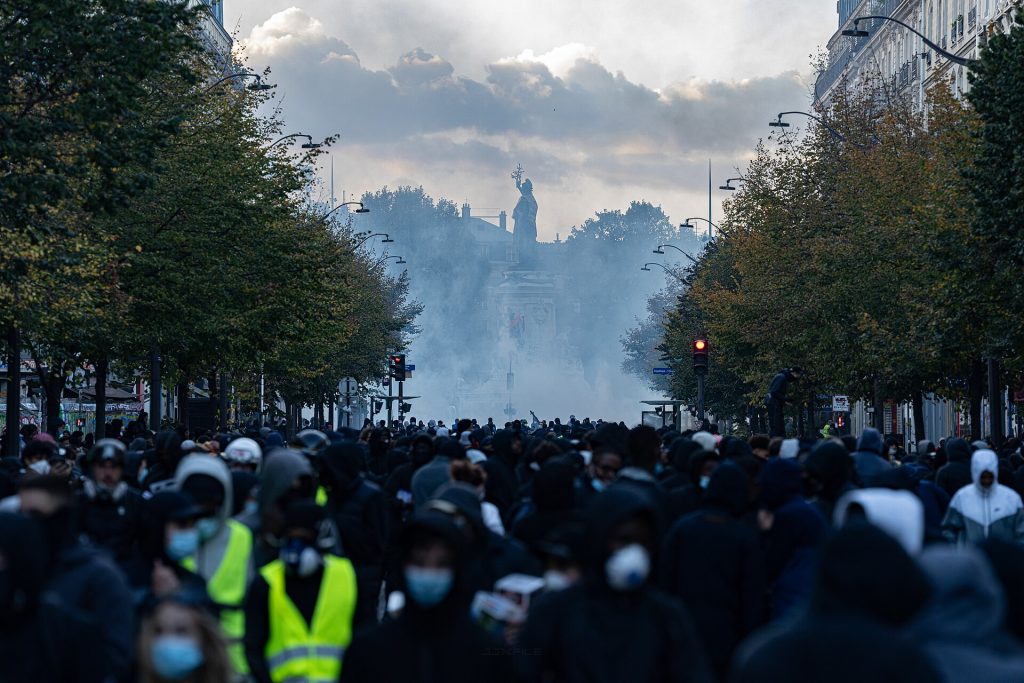
The French political crisis has its own history and its own culture. The streets have long been a means of dialogue between society and the State, and the general strike a way of making those in power understand what they do not wish to hear in Parliament.
In May 1968, student protests led to a general strike that threatened General de Gaulle’s hold on power. In 1995, strikes against social reforms brought the country to a standstill. In 2018, the ‘yellow vests’ began by protesting against rising fuel prices and ended up challenging the political elite.
In 2026, the new chapter begins with secondary school pupils. They are demanding teachers, classrooms in decent condition and buildings where they can study without suffering from the heat or having to worry about rats. According to the protesters themselves, in some schools there aren’t even enough desks and chairs. The Government’s response is to suspend lessons, organise meetings between pupils and school management, and set up a website for submitting anonymous complaints. The State has decided to listen to pupils who, until now, have been lacking the very basics.
But it did not take long for the protests to spread beyond schools. The pupils were joined by parents, teachers, trade unions and other disgruntled members of the public. Demands for educational reform converged with discontent over the rising cost of living, public spending cuts and inequality. A single demand appeared on the banners: invest in education, not in weapons. A localised conflict turned into a dispute over the state’s priorities and over who should bear the brunt of its economic difficulties.
“May ’68”: a fourth and final instalment?
The scene is a familiar one: mass demonstrations, clashes with the police and accusations of state violence. But if we are indeed witnessing a fourth instalment of May 1968, the main question is not whether history will repeat itself, but what the French people want to change today: the government’s decisions, the political elite or the Fifth Republic itself.
The current crisis has another dimension. In 2005, the deaths of two teenagers trying to escape the police triggered weeks of riots in the suburbs. In 2023, the killing of 17-year-old Nahel Merzouk by a police officer once again drove young people from deprived neighbourhoods onto the streets and reignited the debate on police violence and discrimination. In both cases, a specific incident laid bare a mistrust of the state that had built up over many years.
In 2026, protests began over a shortage of teachers and a lack of resources for education. However, the geographical spread of the early demonstrations means we must take a broader view.
The ‘banlieue’ dimension
The movement emerged not in the centre of Paris, but in its working-class suburbs, particularly in the department of Seine-Saint-Denis and the neighbouring Val-de-Marne. Among the first hotspots of protest were secondary schools in Saint-Denis and Aubervilliers. This is no coincidence: Seine-Saint-Denis is one of the poorest departments in metropolitan France, with a high proportion of the population of immigrant origin and significant inequalities in access to public services.
Behind the students’ complaints about conditions in their schools lay a broader sense of injustice: why do some pupils have more opportunities than others simply because of where they live?
Nor can we ignore the background of a significant proportion of the young people in these municipalities. Many are the children or grandchildren of people from Algeria, Morocco and Tunisia. They were born or have grown up in France, attend French schools and direct their demands at the State of which they are citizens. For them, the issue is not so much one of integrating into a foreign society as of understanding why the equality proclaimed by the Republic does not always materialise in everyday life. If schools do not even guarantee basic learning conditions, the promise of equal opportunities loses credibility.
Added to this are their experiences of interactions with the police and their perception of discrimination. Thus, the current student protests tie in with a longer-standing conflict between the republican ideal of equality and the sense of exclusion that has persisted for decades in parts of the French suburbs.
The riots themselves raise a separate issue. The authorities point to the involvement of adults linked to radical groups and of individuals who took advantage of the demonstrations to loot shops and destroy property. There were also reports of the presence of ‘black bloc’ activists – anarchist or anti-capitalist shock troops – who had travelled from abroad.
However, in the absence of consolidated data on the nationality of those detained, it is not possible to draw general conclusions about their composition. It is essential not to confuse peaceful demonstrators, secondary school pupils and those taking part in looting and acts of vandalism.
Debate on immigration
The wave of unrest in France quickly became a talking point in the debate on immigration, both domestically and across the rest of Europe. At a national level, the controversial French politician Éric Zemmour, one of the leading proponents of the ‘Great Replacement’ theory, stated outright that it would not be possible to restore social peace without ‘remigration’.
From abroad, the events in France served to call migration policies into question: US President Donald Trump blamed immigration for what had happened, whilst former Austrian Chancellor Sebastian Kurz presented it as a consequence of the failure of that very policy.
However, what was most striking was that the debate resonated even amongst more liberal politicians: the Hungarian Péter Magyar saw these events as confirmation of the need to maintain a strict immigration policy, whilst the Pole Donald Tusk took the opportunity to emphasise the rigour of his country’s asylum policy, even without directly linking the riots to immigration.
These statements reflect an attempt to explain the French crisis as a failure of migration policy. However, the scale of what has happened compels us to raise a broader question. In an interview published by Le Parisien on 19 October, the political scientist Jérôme Fourquet, director of the public opinion and strategy department at the Ifop institute, described the urban violence as a “genuine question of civilisation”. How has France reached a situation in which the migration issue appears to be linked to a deeper social divide?
The republican ideal
Social inequality, discrimination and a sense of exclusion do not automatically explain the outbreaks of violence, but without taking them into account it is impossible to understand why the conflict between a section of the youth and the state is repeated from generation to generation. This persistence raises a fundamental question: what holds French society together, and to what extent is the republican ideal of equality still compatible with the everyday experience of all its citizens?
In 1968, the people took to the streets to challenge De Gaulle’s authority. Today, what is at stake is the very idea of republican unity. Until France finds a solution to the contradiction between the universal principles of the Republic and the lived experience of a significant proportion of its citizens, the crisis will continue to resurface in new forms. Will this episode be the last of the Fifth Republic, or will it merely pave the way for the next?



Be the first to comment