
Maricarmen’s eviction was the straw that broke the camel’s back, sparking the biggest social movement seen in Spain since the ‘indignados’ 15 years ago.
Laura Wittebroek is a writer and member of Clamour.
Cross-posted from Counterpunch
Over the past few days, Maricarmen has been at the centre of Spain’s housing crisis. Police came to the Madrid home of the 87-year-old woman named Maricarmen and removed her from the apartment where she had lived for 71 years. She is a woman with a disability, uses a wheelchair, and has spent virtually her entire life in that apartment. Both parents died there. She grew old there. She paid her rent for decades. But then the property was sold, and the real estate investment company sought to replace her old rent with one she could not possibly afford. For years, she had paid around €500 a month. The new demand was a 275% increase, raising her rent to 2,650 euros. Her pension is around €1,350 a month. On Wednesday, after making four attempts, they finally carried out the eviction. The police removed the people who had gathered outside to defend her using batons and tear gas as they cleared the way for the eviction. Maricarmen was eventually carried out of the building on a stretcher and taken to an ambulance, after which she was transported to a hospital. It didn’t have to come to this: people had offered to pay the difference between her pension and the new rent for as long as was necessary, and had even proposed buying the apartment outright so that she could remain in it.
There is something obscene about this image. To see an 87-year-old woman being taken out of the only home she has ever known while the police push away the people who have come to stand between her and the street. And there is something even more obscene about the fact that this can be perfectly legal. Because legality and justice are not synonyms. Just because something is legal does not make it just.
And look at who was on the other side of the eviction. It was not a family that needed the apartment because it had nowhere to live. It was not another elderly person desperate for a roof over their head. It was a real-estate investment company. Maricarmen’s apartment was ultimately owned by Urbagestión Desarrollo e Inversión, a real-estate investment company operating in the business of acquiring and managing real-estate assets.
This is what happens when a home becomes an asset. When a place where somebody has lived for seventy years becomes a number on a balance sheet. When the question ceases to be “Where will this woman live?” and becomes “How much profit can we make with this property?”
Maricarmen’s case is a small, brutal illustration of what happens when the social function of housing clashes with its function as a financial asset for the wealthy. A person sees a home. An investor sees an asset. And when those two visions come into conflict, it is usually the person who has to leave.
Not a crisis, but abuse
And Maricarmen is not alone. That is precisely what makes this so frightening. Evictions are happening every day. There are families being priced out, tenants facing impossible rent increases, young people unable to leave their parents’ homes and older people discovering that decades of paying rent offer no guarantee that they will be allowed to remain where they live. Forty-four judicial evictions are carried out across Spain every day, with 25,540 evictionsin 2025 alone, around seven out of ten of them tied to rent.
On the very same morning, in another part of Madrid, a man named David and his son were also thrown out of their home. Their apartment was part of a group of homes originally created as affordable housing but was sold to another investment fund. On September 23, they too were evicted. According to the tenants’ union, the fund did not offer David or the other residents the option of continuing to rent their homes. Instead, residents were offered the possibility of buying at market prices that many could not afford.
Then there is Olga. In L’Hospitalet de Llobregat, just outside Barcelona, a 54-year-old woman took her own life on September 7. Five months earlier, she had been evicted from the apartment where she had lived for more than twenty years after it was bought by a real estate company to which she paid rent. She had two daughters, one of them a minor. After her death, housing activists and protesters in Barcelona described what happened not simply as an individual suicide but as a form of social murder: a death they understood as inseparable from the eviction, the loss of housing and the absence of a real alternative. This captures something essential: an eviction is never merely the removal of a person from a property. It can destroy the material conditions on which a person’s entire life depends. When a person loses their home, they can lose their neighborhood, their community, their children’s stability, their sense of safety, their memories and their dignity all at once.
Different families, different buildings, but always the same underlying logic: homes that ordinary people need as places to live were being treated as assets whose value could be extracted. And when the financial logic of the property demanded that the people inside leave, they had to move, whether they had somewhere to move to or not.
And the scale behind these individual stories is staggering. In five years, the price per square meter has risen 41.8% for houses and 58.9% for flats. Madrid rents are up 82.7% since 2016, Barcelona’s 94.9% — while salaries rose only 45%, so a 100m² flat in Madrid now costs roughly a full average salary a month and twice as much as the minimum wage. Meanwhile, owners with more than four properties have tripled their holdings, from one million apartments to three million, while people who own just the single home they live in have fallen from 10 million to 7.9 million. Only 1.5% of housing in Spain is protected, and half a million of today’s social housing units may lose that status next year as their protections expire faster than new ones are built.
This is what we mean when we talk about a housing crisis, except “crisis” is the wrong word. It suggests something accidental, as if some mysterious force had descended on us and nobody could have seen it coming. But there is nothing accidental about this. It is not a natural disaster. It is the abuse of something people need in order to survive. Housing is being treated as an asset first and a human necessity second. A home is not a luxury or a financial instrument. It is where people sleep, eat, raise children, grow old and build their lives. When companies can treat that necessity primarily as a source of profit, people become obstacles to be moved when they interfere with the return on the investment.
And this is not a Spanish eccentricity but a global system. Across the EU, house prices rose 53% between 2010 and 2024, while rents rose 25%. The UN’s 2026 World Cities Report estimates that up to 3.4 billion people worldwide lack access to secure, adequate housing, a global deficit that grew from 251 million units in 2010 to 288 million in 2023.
Did nobody stop to think?
But systems are made of individual decisions, and Maricarmen’s case shows exactly where those decisions went wrong. So you have to ask: did nobody stop for a moment and think about the person at the center of this?
Did nobody at the investment company think: this is an 87-year-old woman who has lived here for 71 years? Did none of the lawyers handling the case think it? Did nobody in the government think that perhaps there had to be another solution? Did nobody in the justice system look at the situation and think: perhaps we should not use all of this machinery to put an elderly woman in a wheelchair out onto the street? Did truly nobody stop to consider if what they were doing was humane?
The answer, judging by what was sent to carry out the eviction, was no. A huge police operation was deployed around the building, lasting for hours, while activists and neighbours tried to prevent the eviction. Police cleared the entrance with batons, pepper spray and tear gas, and protesters and observers reported aggressive physical treatment during the operation, including officers putting hands over people’s faces and restricting their ability to breathe. Think about the scale of the priorities being revealed here. An enormous security operation was considered necessary to remove an 87-year-old woman from her home, while the people outside were treated as a problem to be cleared away. The police were there to make sure the property decision could be carried out.
There is a bitter irony in this: it is our own taxes that pay for the police operation used to carry out an eviction like this. On September 23, more than 100 police officers and nearly a dozen vehicles were deployed around Maricarmen’s building, while the operation lasted for more than seven hours. A world that places private property above human life is not a humane one. Our taxes are not meant to defend vulture funds trying to squeeze five times the profit out of an apartment.
The contrast is brutal. A private company says the property must produce more money. A court authorizes the eviction. Police clear the people standing in the way. And an old woman leaves her home on a stretcher. The machinery works. The question is who it works for.
Who actually benefits
The answer is not hard to find, but it is rarely the one people are pointed toward. The message is familiar: look at the migrant. Look at the person who arrived with nothing. Look anywhere except at the structure of ownership and the economics of housing. Because a migrant sleeping on a beach did not turn a home into an investment asset. A family arriving from Morocco did not decide that an apartment should generate the maximum possible return. The real culprits are the companies and investment funds that have turned homes into financial assets fueled by speculation, mass tourism, short-term rentals and a chronic shortage of social housing. Large property owners now control more than a million homes in Spain. Investment funds have been major players in the acquisition of housing since the financial crisis, buying up entire buildings, hiking up rents and exploiting legal loopholes to maximize profit.
It is convenient to turn desperate people into scapegoats because it gives anger somewhere to go. But if the people struggling to pay rent are encouraged to blame people who have even less power than they do, they never have to ask the more uncomfortable question: who owns the housing, who profits from it, and why are basic human needs being organized around the pursuit of profit? And there’s no political will to fix it: we’re told to blame migrants and fed hatred, while the same politicians vote down the laws that could actually protect us. Moreover, the Comunidad de Madrid apparently has €6.3 million to spend on a 485-square-metre luxury penthouse, reportedly intended as temporary office space for the regional president. For Maricarmen and thousands of others facing eviction, that same government has offered no comparable solution.
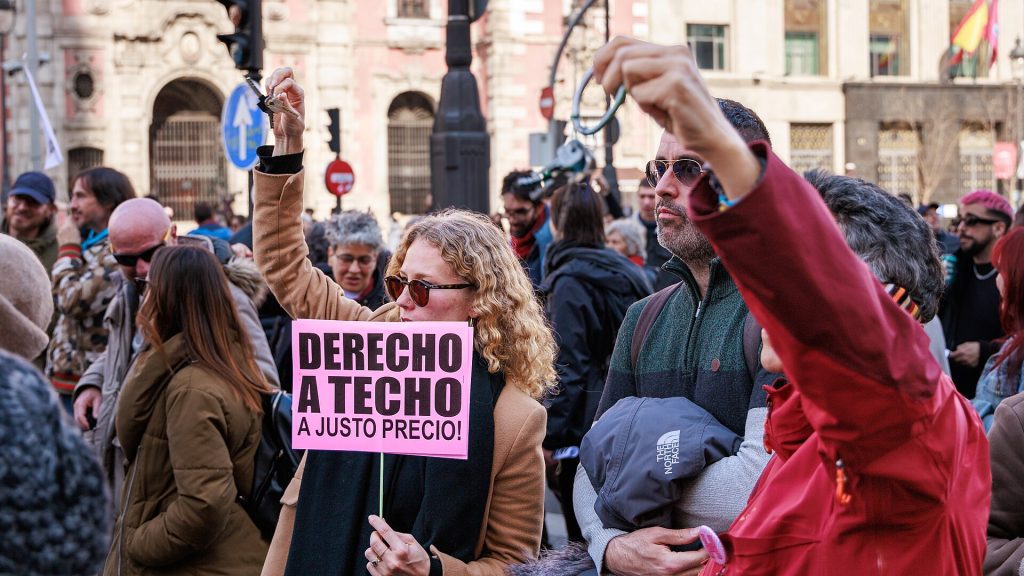
Scapegoats, profit, and misplaced priorities all point to the same underlying truth. And Maricarmen’s eviction has forced that question into the open: who does housing serve? And perhaps the most important thing about the response to her eviction is that people are asking it. Hundreds gathered outside her home. Neighbours stayed through the night. Housing activists organized. Thousands later took to the streets in Madrid and in other cities all over Spain. And, perhaps most importantly, a younger generation that has grown up being told that unaffordable housing is simply the price of adulthood is beginning to say that it is not. In Madrid, police responded to these peaceful protesters with the same violence they had used to clear Maricarmen’s building, a reminder of exactly whose side that force is on.
None of that has stopped people from showing up. Because systems that seem immovable can begin to move when enough people stop accepting them as inevitable. Maricarmen should never have had to become a symbol. She should simply have been allowed to grow old in her home. But now that this has happened, her eviction can either become another shocking story that disappears in a week, or it can become a point of departure. The people who stood outside her building have already shown what that departure can look like: organization, solidarity and collective refusal to accept that profit matters more than people.
Let this be the beginning. Not the beginning of another political slogan, but the beginning of a movement that makes housing impossible to ignore. A movement that says a home is for living in. A movement that refuses to let the elderly, the young, tenants, migrants or workers be turned against one another while property becomes more profitable.
Because Maricarmen’s eviction was not inevitable. And neither is the system that produced it.


Be the first to comment