
The Parades Commission has approved an attempt by the Orange Order to march into a predominantly Irish Nationalist community, but the move is being resisted on the streets.
Chris Bambery is an author, political activist and commentator, and a supporter of Rise, the radical left wing coalition in Scotland. His books include A People’s History of Scotland and The Second World War: A Marxist Analysis.
Cross-posted from Counterfire
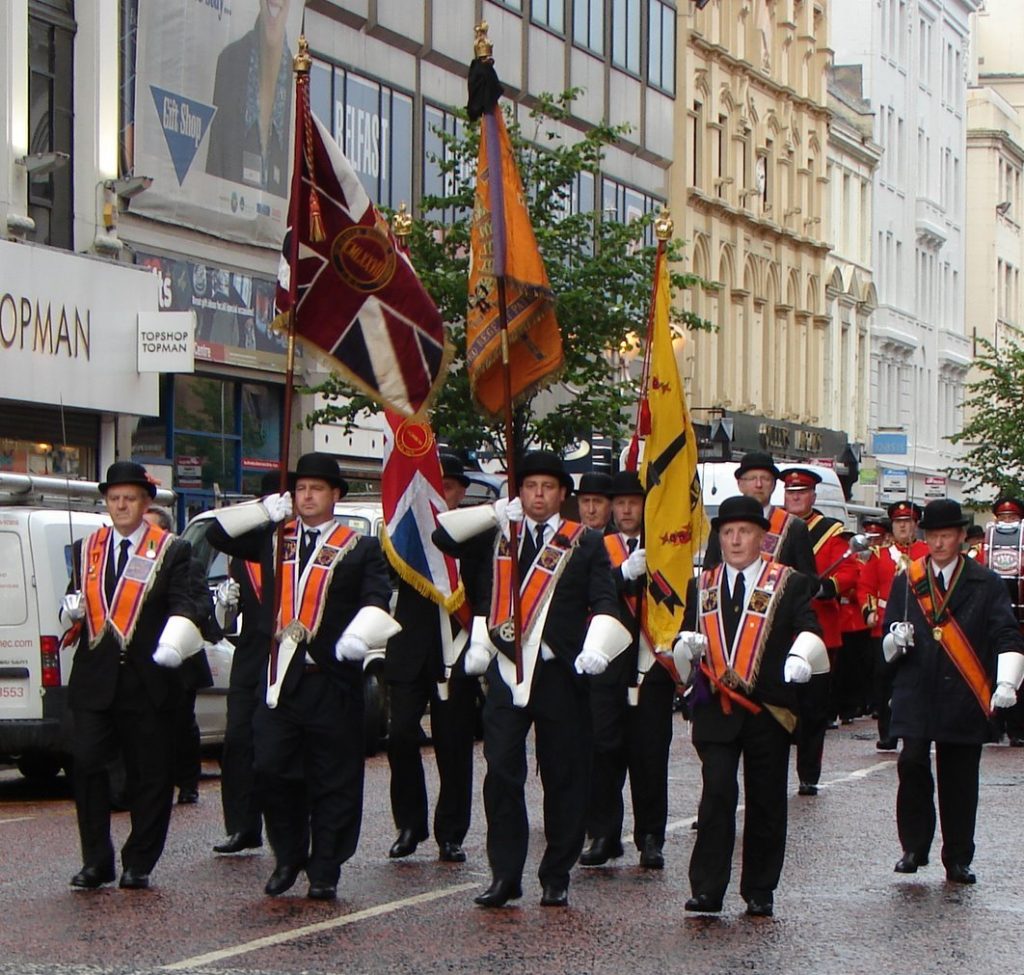
There have been many terrible decisions made by British governments in their dealings with Ireland that they have come to regret; not least that of 1921 when they partitioned Ireland and created a sectarian state in Northern Ireland based on a headcount of how big a Unionist majority it contained.
But the decision to allow an Orange march to proceed down the Garvaghy Road in Portadown, home to a nationalist community must be high up there. Because between 1995 and 1998 there had been a bitter standoff between residents of Garvaghy Road and the Loyal Orange Order over the latter demanding they had a right to march there whatever the wishes of local residents.
Late on Saturday night a Belfast court decided to allow the Orange Order to march from Drumcree Church, along the Garvaghy Road and into Portadown town centre as long as there were just 35 marchers and it was held in complete silence at 8am on a Sunday morning.
What’s the harm in that you might ask? Well firstly the Orange Order is a paramilitary organisation based on anti Irish racism. It was the mainstay of the Unionist government which ruled Northern Ireland as a one party state from 1921 until 1972. That state was based on systematic discrimination against the Catholic minority and constant repression, including the introduction of internment without trial in every decade of Unionist rule.
Secondly, the “right” of the Orange Order and associated sectarian bodies went right to the heart of the nature of that state. For decades nationalists had to grin and bear it as these bigots marched through their streets and past their places of worship singing sectarian songs and hurling abuse at onlookers, ushered through by the armed Protestant police force, the Royal Ulster Constabulary.
In August 1969 the Unionist government refused to ban a march by the Apprentice Boys of Derry through that city’s centre, despite the civil rights protests which had taken place there over the previous months.
The nationalist Bogside exploded into what was effectively an insurrection defeating the RUC. At that point the Unionist government asked the Labour government in London to send in troops to maintain order. We were told they were there to keep the peace but the truth was they were sent at the request of a Unionist government whose police force could no longer cope.
In Belfast Loyalists launched a pogrom which saw seven people killed and hundreds wounded, five of them Catholic civilians shot by police. Some 1,820 families were forced to flee their homes, 1,505 of them Catholic.
This was the start of the Troubles.
Returning to Portadown I wrote about the history of the march from Drumcree in my book The Old Divide: A History of Sectarianism in Scotland (Tippermuir Press) – I did so because of the close links between the Orange Order and Loyalists in Scotland with their brethren across the Irish Channel.
In 1985, the RUC Chief Constable decided to use his powers to regulate parades in four areas, Portadown being one. The Orange Order church parade to Drumcree was permitted but two marches on 12 and 13 July organised by the Orange Order and Royal Black Institution were not allowed to pass through the Catholic areas. Orangemen converged on Portadown on 12 July to protest the ban and serious rioting followed between loyalists and the RUC in which 52 police officers were injured and properties were attacked.
Following this, discussions were held between the Portadown District of the Orange Order, Unionist politicians and the RUC. As I wrote:
‘An agreement was eventually reached, but it was the first of many negotiated in haste in times of great stress, and afterwards understood very differently by each of the parties involved. In this case the Orangemen believed they had agreed to give up marching along Obins Street in exchange for a permanent guarantee they could march along the Garvaghy Road.’
The police claim there was no such commitment. There is no written record of the agreement.
The SDLP leader John Hume, did object to the marchers being allowed to parade along the Garvaghy Road, as they did until 1995.
Article five of the Public Order (Northern Ireland) Order 1987 gave the Secretary of State for Northern Ireland the power not only to reroute parades, but also to ban them if they threatened public order. Nonetheless, in 1995 and 1996, the then Conservative Secretary of State, Sir Patrick Mayhew, refused to use his power to reroute or ban the Drumcree parades, insisting that parade routes were ‘an operational matter for the RUC’.
Meanwhile, the RUC claimed that re-routing parades was a matter for Sir Patrick. They seemed to be passing the buck between them. The Conservative government of John Major, with a small Parliamentary majority were relying on the votes of UUP MPs.
In July 1995, the RUC decided the Portadown District Orange Lodge could not march along the Garvaghy Road on its traditional return journey from a service in Drumcree Parish Church to its hall in Portadown centre.
The DUP Leader, the Reverend Ian Paisley, claimed: ‘If we don’t win this battle, all is lost. It is a matter of life or death. It is a matter of Ulster or Irish Republic, it is a matter of freedom or slavery.’
What followed was a two-day standoff between police and Orangemen, who refused to be rerouted or dispersed. Clashes broke out between Orangemen and the RUC. Talks brokered by the Catholic and Protestant primates, Cardinal Cathal Daly and Archbishop Robert Eames, led to an agreement that the Orangemen could pass in silence with just one banner and would not march on the Garvaghy Road on the following day, 12 July. But violence was sparked in nationalist areas when the Democratic Unionist Party leader, the Reverend Ian Paisley, and the UUP leader, David Trimble, held their arms in the air at the end of the march in an action perceived by some as a victory sign.
In 1996, the RUC once again banned the Orange Order from marching along the Garvaghy Road prompting a four-day stand-off as thousands gathered facing police lines at Drumcree Church. But the leadership of the protest was contested, between David Trimble of the UUP and Ian Paisley of the DUP, and between the leadership of the Orange Lodge and hardline members allied to Loyalist paramilitaries.
The Sunday Times would reveal that the Grand Master of the Grand Lodge of Ireland, the Reverend Martyn Smyth, had prepared a plan to paralyse Northern Ireland if the parade was not allowed down the Garvaghy Road. Blockades spread across the Six Counties and after five days, with Belfast International Airport blockaded and the killing of a Catholic taxi driver in Lurgan.
Trimble briefed Sir Patrick Mayhew about the danger posed by the UVF’s [Ulster Volunteer Force] Billy Wright who was in attendance pointing out a digger had turned up at the church and was intended to be used to force police lines.
In 2019, the BBC reported on newly-released state papers from 1996 detailing discussions between the RUC and British government ministers and decisions that followed:
‘The Portadown flashpoint was discussed at a meeting between NIO security minister, Sir John Wheeler and then RUC Deputy Chief Constable, Ronnie Flanagan on 17 May 1996. Flanagan felt that the best solution was one which “allowed honour to both sides”. However, the RUC had to look at the wider picture and “increasing unionist resentment at marches being banned.”’
Police intelligence, he went on, indicated that a ban on the Orange march down Garvaghy Road that July could result in ‘a very high number of Orangemen laying siege to Portadown’.
This would ‘create an enormous public order difficulty’.
As regards the influence of then Ulster Unionist leader and Upper Bann MP, David Trimble, Wheeler felt that his controversial role in the previous year’s Drumcree situation – when he had joined Reverend Ian Paisley in leading the contested Orange parade – ‘had to be seen in the context of his [UUP] leadership bid’.
A decision was made to ban the 12th July parade from going along the Garvaghy Road but Loyalist violence flared at Drumcree and elsewhere. As violence gripped Unionist areas and threatened to bring Northern Ireland to a standstill, the RUC Chief Constable, Sir Hugh Annesley reversed the decision and allowed the march to proceed on 11 July, triggering widespread disturbances in nationalist areas.
Of Trimble, Paisley and the Orange Order celebrations, Eric P Kaufmann points out:
‘Yet in the very moment of the Orangemen’s victory there lay the seeds of its ultimate defeat as Britain, Ireland and the world once again associated the Orangemen with sectarian violence and intimidation.”’
Meanwhile, under pressure following the scenes at Drumcree and from the Dublin government, Mayhew announced the independent review of parading in Northern Ireland. While the Conservatives accepted in principle the recommendations of the review, they did not pass them into law. Instead, an independent Parades Commission was established ‘with an education, conciliation and mediation role’, but without legal powers to recommend the re-routing of parades.
The Major government amended the Public Order (Northern Ireland) Order 1987 to introduce an extended notification period for all parades, and new controls on alcohol at such marches. But their failure to enact the review’s recommendations was seen as a concession to the UUP, who did not favour the formation of a Commission with legal powers to oversee parades.
In 1997, the new Labour government of Tony Blair had allowed the march to proceed down the Garvaghy Road because the RUC believed it could not police disorder which would follow a ban.
On Sunday, 6 July 1997, in the early hours of the morning, 1,500 RUC officers, supported by British troops, moved onto the Garvaghy Road and sealed off the area. Rioting broke out met with plastic bullets. That afternoon the Orange parade proceeded along the Garvaghy Road. Later that day, the RUC Chief Constable, Ronnie Flanagan, explained he had decided to let the march proceed because of threats to Catholic civilians from Loyalist paramilitaries. Rioting spread to nationalist areas across the Six Counties.
A year later the rerouted the Drumcree march passed the house in Ballymoney where at 4.30 am on the morning of Sunday 12 July 1998 three Catholic children were killed in an arson attack carried out by Loyalist. The march organisers agreed bands would not play as they passed the house. But eight did not comply, including one on whose drum bore the words ‘Britannia Flute Band Scotland’.
Another Scottish flute band, the Broxburn Loyalist Flute Band defied calls from Ulster Unionist leader, David Trimble, and the chaplain to the Armagh Orange Order when they led a march up to the barrier closing off the Garvaghy Road in Portadown.
A scene on TV which embarrassed the Blair government was Garvaghy Road residents barred from reaching their church by the security forces blockade having to celebrate mass in the open.
Blair quickly sought to distance itself from making decisions on such parades, and to present itself as a neutral arbiter, its actions in parading disputes, by passing the issue to the Parades Commission. The Blair government supported its decision to reroute the 1998 march at Drumcree. By now those demanding the right to march there were clearly in opposition to the Good Friday Agreement.
Drumcree 1998, led to the burning of Catholic chapels, roadblocks and disruption to public transport across Northern Ireland by Loyalists. The Belfast Telegraph reported on 2 July that there had been 509 petrol-bombing incidents with 1,687 petrol bombs recovered and 154 across Northern Ireland.This time, the Blair government stood by its decision to ban marchers from the Garvaghy Road. The Guardian’s political correspondent, Hugo Young, made a telling point regarding that decision: ‘British acquiescence will never be the same again. Any British complicity in perpetuating Ulster’s multiple intolerances is at an end.’
The protests at Drumcree would continue but the security forces had faced them down from marching on the Garvaghy Road for good.
Or so we thought.
The government of Andy Burnham is hiding behind the fig leaf that for them to ban the march it could only be at the request of the Chief Constable of the Northern Ireland Police Service. Hmmm.
Burnham does not seem to understand the realities of the 1998 Good Friday Agreement. He for instance said he ruled out any referendum on Irish Unity. But the Agreement says such a poll must go ahead if both the Northern Ireland Assembly and the Irish parliament vote in favour.
The agreement involves the Irish government and is guaranteed by the European Union and the US, so Burnham cannot go making decisions all by himself.
By standing idly by Burnham and his Northern Ireland Secretary, Chris Bryant, have created anger across nationalist Ireland. It is to the credit of Sinn Féin’s Michelle O’Neill and Mary Lou McDonald that they joined the Sunday morning blockade of Garvaghy Road to stop any march.
If there was one thing which could have undermined the peace process it is allowing the Orangemen to march on the Garvaghy Road. It has re-opened a searing wound most of us thought had been sealed 30 years ago. The fools, the fools!


This is a problem that won’t be sorted until there is a united Ireland, where there will no longer be either a reason or forbearance for such bigotry and thuggery.