
The march towards war, set in motion amidst a thick fog of irrational threats, hysterical incantations, dogmatism, censorship, and visceral fear
Raphaëlle Auclert holds a PhD dedicated to the Cold War from the University of Sheffield and teaches at the Catholic Institute of Higher Education (ICES, France). She is a regular columnist on geopolitics, Russia and French politics and society in media such as Valeurs Actuelles, JDD, La Tribune, Atlantico, Radio France Internationale, Russia in Global Affairs, Journal of Russian American Studies (University of Kansas).
The article was first published in French in the magazine Le Diplomate
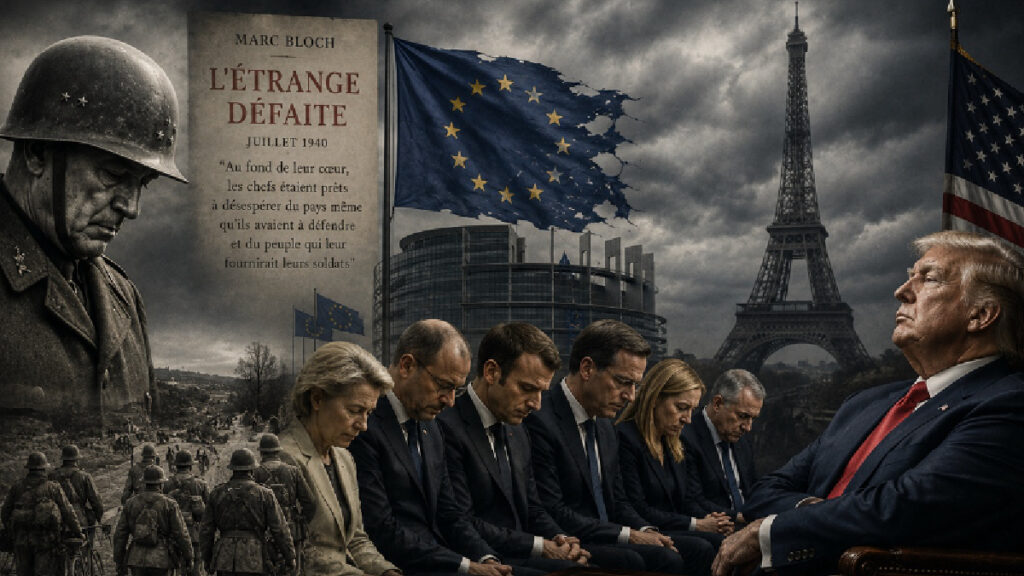
Réalisation Le Lab Le Diplo
After the Nazi army occupied France in the summer of 1940, medieval historian and resistance fighter Marc Bloch wrote an essay titled “The Strange Defeat,” in which he describes the causes of this tragedy. In his view, its roots lie in the internal failings of the French leadership, as well as in French society itself. Last June, President Macron presided over the ceremony to reinter Bloch’s remains in the Panthéon—the final resting place of the nation’s great figures. However, the reflection of the French people of the 1930s in the mirror held up by Bloch bears a striking resemblance to present-day France, evoking as much bewilderment as it does apprehension for the future.
“Deep down in their hearts, the leaders were ready to lose all hope in the very country they were supposed to defend and in the people who would provide them with soldiers.”
Marc Bloch, July 1940
History is sometimes cruelly ironic: just as the great intellectual and Resistance fighter Marc Bloch has been enshrined in the Panthéon, the tragedy he described in The Strange Defeat seems to be unfolding before our very eyes. After the French army was crushed in a matter of weeks by the Wehrmacht, he spoke of “the most atrocious collapse in our history.” But isn’t another, even worse one, unfolding before us?
For we can sense it, irresistible: the march towards war, set in motion amidst a thick fog of irrational threats, hysterical incantations, dogmatism, censorship, and visceral fear instilled in every speech through a single phrase or an implied meaning. France should prepare itself, we are told, to ‘lose its children’ or to ‘pay the price in blood’. Whilst the 1930s were marked by the pacifism of a people scarred to the very core, never having recovered from their journey to the end of the night in 1914, it is now an unashamed hubris that seems to have taken hold of our elites.
Yet, behind these opposing blind passions, one senses the same fatal recklessness – Bloch spoke of a ‘crude optimism’ – the same tacit contempt on the part of leaders who are throwing the peace and future of their people to the mercy of fate. They, for whom politics is less a vocation than a way of life, no longer speak for France. They are content merely to join in the hubbub echoing decisions taken elsewhere. After the humiliations suffered in the Oval Office, whether in February or in August 2025, all that remains of a Europe that once dominated the world is the image of eternal schoolchildren listening eagerly to their teacher and anxiously watching for the slightest approving smile or furrowed brow.
In Ankara, leaders in search of a protector
This, incidentally, is exactly what happened in Ankara. No sooner had he stepped off the plane than Trump was quick to rebuke his European counterparts for their lack of commitment on Iran; ‘could do better’, he thought aloud, letting out a sigh, before declaring in no uncertain terms that, were it not for his friendship with Erdogan, he would not even have come. Just like Pirandello’s play Six Characters in Search of an Author (1921), the European elites are reduced to playing the roles that the American president assigns them in his narrative. A dream come true for someone whose quick wit and storytelling genius set the tone for the entire diplomatic landscape, making and unmaking reputations with every post on his Truth Social network, or setting the stage for titanic battles, such as in Iran.
Lacking support at home, those cheerleaders are therefore seeking legitimacy from their American ‘dad’, if Marc Rutte is to be believed. Braving a phantasmagoric Russian threat, they no doubt expect to be flattered in their bellicose zeal against Moscow. To no avail. With a jaded pout, Trump shows no interest in the European theatre, preferring to turn his attention to the Pacific and the Middle East. When he declares in Ankara, his voice quivering, that there is ‘a lot of love in the room’, the occupant of the White House manages to reassure his future former protégés of his goodwill towards them whilst, in practice, signalling his disengagement, leaving them dazed in a whirlwind of cognitive dissonance.
Devoid of any strategic initiative and reduced to simply pulling out their chequebooks, what were once the great European powers are, moreover, being drawn into large-scale militarisation mechanisms, exacerbating their loss of sovereignty and the risks of an escalation spiralling out of control. Lately, everyone has been talking about burden-sharing, yet the Europeans have just been ordered to share it… amongst themselves. But let us focus instead on the lessons Marc Bloch has bequeathed to us.
A Europe that is an ‘immense zone of weakness’
In his scathing pamphlet against pre-war France, Marc Bloch lists the causes of this ‘strange defeat’. Having read it, one realises that this defeat was less strange than logical. It is worth noting, moreover, that Bloch’s dismay is shared by another major witness of the era, General André Beaufre. It is Beaufre, in 1940: the Fall of France (1965), who describes Europe as an ‘immense zone of weakness’.
In his indictment, Bloch holds ‘the entire French community’ responsible, accusing it of being too pacifist, too fragmented and more individualistic than patriotic. The political and military elites are also held responsible for what Bloch further terms ‘the great disaster of 1940’, paralysed by ‘bureaucratic rigidity’, ego clashes or factional squabbles. Bloch also lambasts the gerontocratic nature of 1930s France, which was forced to wage a ‘war of old people or know-it-alls’. Beaufre says much the same when he speaks of the ‘poisonous fruits of victory’, which he contrasts with the German foresight born of defeat. The historian concludes coldly: ‘In 1940, the French were repeating the war of 1914–1918. The Germans were waging that of 1940.’
Readers of Bloch in 2026 cannot help but be struck by the relevance of this picture. In stark contrast to the so-called ‘European strategic awakening’ announced with great fanfare on 14 July this year, we now see the same ‘intellectual lethargy of the ruling classes’ denounced by Bloch in 1940. This time, the Islamist threat has taken the place of the Nazi threat; and terrorist attacks have replaced the ‘capacity to instil terror’ of the air raids described by Bloch, inducing what he called a veritable ‘nervous breakdown’ felt by the entire population. Just as in 1940, when ‘there was no real rear, for the bombings had eaten away the distance’, nowadays not a single square metre of the country is safe from a knife attack or a runaway lorry mowing down passers-by.
There is, however, one caveat to this comparison. Bloch said he ‘belonged to a generation with a guilty conscience’. This guilt seems miraculously to have spared our current leaders, despite their active role in the ruin and the seeds of civil war threatening our country. But in recent months, the leading figures of the MAGA movement have indeed reminded European leaders of their failings. In an unexpected turn of events, they thus echo Marc Bloch’s scathing criticism, voiced nearly a century earlier.
Trump, a concerned observer of a Europe adrift
Although he makes no secret of his delight in strutting his stuff in Ankara or elsewhere in front of sheepish European heads of state, Trump is nonetheless concerned about the fate of the Old Continent. In recent speeches at international forums, he, J.D. Vance and Marco Rubio have repeatedly lamented Europe’s apparent decline since the end of the Soviet Union.
The choices of the 1980s were certainly not the same as those of the 1930s. Before the war, the focus was on peace and social progress, whereas our current policies have set a course towards globalisation, encompassing a leisure-oriented society, the free movement of people (mass immigration) and goods (relocations and imports), all financed by an abysmal level of public debt. But isn’t it all the same in the end? It is still the choice of complacency and demagoguery over clear-sightedness and hard work; the so-called dividends of a dreamt-of perpetual peace over the valiant building of an armed peace – the famous ‘peace through strength’ promoted by Trump in his State of the Union address. A concept, incidentally, borrowed from Henry Kissinger, who knew what he was talking about, having fled the threat of Hitler at the age of 15.
The US President is, above all, a businessman, and therefore fundamentally pragmatic and liberal. Consequently, the sight of a Europe in decline and crippled by regulations can only shock him. Speaking in Davos, he denounced “the failure of the Western model”: “colossal debt, mass immigration, endless imports”, with leaders themselves orchestrating the deindustrialisation of their own countries. “They have turned their backs on everything that makes nations rich, powerful and strong,” the US president lamented at the time. He expressed regret at the visible consequences of these policies, leading to the physical disappearance of Europe, with a falling birth rate and the transformation of its familiar appearance: “Certain places in Europe are not even recognizable, frankly, any more they are not recognizable”, he added with emotion.
We see a striking contrast in Davos between the speeches of the American leader and Macron. The latter, formulaic and out of touch of reality, speaks only of global challenges and artificial intelligence. One might well think that ordinary people are not among the French president’s concerns. He prefers to focus on preparing for the upcoming war.
The coalition of the warmongers
It is therefore a divided, indebted and self-doubting Europe that its leaders are slowly but surely leading toward war. The French government is not content merely with supplying arms and intelligence to Ukraine. In February 2024, the French President declared that he “does not rule out sending troops to Ukraine”, provoking in Moscow an indescribable sense of dread mixed with sadness.
Prioritising escalation over seeking paths to peace, European heads of state ceaselessly sabotage all attempts at a diplomatic settlement. First and foremost, let us mention their tacit acceptance of the decree issued by Zelensky on 30 September 2022, prohibiting any negotiations with Russia and advocating the rearmament of Ukraine. Lately, there was the 28-point plan proposed in November 2025 by the Americans, drafted in the wake of the Anchorage summit in direct coordination with the Russians, who considered that ‘the Russian position [was] truly understood’. It was a diplomatic feat and a genuine source of hope. But Jean-Noël Barrot rejected this opportunity for peace, dismissing it out of hand by interpreting it as a ‘capitulation by Kyiv’. Such obstinacy is simply criminal: how many lives, both Ukrainian and Russian, might have been spared had this plan been accepted?
What this attitude reveals is that it is the European leaders who do not want peace, for peace would deprive them of their raison d’être, which for the past 80 years has been the export of democracy through the fight against a Russia portrayed as autocratic and bloodthirsty.
The very moment a compromise were to be reached with Kyiv and a new European balance were to emerge – counterbalanced by a Russia exercising its power in accordance with its unique, peaceful model of the ‘civilisational state’ – Brussels’s vision legitimacy would crumble; its leaders would find themselves confronted with the discord, suffering and hatred that their globalist whims have caused at home.
But the ravages of this diplomacy of chaos go much further. By fuelling the escalation, refusing to engage in any negotiations, and crossing all of Moscow’s red lines one by one, it is Europe itself that its leaders are leading to destruction. It is, moreover, highly presumptuous to count on the Kremlin’s boundless patience. There are limits, and they are on the verge of being crossed. Putin certainly has an aversion to times of troubles: the Bolshevik Revolution, the Second World War and, more recently, the ‘bloody 1990s’ have remained etched in the Russian collective unconscious as a nightmare to be avoided at all costs. Moreover, as a skilled judoka, he always seeks, both domestically and internationally, to find a form of balance.
But the repeated violations of the inviolability of Russian national territory, with their accompanying civilian casualties – unthinkable during the Cold War – are, for him, an unacceptable affront. Europeans who are playing at tickling the bear in its den are acting very unwisely. They should bear in mind that a proportionate but unstoppable Russian response is technically possible and that it will come. Certain European drone production sites intended for Ukraine have already been designated by Moscow as potential targets. And, contrary to the cynical calculations of European leaders, in the event of a Russian strike, the United States will neither invoke Article 5 nor provide military support to enable them to retaliate. If they push the escalation too far they will, like Georgia did in 2008, have to face Russian retaliation and accept this humiliation before the world and before history. This event will mark the end of NATO.
Europa delenda est
The destructive policies of our leaders must be halted as a matter of urgency. Debt, security risks, the draining of our nation’s vitality by bloated, technocratic states, coupled with this forced march towards war, can only lead us to an apocalypse. Europe is indeed under threat of extinction. It no longer dominates the world. And if we scatter our forces and our wealth in senseless hubris, as Napoleon did two centuries ago, it may well be that the new masters of the world will come to an agreement at our expense at the next Congress of Vienna.
We have seen this with the Trump administration, but it is also true of Xi and Putin; all three despise our arrogance, our bureaucratic and intellectual inertia – of which only unworthy elites boast – but, above all, they despise our weakness.
Conversely, they view with interest the chauvinistic fervour displayed by Germany and Turkey. Clearly, those who were humiliated in the twentieth century are determined to take their revenge. Thus, one cannot ignore Berlin’s undisguised ambition to rebuild its military power. During his very first speech at the Bundestag in 2025, didn’t the German chancelor promise “the most powerful conventional army in Europe”? Besides, his stance is perfectly summarised in an article by Foreign Affairs entitled ‘Europe’s Next Hegemon. The Perils of German Power’; note the telling absence of a question mark.
We began our unvarnished re-reading of Bloch in Ankara, and it is in Ankara that we conclude it. In the space of a century, the ‘sick man of Europe’ has become NATO’s second-largest army and the continent’s largest. What a superb revenge on history! Erdogan seized the opportunity of the summit to send a message in his own way: each delegation received as a gift a .357 Magnum revolver. For us, this is an unequivocal warning: Erdogan is signalling to NATO members that they must prepare for confrontation. For Erdogan, the glorious splendour of the Europeans is a legacy of the 20th century that has had its day and is now on borrowed time.
Nevertheless, it should be borne in mind that these external attacks would have no effect if Europe’s internal foundations were not already faltering – that ‘threat from within’ Vance alluded to in Munich in 2025. This is precisely the point of Bloch’s argument, and it is the thesis put forward by the German philosopher Edmund Husserl in a lecture delivered in Vienna in 1935, which was to be his final testament titled The Crisis of the European Sciences and the Phenomenology of Transcendental Sciences. For Husserl, ‘the worst thing that could happen to Europe is for it to grow weary.’ By weariness, he means a twofold crisis: firstly, that brought about by advances in the technical sciences, which are powerless to provide answers to questions about the meaning of human existence and which foster the rise of extremism and nihilism. The second form of this weariness is that Europe, having lost faith in its spiritual mission, is tempted to sink into barbarism. In his preface, the French translator, Gérard Granel, speaks of ‘a sort of toppling of a world that took itself for the World’.
Bainville, a contemporary of Husserl and Bloch, also warned in his History of Three Generations (1918) of the dangers facing a weary Europe: ‘The turmoil of the Revolution and the Empire had left France exhausted, ultimately defeated and stripped bare, yet bathed in military glory and drunk with that glory.’ This observation, made in 1918, remained true in the France of the 1930s, the era of The Strange Defeat; it is even more so today, after the 30-year post-war boom of Gaullist, nation-building France, followed by three other decades of the heady, globalist washout. And Bainville goes on to say: ‘The French had enjoyed themselves like gods. That is why, far from resenting Napoleon, they worshipped him for so long. In the absence of any other empire, he had bequeathed to them one of the imagination.’ It is therefore to be hoped that today’s France and Europe will eventually renounce the empire of globalist imagination and their warlike chimeras inherited from Napoleon, in order to return to a lucid and patient power policy, guided by their national interests and the pursuit of peace as the supreme good.
*
* *
To conclude, with the emergence of a multipolar world – revealing a weary Europe and a very alert China – we are witnessing this ‘kind of toppling of a world that took itself for the World’ referred to by Husserl’s translator.
Amid this upheaval in a Nero-like France beset by flames, discernment is more vital than ever to ensure we do not embark on a senseless war against Russia – a war that would be pointless and lost before it even began. On the other hand, Islamist terrorism demands our full vigilance and the urgent mobilisation of our resources to eradicate this deadly threat.
Despite this worrying picture, the reflection undertaken here on our strange defeat does not advocate defeatism. It is a call for the kind of awareness advocated by Marc Bloch for a Europe at peace. Let us not, therefore, be content merely to enshrine this great Resistance fighter in the Panthéon; let us also heed his lessons, even if – and especially if – they are harsh.


Be the first to comment