
Germany’s rulers face a deep crisis of political legitimacy.
Cross-posted from Counterfire
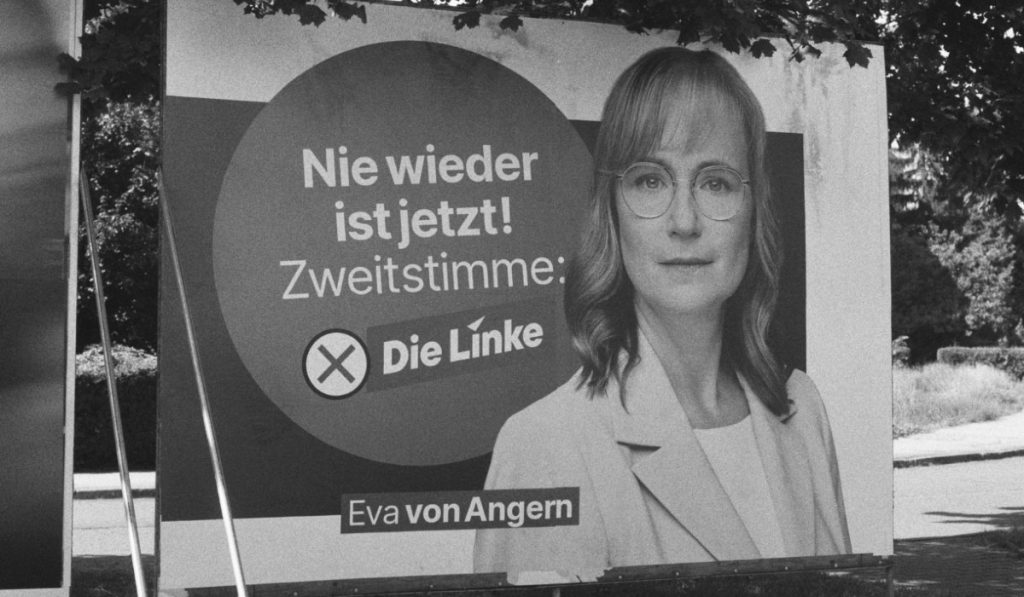
Left Party poster, Dessau, August 2026: ‘Never again is now!’ Photo: Robert Dale
The election result in Sachsen-Anhalt came in fairly much as predicted, like a car crash in slow motion. Now we know where the wreckage has landed: AfD 43.8 per cent (up 23.0), on a stunning turnout of 77.8 per cent. The previous governing coalition lost heavily, down from 52 per cent to 29, breaking down as: Christian Democrats (CDU) 17.2 per cent, Social Democrats (SPD) 9.3 per cent, Free Democrats 2.6 per cent and out of parliament. The Greens and the Left Party got 8.9 and 8.6 per cent respectively, while the anti-war BSW scraped in unexpectedly on 5.3 per cent.
In terms of seats the result leaves the AfD three short of a majority, with no other party prepared to form a coalition (as of now at least). There is talk about possible defections from the CDU. The AfD and the anti-AfD ‘firewall coalition’ each have 39 seats, while the BSW holds the balance with five and talks about a technocratic government relying on changing majorities. So it will be a while before we know what kind of state government we are looking at. The question of whether this is 1933 all over again remains on hold (TL;DR: it’s not).
What we certainly can do already is consider what the voting figures mean. Turnout was the highest in any state election in Sachsen-Anhalt since reunification, reflecting elevated politicisation and polarisation, but in a passive and electoral form.
The AfD’s vote has been building for a while, but 44 percent is unprecedented. Exit surveys show it polling particularly strongly among manual workers and the self-employed, and in the 35 to 59 age group. The latter represent the cohorts who began their working lives in the neoliberal jungle of the post-reunification decades and have seen grim times not getting any better. The party’s gains came in the first place through mobilising non-voters, in the second place taking votes from the CDU.
How has all this come to pass? The principal explanation among liberals and reformists is that AfD voters are all aligned with the party’s leadership and the worst parts of its manifesto: racist, fascist, reactionary or at least backward. They need to be excluded as far as possible from the political process. This view has been pretty much hegemonic in the public discussion and is backed by state television and most of the press.
The anti-war left, including the BSW, would point to the failure and unpopularity of the old parties, and material questions such as energy prices and the cost of living in general, crumbling infrastructure and underfunded public services. This line is suppressed and belittled by the established media. (There would be more to say on all this, I’ll come back to it in due course). The BSW’s comeback is notable in itself, amidst a public spat over participation in state coalitions.
Highly unpopular
To my mind, one thing comes out clearly: Germany’s rulers are mired in a deep crisis of political legitimacy. Twelve months in, Chancellor Merkel (2005–2021) had a popularity rating of 56 per cent. Scholz (2021–2025) managed 36 per cent. Today Chancellor Merz gets just 16 per cent. He campaigned for just half a day in Sachsen-Anhalt and was kept entirely out of public sight after being booed and jeered in a different eastern state that same morning.
It’s not just Merz and the CDU. All the ‘old parties’ are highly unpopular among ordinary people, although the Left Party and the Greens can still generate enthusiasm among students and graduates, and consequently did least badly in the cities of Magdeburg and Halle. The Left Party also attracted support among the youngest voters more generally.
There are various signs of all the ‘established parties’ acting as a block, as an anti-AfD alliance. The Left Party spent the campaign begging the CDU to agree to form a coalition, while private donors campaigned for a tactical vote for the SPD or the Greens (if either had failed to pass the 5 per cent threshold, their votes would have been lost to the anti-AfD coalition). The campaign appears to have been successful; both parties’ results were higher than expected, the CDU’s lower.
At one point in the campaign, an economic institute costed the AfD’s manifesto and found it ‘unaffordable’. The old parties, the anti-AfD firewall were all over it, gleefully commenting, see, you certainly shouldn’t vote for those wanton spendthrifts. Free childcare and free school meals. Oh dear…
More than anything, the result will shake up national politics and the left’s discussions. It’s a harsh blow for the already beleaguered Chancellor Merz. For the left, the questions of who is voting for the AfD, why, and what to do about it are going to have to be revisited.
Postscript
I spent a couple of days in Dessau and Magdeburg during the campaign. What I saw there is part of the picture, though I can’t judge the extent to which it is representative of the state as a whole.
The first thing that struck me was the lack of vandalism of either side’s election posters. That looks different in Berlin, for example, and felt jarringly civilised. The AfD’s poster themes were not focussed heavily on conflict or immigration. Instead, bread-and-butter issues, and slightly ambiguous slogans that can be read as bland but also contain a nudge and wink for a harder clientele (‘Proud again’).
As noted in an earlier piece, the Left Party and Greens both campaigned explicitly on the prospect of fascists/Nazis ‘taking power’. The BSW ran punchy posters that many on the polite left would find tasteless. There appears to be an audience for that.

AfD election posters, Dessau and Magdeburg, August 2026. Clockwise from top left: ‘Fill the tank without tears’; ‘Take your country [or state] back’; ‘Patients before profit’; ‘Save the country [or state]’; ‘Listen to the people’; ‘The best schools in the world’; ‘A country [or state] without illegals’; ‘Proud again’. Photos: Robert Dale

BSW election posters, Magdeburg, August 2026. Left: ‘Knock out the pension pinchers’; right: ‘If you suppress opinions you destroy democracy’. Photos: Robert Dale


Be the first to comment