
Spanish general strikes in the post-Franco era have been about regressive labour reforms and slashing wages – this one stands out as the first about a broader social issue, namely housing.
Víctor Climent Sanjuán is a professor of sociology at the University of Barcelona.
Cross-posted from The Conversation (original in Spanish)
The end of the Franco regime brought profound changes to labor relations in Spain, shifting from a strictly authoritarian framework—centered on the “Vertical Syndicate”—to the full constitutional recognition of trade unions and employers’ associations as the primary actors in collective bargaining.
During the Transition (1977–1982), social partners—unions and employers—promoted a process of “social concertation” (tripartite dialogue) aimed at fostering the consolidation of Spanish democracy and mitigating the severe economic crisis that began in 1977. This crisis stemmed from overproduction and a sharp spike in oil prices, which, in Spain, drove up production costs and fueled high inflation and unemployment.
This social dialogue helped ensure social peace and led to significant labor agreements, such as the 1980 Interconfederal Framework Agreement (AMI), the 1981 National Employment Agreement (ANE), and the 1985 Economic and Social Agreement (AES).
However, from 1987 onward, this social consensus began to unravel. Trade unions grew increasingly dissatisfied due to the failure of employers and the government to honor their commitments—particularly regarding employment—as well as the new competitive pressures brought about by Spain’s 1986 accession to the European Economic Community (EEC). It is within this context that the first general strike of the democratic era took place.
December 14, 1988
The strike was called by the Workers’ Commissions (CC. OO.) and the General Union of Workers (UGT) against the government of Felipe González. The immediate trigger was a proposed “Youth Employment Plan,” which envisioned temporary contracts with lower wages for younger workers. In their demands, the unions called for the withdrawal of the plan, an increase in minimum pensions, and a reduction in the prevalence of temporary employment.
The strike of December 14, 1988, saw a remarkably high turnout: public transport ground to a halt, TVE interrupted its regular programming, and the industrial, construction, and a large portion of the service sectors joined the walkout. It was, without a doubt, the mobilization with the greatest political impact in the history of Spanish democracy. In the subsequent negotiations, the government withdrew its Youth Plan, improved pensions, and initiated a new phase of cooperation with the trade unions.
The Crisis of ’92
At the beginning of the 1990s, the first signs of a new economic recession emerged. While Spain’s entry into the EEC had fueled the country’s economic growth, subsequent factors—such as the first Gulf War, the crisis of the European Monetary System, and a decline in Spanish industrial production following years of prosperity—caused economic growth indicators to deteriorate.
The impact on employment was immediate; in just over two years (1992–1993), the unemployment rate climbed back above 20%. Meanwhile, across Europe, member states of the European Economic Community were negotiating the Maastricht Treaty, which would transform the former EEC into the European Union. Following the signing of the agreement in February 1992, the government, employers’ associations, and trade unions attempted to resume social dialogue.
The Strikes of ’94 and ’97
However, these negotiations failed. The 1994 reform of the Workers’ Statute—among other measures—legalized temporary employment agencies (TEAs) with the aim of providing a flexible workforce to meet short-term labor needs. This reform was implemented without sufficient consensus, backed only by the PSOE and the parliamentary right. Once again, social discontent manifested in a general strike in January 1994.
The strike was called by the trade unions CC.OO. and UGT to protest the widespread use of temporary contracts and the excessive deregulation of the labor market. Although the strike was less successful than the one in 1988, it saw significant participation within the industrial sector and public transport. The government maintained the core elements of the reform, and the mobilization solidified the rift between the PSOE and the major trade unions. The 1997 labor reform, promoted by the government of José María Aznar and signed by the employers’ association (CEOE) as well as the trade unions CC.OO. and UGT, marked a turning point in the labor market. The agreement reduced the prevalence of temporary employment by introducing a new type of permanent contract (for new hires) that featured lower severance pay—set at 33 days of wages for every year worked, up to a maximum equivalent to 24 months’ pay.
21st-Century Strikes
In May 2002, the Aznar government once again reformed the labor market—this time without prior agreement with the trade unions—by passing Royal Decree-Law 5/2002, which modified the unemployment protection system.
The trade unions CC.OO. and UGT called for a general strike on June 20, 2002, arguing that the Royal Decree-Law (referred to as the decretazo—a pejorative term implying an imposition by decree) made layoffs easier and cheaper, while curtailing workers’ rights and benefits. The strike had a significant political impact; once it concluded, the government initiated negotiations and ultimately amended some of the most controversial aspects of the reform.
In 2006, social partners (unions and employer associations) and the government of José Luis Rodríguez Zapatero agreed on a new labor market reform aimed at reducing temporary employment and increasing the number of permanent, open-ended contracts. However, from 2010 onward, the effects of the international financial crisis (2008–2015) compelled the government to implement a series of austerity measures, which included reducing public sector wages, freezing pensions, and cutting public investment. Against this political backdrop, a new labor reform was approved in June 2010.
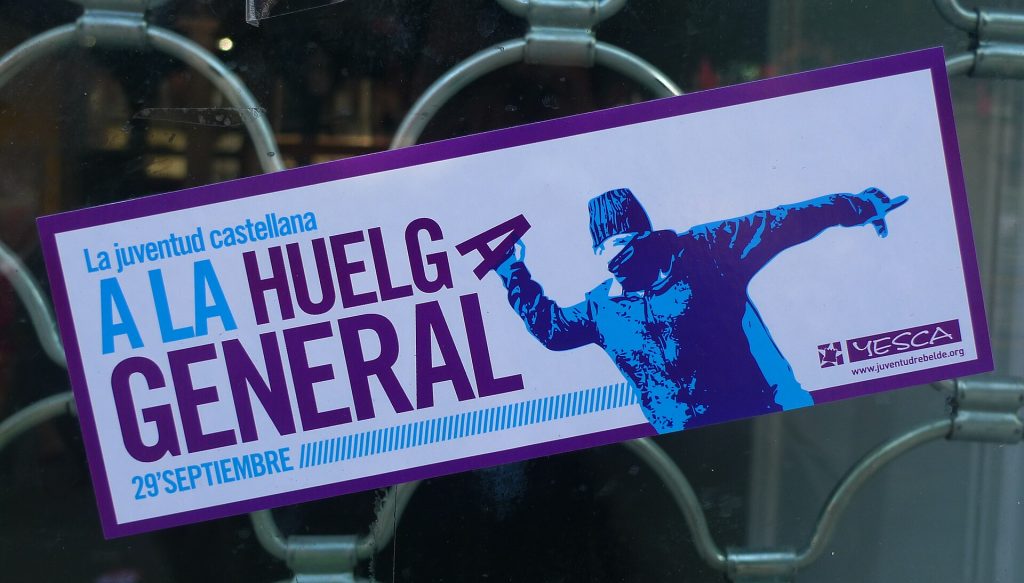
The strike on September 29, 2010, was organized by CC.OO. and UGT to oppose the labor market flexibilization introduced by the new reform, as well as to protest the austerity policies—demanded by the European Commission and international markets—that were subsequently carried out by the Zapatero administration. Participation in the strike varied, and the government did not withdraw any of the measures it had introduced. Months later, Prime Minister Zapatero called for general elections, which, in December 2011, led to Mariano Rajoy taking office.
New Reform and European Bailout
The 2012 labor reform, enacted by the Rajoy government, represented a substantial shift in Spain’s labor regulations during a highly complex political period. That same year, the Spanish economy came under the oversight of the Eurogroup—and, de facto, the European Commission—through a bailout of the Spanish banking sector, totaling up to 100 billion euros.
However, this reform was not merely a consequence of the effects of the financial crisis; it also responded to an economic context in which employers’ associations consistently pointed to “excessive” regulation of hiring and the “extreme” rigidity of dismissal procedures as the primary problems facing the Spanish labor market.
Against this backdrop, the trade unions CC.OO. and UGT called for two days of general strikes—one on March 29 and another on November 14, 2012. The objective was to pressure the government to reverse the harshest measures of the 2012 reform, particularly those that made it easier to dismiss workers or reduce their wages. Although participation in the strikes was very high, the reform was not repealed; it marked the peak of social discontent during the 2008–2015 crisis period.
Strike for Housing
Unlike the administrations of Zapatero and Rajoy—during which collective bargaining broke down as a result of the severe crisis and austerity policies—the government of Pedro Sánchez (2018–2026) managed to restore dialogue with labor unions. This engagement covered a wide range of issues, including the quality of employment (higher wages, reduced reliance on temporary contracts, and improved professional training), the implementation of temporary furlough schemes (ERTEs) during the COVID-19 pandemic, increases to the minimum wage, improvements to pensions, and the 2022 labor reform. This political dynamic explains the absence of general strikes and stands as an exceptional development when compared to previous administrations.
However, in the wake of the pandemic, the difficulty of accessing housing has become one of the major problems facing Spanish society. A sharp surge in demand—driven by rapid population growth—compounded by insufficient supply and intense market speculation, has fueled a significant rise in prices. This has created a housing accessibility crisis that has all but wiped out the supply of affordable housing from the market.
It is against this backdrop of a housing crisis that the general strike of November 11, 2026, must be understood. Called by the Tenants’ Union (Sindicato de Inquilinas) and supported by the trade unions CC.OO. and UGT, the strike aims to draw the attention of political authorities and the general public to a social crisis that prevents young people from pursuing their life goals—specifically, the ability to establish a home of their own at a price that aligns with their purchasing power.
Consequently, this is a highly significant historical event: it marks the first major general strike not prompted by opposition to labor reforms or wage-cutting policies, but rather by the excessive surge in housing prices and the extreme difficulty young Spaniards face in achieving independent living.


Be the first to comment