
Nigel Farage’s Reform party has attracted significant support by those disgruntled with establishment parties in the UK, but its voters have very different views on key economic questions.
Zain Asaf has a PhD in Political Science from the University of Toronto. His dissertation was on party competition between mainstream and niche parties in advanced democracies. His research interests are political behavior and political institutions. From Jan 2024-March 2025 he was a researcher at UKICE and from July 2025-April 2026, he was a Researcher and Data Analyst at More in Common, UK.
Cross-posted from LSE Politics
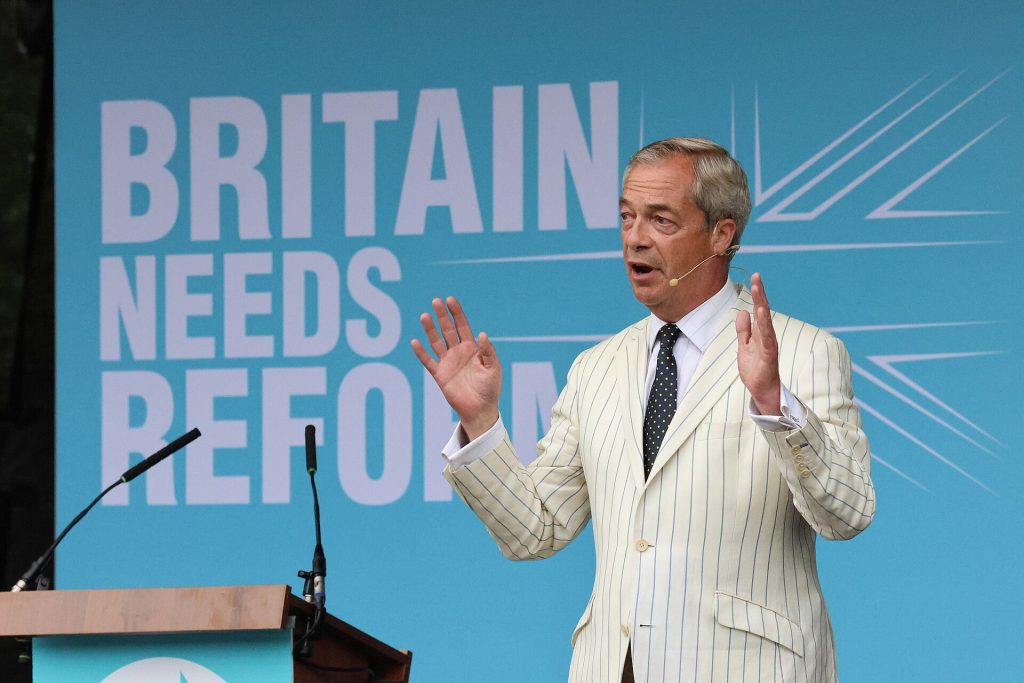
Reform UK’s polling surge since the 2024 election has drawn attention to its economic policies. This scrutiny has intensified following the party’s recent conference, where Robert Jenrick unveiled the party’s flagship economic pledge: raising the income-tax personal allowance to £15,000 within its first 100 days in office. Reform draws support not only from former Conservatives, but also from former Labour voters who favour more public spending and greater efforts to reduce inequality.
Where Reform voters differ from supporters of other parties is in how divided they are on economic issues. At the same time, Reform itself is hard to place in terms of where it sits on economic policy. Thus far Reform’s economic offerings have mixed left and right: an extra £17 billion a year for health and 50 per cent public ownership of utilities, but also a £50bn cut in welfare, alongside a corporation tax cut to 15 per cent, and restoration of the two-child benefit cap.
So, can Reform UK hold together voters who fundamentally disagree over whether to raise taxes to fund social services and over how much government should do to close the gap between rich and poor?
An economic coalition pulling in different directions
The 2024 post-election British Election Study (BES) asks voters to indicate their economic preferences by placing themselves on two 0–10 scales. The first runs from cutting taxes and spending much less on health and social services to raising taxes and spending much more; the second, from government closing the gap between rich and poor to leaving it alone.
Since the scale ties tax cuts to spending cuts, most voters — across all parties — place themselves toward the higher-tax, higher-spending end, which is what makes the size of Reform’s low-tax bloc notable. Counting everyone on each side of the midpoint, 43 per cent of Reform’s voters place themselves on the higher-tax side and 29 per cent on the lower-tax side, with 28 per cent exactly in the middle. On redistribution, 48 per cent place themselves on the leave-alone side and 27 per cent on the side of closing the gap. Reform voters are divided on both dimensions, and in much the same proportions.
All other parties’ supporters come down decisively on one side of at least one of these questions. On tax and spending they all favour higher taxes and more spending, but by substantially different margins: by three and a half to one among Conservative voters, and by six to one or more among Labour, Liberal Democrat and Green voters, against three to two among Reform’s. On inequality, Labour and Green voters take the pro-redistribution side by more than two to one. Only Conservatives are similarly split on redistribution, although they are far more united on tax and spending. Reform is therefore the only party whose voters do not lean clearly in either direction on either question.
When disagreement becomes a liability
This division matters only if economic positions shape how people vote. The prevailing view is that for Reform they do not: its support is driven by immigration, Brexit, distrust of politics and Farage himself.
Data from the BES suggests otherwise. Voters also placed the parties on those scales, and on both, the wider the gap between a voter and where they place Reform, the less likely they are to back it. Support falls at much the same rate as it does for the other main parties.
Taken alone, neither finding would be remarkable. A divided coalition makes it difficult for a party to find an economic position close to most of its voters. But being out of step with some voters matters electorally only if economic preferences shape vote choice. Reform is the only party that combines both: a divided coalition and voters who are less likely to support it when they see the party as out of step with their own economic views. It is this combination that turns disagreement within its coalition from a curiosity into a strategic problem.
To assess whether economic proximity — how close voters are to a party on these questions — structures vote choice, I compare each voter’s own position with where they placed each party on the same two 0–10 scales, ignoring direction: three points to a party’s left counts the same as three points to its right. I then estimate how the probability of voting for that party changes as the gap between them widens. Crucially, the model treats the vote as a single choice between all five parties, the way voters actually decide in a General Election context, rather than modelling each party separately.
Figures 1 and 2 show how support for each party falls the further a voter sits from it, compared with someone who sees no gap between their own position and the party’s. The steeper the line, the more disagreement costs
Figure 1: Tax and spending: Reform’s support falls at much the same rate as Labour’s and the Liberal Democrats’; the Conservatives’ falls fastest

On tax and spending, economic distance clearly matters for Reform. A voter five points from Reform is around 14 percentage points less likely to support it than one who agrees with it exactly. That decrease is similar to those for Labour and the Liberal Democrats. The effect is larger for the Conservatives: the equivalent five-point gap is associated with a 29 percentage-point fall in support.
However, Reform’s voters are divided on this question in a way Conservatives are not. Nearly twice as large a share of Reform’s voters wants lower taxes and lower spending: 29 per cent, against 15 per cent per cent of Conservatives. Choosing a position is therefore easier for the Conservatives. Wherever Reform stands, more of its own voters are likely to find themselves some distance away.
Figure 2: Redistribution: Labour’s support falls fastest; Reform’s falls at a rate similar to the Conservatives’

Why Redistribution is the Harder Problem
On inequality, voters who disagree with Reform are still less likely to vote for it, but here, the same distance on the 0-10 scale decreases the likelihood of voting Reform by more than it reduces the likelihood of voting Conservative. A voter who places themselves five points from Reform is around nine percentage points less likely to support it than one who thinks the party shares their position — a gap somewhat larger than for Conservative voters (six points), but smaller than for Labour voters (fourteen points).
The nature of Reform’s division on redistribution also differs. On tax and spending, they are more spread out than Conservative voters, but relatively few sit at the extremes. On inequality, many do. Taking the three points at each end of the 0–10 scale, nearly half of Reform voters sit at one extreme or the other: 15 per cent at the redistributive end (0–2) and 33 per cent at the free-market end (8–10). On tax and spending, fewer than three in ten sit at either end.
That makes compromise harder. A moderate position on tax and spending would put Reform within two points of seven in ten of its voters. On inequality, by contrast, it would put it close to barely half. Whichever direction Reform moves, a substantial group risks finding itself a long way from the party.
Voters are least sure where Reform stands on these economic questions. Such ambiguity could have advantages with divided supporters. But these data cannot tell us whether that ambiguity is deliberate, or whether it has helped Reform electorally.What they do show is the dilemma. Reform is alone in combining voters who do not come down decisively on either economic question with an electorate that appears to care about its economic distance from the party. A clear move in either direction therefore risks bringing Reform closer to one part of its coalition while pushing another away.
For a Party that has prospered by bringing together voters from different political backgrounds, the question is whether it can develop a clearer economic programme without exposing the divisions within the coalition it has built.

BRAVE NEW EUROPE is one of the very few Resistance Media in Europe. We publish expert analyses and reports by some of the leading thinkers from across the world who you will not find in state and corporate mainstream media. Support us in our work.
To donate please go HERE.

Be the first to comment