
Using private finance to build public infrastructure is short-sighted and almost always ends up costing the public purse more in the long run.
Maike Schmidt is an assistant researcher at the New Economics Foundation and is based in Brussels. Her work focuses on European monetary and fiscal policy change and public and private finance. She previously completed an EPOG master’s degree, which takes a pluralist and interdisciplinary approach to economics, and has held multiple research positions.
Theo Harris is an economist at the New Economics Foundation specialising in the interactions between fiscal policy, monetary policy, and financing a just transition. He studied history and economics at Oxford University and has previously worked in management consulting as well as being a UK youth representative to the G20.
Cross-posted from Green European Journal
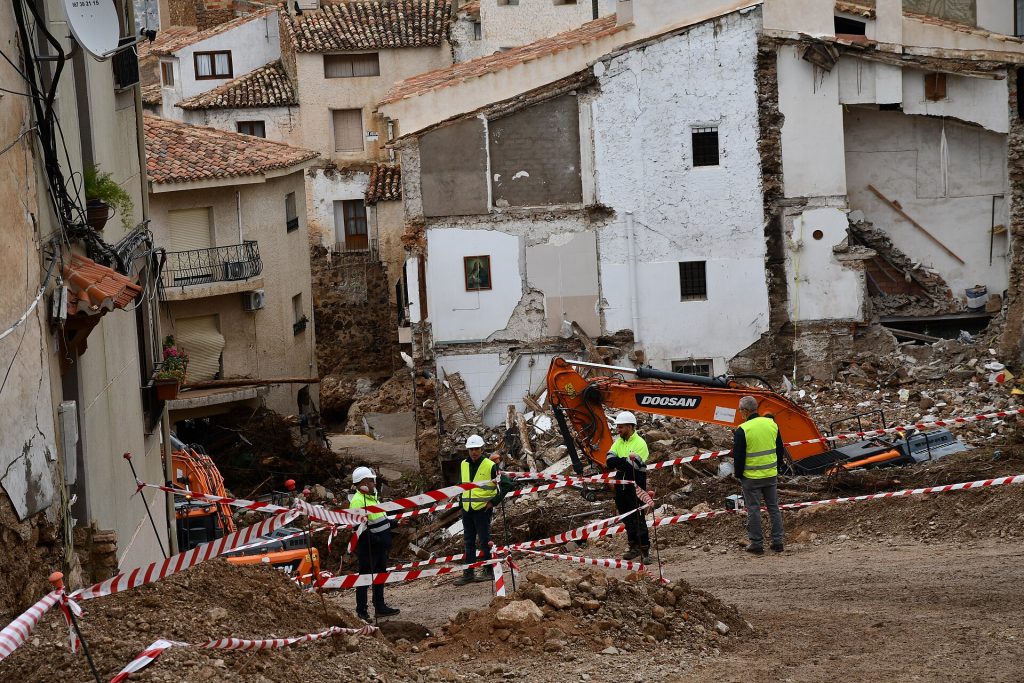
In October 2024, torrential downpours hit Valencia, leading to catastrophic floods with devastating consequences, destroying homes and businesses, wrecking roads and rail lines, and submerging cars. The event was a human tragedy, in which hundreds of people lost their lives, and many others lost their livelihoods. It also revealed a painful truth: Europe’s infrastructure is not fit for the changing climate. The floods caused total direct damages of over 18 billion euros. To put this into context: Spain’s annual infrastructure investment deficit (that is, the difference between current and needed spending) is estimated to be around 19 billion euros per year. This means that a single storm caused damage equivalent to around one year of Spain’s infrastructure investment gap.
The problem goes beyond climate adaptation. Across Europe, countries are struggling to maintain deteriorating infrastructure and build new projects. Recent high-profile failures, such as the collapse of the Carola Bridge in Dresden in September 2024, should make this crisis impossible to ignore. The bridge collapsed due to corrosion and material fatigue, yet renovations were only scheduled for the following year.
Governments are also struggling to find money for renovating and building schools, hospitals, and electricity grids.
Everyone appears to agree on the need for more infrastructure investment, but the prevailing question is: who is going to pay for it? In answering this question, policymakers are falling for the private finance myth: the idea that the market will finance our essential public services.
This is happening at EU and national levels alike. The Competitiveness Fund proposed by the European Commission as part of the next EU budget, for example, specifically aims to attract private investment, including for infrastructure projects. Similarly, the Germany Fund launched by Berlin in early 2026 aims to mobilise 130 billion euros in private investment for a major expansion of public infrastructure and defence capabilities.
At first glance, this strategy may sound effective. If the private sector shoulders the bulk of Europe’s infrastructure investment, public resources can be allocated to other essential needs, such as social welfare and education. However, contrary to what policymakers would have us believe, private finance does not come for free.
Socialising risks, privatising profits
Private investors expect returns commensurate with the risk they take. When it comes to infrastructure, these returns must come either from the people who use that infrastructure (through energy bills or road tolls, for instance) or from public contracts and subsidies. Whether the upfront investment for the project is financed by the public or private sector, it is always eventually paid for by some combination of billpayers and taxpayers.
Moreover, many socially beneficial infrastructure projects require huge upfront investment without necessarily delivering high profits. For example, a new metro line requires billions in upfront construction costs, takes decades before it generates any return, and in most European cities never turns a profit at all.
To get private actors to invest, governments therefore need to provide incentives. This is called derisking. Through deregulation or by providing public funds, for example in the form of a guarantee, public authorities aim to adjust the risk-return profile of investments. The German federal government, for example, is backing the Germany Fund with public funding and guarantees totalling around 30 billion euros. The problem with derisking is that it is often done today without any meaningful conditions in place, as also pointed out by former Italian prime minister Enrico Letta. This leads to socialising the risks while privatising the profits: if an infrastructure project is successful, the private sector collects the profits; if it fails, the public shoulders the costs.
The Castor underground gas storage plant in Spain is a prime example of derisking gone wrong. The project, built off the Mediterranean coast by the privately owned company Escal UGS, had to be shut down in 2013, before it even entered commercial operations, because it triggered hundreds of earthquakes along the coast of Valencia and in Catalonia’s Ebro Delta. Even though the company was to blame, the Spanish government had to compensate it with a 1.35 billion-euro package. This is because public authorities had derisked the investment, agreeing that the state would compensate shareholders in the event of a shutdown, even if the shutdown was due to negligence or deceit traceable to Escal UGS. The Castor gas project is just one of many in which citizens bear the costs, while private investors are shielded.
Private finance won’t save us
It is arguably true that some amount of private finance is useful for Europe’s infrastructure investment needs. The problem with the private finance myth is that it claims private finance should be the default option, ignoring its shortcomings and the potential benefits of public or alternative models.
Our recent research at the New Economics Foundation shows that there is no straightforward economic evidence that private finance is better for taxpayers or billpayers. If infrastructure projects can generate revenues for private companies, they can also do so for the public. Instead of bearing the costs that come with subsidising a privately owned project, by retaining full ownership of the project, the public could ultimately see a long-term fiscal return. The remunicipalisation of Hamburg’s electricity grid is one such example. In 2024, it generated profits of around 109 million euros for the city.
In terms of cost efficiency, consumer prices, employment conditions, and service delivery, private ownership is often not the better choice. Privatisation has been linked to higher electricity prices, increased job precarity and cuts in the postal industry, and decreased preparedness for the Covid-19 pandemic in hospitals across Europe. While investors profit, workers and citizens bear the costs.
There are at least four structural factors which can explain why the private sector generally charges higher bills, while investing less in job and service provision.
First, the cost of capital for the private sector is generally much higher. Most EU governments currently borrow at 3.5-5 per cent on a 30-year bond. Private infrastructure funds, by contrast, typically target returns of 12-16 per cent or more. This determines what equity investors demand when committing capital to a project, and what users or taxpayers ultimately have to cover through bills or public subsidies.
Second, incentive structures differ. Private firms are motivated by profit, whereas public authorities typically pursue broader social objectives, like income redistribution or public health. The Corporate Europe Observatory, for example, found that the privatisation of healthcare across Europe has led private providers to “cherry pick” lower-risk and higher-paying patients over higher-risk and lower-income patients.
Third, many infrastructure sectors, such as water or electricity grids, are natural monopolies. A natural monopoly exists where a single provider can supply the entire market at a lower cost than any combination of competing firms, typically due to high fixed costs and significant economies of scale. A report by Common Wealth on the UK’s major electricity and gas distribution networks, for example, revealed that, amid the cost-of-living crisis, companies were able to exploit their natural monopolies, paying dividends to shareholders totalling between 2.4 and 3.6 billion pounds from 2017 to 2021.
Lastly, while effective regulation can mitigate some of the above failings, recent decades have been marked by a lack of regulation. And the trend is moving in the wrong direction as the Commission pursues deregulation across the board, ranging from the energy system to digital technologies and food safety.
No government policy can fully resolve these structural issues. Private capital, by its very nature, allocates funds to areas where returns are highest, rather than where need is greatest. Societally vital and environmentally necessary investments that do not meet return thresholds are simply not considered. An overreliance on private finance thus does not just risk delivering worse outcomes; it also entrenches a logic in which the boundaries of what is possible are drawn by investors, not citizens. This makes it essential for society to take conscious decisions about where and how private finance should play a role, rather than delegating broad swathes of infrastructure finance and delivery to the private sector by default.
Evidence-based approach
Rather than sticking to a misplaced loyalty to private finance, policymakers should apply a systematic approach to determining whether and when public or private delivery better serves societal interests.
Instead of focusing solely on immediate public spending, policymakers need to consider the full bandwidth of financial considerations: project delivery costs, revenue streams, and financing costs. Additionally, wider economic effects, known as “multiplier effects”, need to be incorporated, as infrastructure projects can raise economic activity and tax revenues in the surrounding area.
Importantly, non-financial considerations also need to be included. Factors like environmental consequences, the local benefits of community ownership, and strategic motivations, for example public ownership of the energy grid to ensure energy security, must be part of an informed decision. Otherwise, governments will continue to hand over critical infrastructure to private actors, with detrimental long-term effects on society and the environment.
This requires broader changes to macroeconomic policy to address the underlying causes of underinvestment. Decades of austerity and stringent fiscal rules have created a self-perpetuating cycle. As governments cut public investment and outsource to the private sector, they lose the institutional capacity, expertise, and leverage to deliver infrastructure themselves, becoming increasingly dependent on private actors and less able to dictate their terms.
The fact that austerity impedes rather than spurs economic prosperity has also been highlighted in a recent publication by the International Monetary Fund. They show that, on average, austerity policies aimed at reducing public deficits can increase debt-to-GDP ratios due to the negative impacts on tax receipts and economic activity. To break this cycle, governments must rethink their approach and design fiscal policy to accommodate public infrastructure investment, where it is deemed in society’s best interest.
A threat to democracy
Infrastructure is not just a financial asset – it is foundational to a functioning society. It determines how we move, how we learn, and how we are cared for. These decisions should not be made by the market, but through democratic deliberation.
The state not being able to provide the infrastructure its citizens need is a threat to democracy. This has also been pointed out by the German conservative minister of transport, Patrick Schnieder, in connection with the dire state of the country’s railway network. We also see this unravelling in Valencia, where the far-right party Vox used the floods as a springboard for both anti-government and anti-climate rhetoric.
Valencians will be heading to the polls next year. Recent projections place Vox in the lead with 24.4 per cent – a doubling of what they currently have. At the same time, experts warn that infrastructure improvements following the floods have been lagging behind, meaning that there is no guarantee that the same could not happen again. Rather than outsourcing our collective future to actors with no democratic mandate to shape it, the public must be given back control.


Be the first to comment