
Trump’s catastrophic miscalculation in Iran and refusal to accept the inevitability of defeat is pushing us towards a global depression and ensuring the suffering and immiseration of millions.
Chris Hedges is a Pulitzer Prize–winning journalist who was a foreign correspondent for fifteen years for The New York Times, where he served as the Middle East Bureau Chief and Balkan Bureau Chief for the paper. He previously worked overseas for The Dallas Morning News, The Christian Science Monitor, and NPR. He is the host of show The Chris Hedges Report.
Cross-posted from Chris Hedges’ Substack
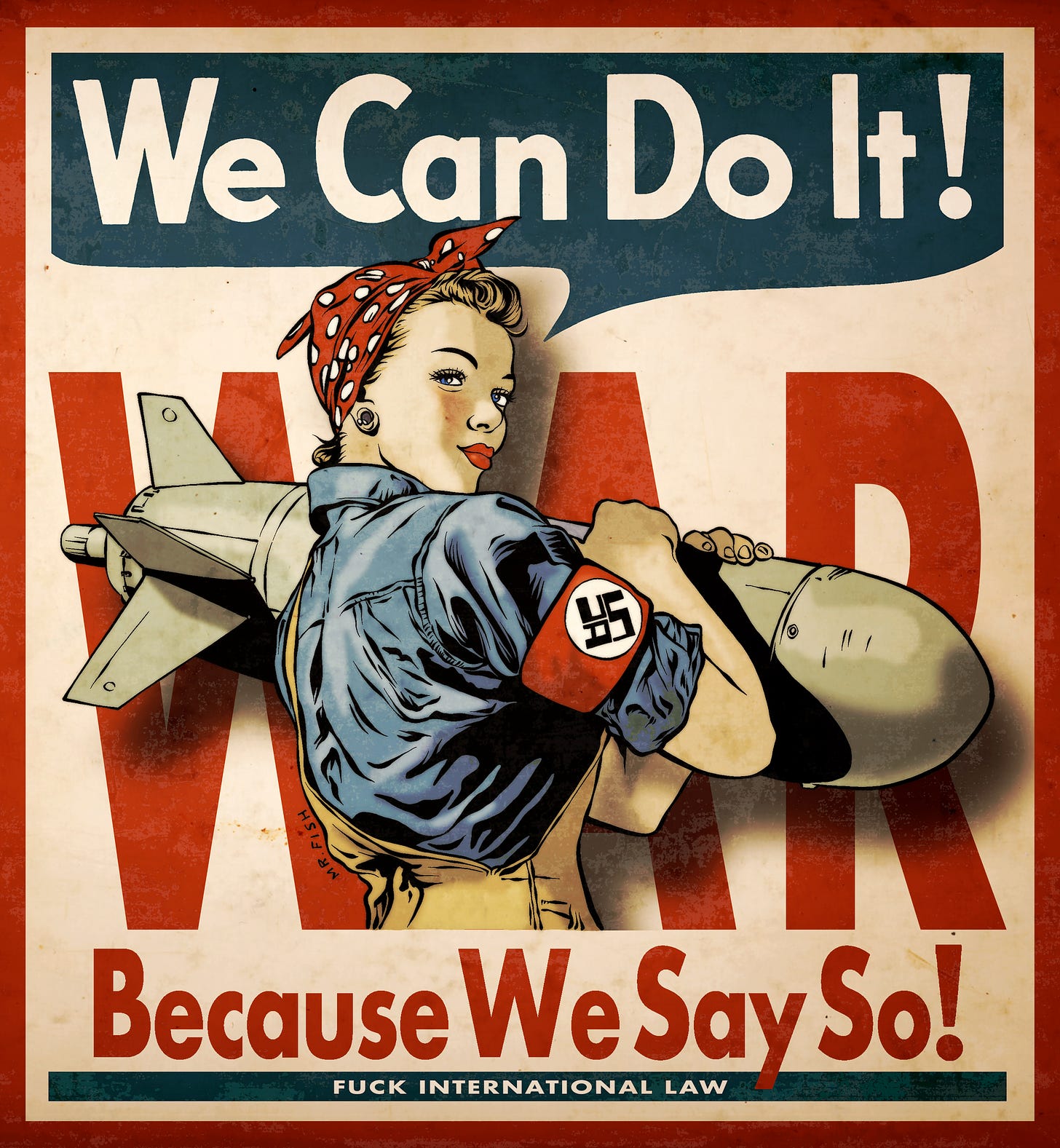
Because We Say So – by Mr. Fish
America’s newest quagmire in the Middle East is like its old quagmires in the Middle East. It is based, as were the wars in Afghanistan and Iraq, on a gross misreading of our adversaries, a catastrophic failure to understand the limits of imperial power and no discernable strategy. It swells the profits of the war industry, wasting billions of public funds, alienates our allies and erodes the global power and prestige of the United States.
Dying empires, governed by the corrupt and the incompetent, are blinded by militarism and hubris. They are unable to read the world around them. They stumble into self-defeating cul-de-sacs — as we did in Iraq, Afghanistan and earlier in Vietnam — where military adventurism accelerates self-inflicted wounds.
The war on Iran is one more chapter in our precipitous and ultimately fatal decline.
Tehran’s 10-point temporary ceasefire proposal — brokered by Pakistani mediators and presented to the U.S. 40 days after war against Iran had begun — is tantamount to surrender terms. It demands the end of U.S. and Israeli attacks, including in Lebanon. It calls for the removal of U.S. military bases and installations from the region. It solidifies Iran’s control over the Strait of Hormuz. It refuses to abandon uranium enrichment. It calls for the end to sanctions and termination of anti-Iranian resolutions by the United Nations Security Council and International Atomic Energy Agency. It also requires release of frozen assets — estimated at $100 billion — and reparations for the U.S. and Israeli attacks.
This is too bitter a humiliation for the U.S. and Israel to accept.
Within hours of the Iranian proposal, Israel — determined to sabotage any agreement — launched a devastating air attack against Lebanon. The attack, which was carried out over 10 minutes, included the bombing of central Beirut. It involved 50 fighter jets and 108 airstrikes that dropped around 160 bombs, killing 350 people and wounding 1,000 others. The lightning and unprovoked massacre, known as “Black Wednesday,” is a potent reminder that Israel has no intention of allowing this war to end. With the U.S. not ready to admit defeat, and Israel’s bloodlust, we are in for a very rough ride.
Iran submitted an updated proposal last week, which Trump said is “totally unacceptable.”
But Iran, with its stranglehold over the Strait of Hormuz, can afford to wait. The longer it maintains its blockade over shipping — roughly 20 percent of the world’s oil and liquified natural gas flows through the Strait of Hormuz — the more global economic pain it inflicts.
There is no good outcome for the U.S.
The Trump administration’s obstinacy and Israel’s determination to resume attacks on Iran ensures that the global economy will barrel towards a global depression.
The World Bank projects a 31 percent increase in the cost of nitrogen fertilizers which are produced in the Gulf and transit through the Strait of Hormuz this year if the war continues. This ensures a huge rise in food costs.
Shortages are already shutting down global manufacturing and production. The fragile, interdependent global supply chains are seizing up.
This economic ecosystem, as Iran has shown, is easy to destroy. It will be very hard to piece back together.
Iran suffered devastating blows to its civilian infrastructure and economy — including residential areas, schools, health centers, police stations, churches and synagogues and energy, desalinization plants, steel and pharmaceutical facilities — as well as its military assets, including parts of its navy, air force and missile launch capabilities. It endured “decapitation strikes” against its senior political and military leaders at the start of the war, which included the assassinations of the Supreme Leader of the Islamic Revolution, Ayatollah Ali Khamenei, the secretary of Iran’s Defence Council, Ali Shamkhani, and the chief of staff of Iran’s armed forces, Abdolrahim Mousavi, among others.
None of the U.S. and Israeli objectives, however, have been met.
The new Iranian leadership — centered around the Islamic Revolutionary Guard Corps (IRGC) — is more defiant and intransigent than the previous leadership.
Iran maintains control over the Strait of Hormuz. It charges as much as $2 million for every oil tanker passing through it. These tariffs — which Iran introduced as part of its demand for war reparations — must be paid in Chinese currency, part of an attempt by Iran, China and Russia to break the hegemony of the U.S. dollar. Iran also retains significant missile and drone stockpiles and enriched uranium, which it has warned it will increase to 90 percent purity if attacked again.
Iran is the clear winner of Operation Epic Fury. Trump is the clear loser. The dilemma is that Trump’s penchant for inventing his own reality means he is unlikely to acknowledge his blunder and negotiate a way out of the debacle he created.
Trump, without Congressional approval, has already squandered at least $29 billion on the war according to the Pentagon, although analysis by Stephen Semler of Popular Information places the figure closer to $72 billion.
The human cost is already high. U.S. and Israeli strikes have killed more than 3,300 Iranian civilians, including at least 221 children. Over three million Iranians have been displaced, along with over one million Lebanese from Israel’s ongoing bombardment and ethnic cleansing of southern Lebanon. There are, at the same time, over two million displaced Palestinians from the genocide in Gaza and another 1,100 killed and 40,000 displaced Palestinians in the occupied West Bank.
Fuel shortages and supply disruptions are crippling countries in Asia, with Thailand facing panic buying and rationing at some petrol stations. Vietnam and South Korea are scrambling to secure alternative crude and fuel supplies. Japan, which relies on the Persian Gulf for roughly 95 percent of its crude oil imports, has had to dip twice into its strategic reserves since the war started in February.
The rise in price of liquefied petroleum means cooking fuel prices have increased by about seven percent for domestic use in India, but have skyrocketed by around 76 percent in the commercial sector. This has resulted in production cuts and job losses in the garment and textile sector in India, as well as in Bangladesh and Cambodia.
There are shortages of helium, aluminum and naphtha, also transited through the Strait of Hormuz. These shortages have seen production declines, including among microchip manufacturers, construction firms and the plastic packaging sector. Steel mills in India and automakers in Japan have cut production. Tens of thousands of workers across the globe have already lost their jobs.
Asian airlines, along with many on the European continent — including those from Germany, Turkey and Greece — are loading extra fuel at their airports, cutting flights and raising surcharges with the doubling of the price of jet fuel. The United Arab Emirates — one of the world’s richest states with sovereign wealth funds that total more than $2 trillion — has asked the U.S. for a “Wartime Financial Lifeline” in the wake of missile-damaged gas fields and a halt to shipping in the Strait of Hormuz, according to the Wall Street Journal.
Millions of people, especially in Asia and Africa, are at risk of falling into dire poverty because of the war, according to the United Nations Development Program.
The U.S., which is a net exporter of oil and natural gas, has been relatively insulated from the global shock, although gasoline prices have risen by around 40 percent to more than $4.50 a gallon. The average U.S. diesel price has increased by nearly 50 percent, surpassing $5.60 a gallon. But it is only a matter of time before the breakdown of the global economy ravages the U.S.
The Trump administration is pushing us towards a global depression with all of the social and political instability that comes with a catastrophic financial crisis.
Trump is desperate. He spews out expletive-laden threats to Iran on social media, writing “Open the Fuckin’ Strait [of Hormuz], you crazy bastards.” He also posts Artificial Intelligence generated images showing the U.S. military obliterating the Iranian military. He has threatened to bomb Iranians “back to the stone age where they belong,” and lambasts his critics as traitors:
“When the Fake News says that the Iranian enemy is doing well, Militarily, against us, it’s virtual TREASON in that it is such a false, and even preposterous, statement.” He declared on Truth Social, “They are aiding and abetting the enemy!”
This screed was followed by an image of a map with Venezuela overlaid with the U.S. flag. The caption read: “51st State.”

Before leaving for China, Trump claimed: “We have Iran very much under control… We’re either going to make a deal or they’re going to be decimated. One way or the other, we win.”
The rants are pathetic and unhinged. But they are also ominous.
The U.S. is building up troop levels in the region. It has deployed the Tripoli Amphibious Ready Group with the 31st Marine Expeditionary Unit — composed of about 3,500 sailors and Marines — in addition to transport and strike fighter aircraft and assault and tactical assets. It has deployed the Boxer Amphibious Ready Group along with about 2,500 Marines from the 11th Marine Expeditionary Unit equipped with F-35B Lightning II Stealth Fighters, MV-22B Osprey, tilt rotors and attack helicopters. The U.S. has also sent around 2,000 paratroopers to the Persian Gulf and is reportedly considering augmenting these forces with an additional 10,000 troops.
A resumption of the bombing, coupled with even a limited ground assault, would ensure a long and costly war. It will fulfill Israel’s objective — which seeks to bomb Iran into a failed state — but will be another mortal blow to the U.S. empire.
A ground assault on Kharg Island — which lies 16 miles off Iran’s coast and serves as the country’s main oil storage and export terminal, processing around 90 percent of the country’s oil exports — would send seismic shock waves through the global economy. And if U.S. troops attempt to seize Iranian territory, Iran will deploy its arsenal of anti-ship cruise missiles, ballistic missiles, underwater drones and mines, making any occupation deadly.
We are in serious trouble.
The management of the conflict is far beyond the capabilities of the buffoons within the Trump administration. They prefer global misery and carnage to defeat. By the time they face the inevitable, they will have left mounds of corpses in their wake.
The tragedy is not that the empire is dying. The tragedy is that the empire is bringing so many innocents down with it.


Be the first to comment