
How Western capitalists use China-bashing to deflect attention from their soaring profits
Branko Milanović is an economist specialised in development and inequality. His latest book The Visions of inequality, was published October 10, 2023.

The discussion began with me, being tired of permanent Franco-German kvetching about China’s trade surpluses, writing this on Twitter:
“Nobody can take seriously European complaints about China. China is now building things better and more cheaply than Germany or France. When France and Germany built things better and more cheaply than others, they ridiculed such complaints. Now they are losing and not liking it. Moreover, Europe came to that position by exploiting the rest of the world. China did not.”
The Franco-German complaint about China subsidization, workers working too long hours etc. reminded me of similar complaint, but coming from the other side, that I heard many years ago in Africa, while working for the World Bank. Africans also complained of permanent trade deficits with Europe and spoke of unfair competition: “Look, Europeans have these fancy machines and in one hour they produce ten widgets. We, in Africa, have to work ten hours to do the same thing. Obviously, we are undersold, we run permanent trade deficits and then have to borrow from the IMF under atrociously bad conditions. We are all for fair competition—but European should get rid of their new machines, and then let us compete like men: mano a mano, fairly”. Obviously African comments were met with derision: they are, the French and the IMF argued, Luddites, ignoramuses, foes of productivity and technical progress.
But now when the shoe is on the other foot, European make the same complaints against the Chinese: they should work less, invent many fewer new things, and pay their workers much more (I will return to this last point).
In response to my tweet Michael Pettis wrote:
“Although I agree with much of Milanovic says about inequality, I disagree with him here. I think he is confusing “efficient” manufacturing with “competitive” manufacturing. China is not necessarily building things better and more cheaply than Germany or France, but it is certainly selling them far more cheaply, and the difference shows up both in the extremely low share households receive of what they produce and in the astonishing rise in China’s debt-to-GDP ratio. This was the same strategy Japan followed in the 1980s, and not only was it unsustainable, but the high debt and low consumption share ultimately forced Japan into an extraordinarily difficult adjustment. If Germany and France were willing to suppress wages (or, which is the same thing, to eliminate social transfers), or if they were willing to borrow comparable amounts to subsidize the competitiveness of their manufacturers, it is pretty obvious that French and German manufacturers would also be able to sell much more cheaply in global markets. But while these policies would increase manufacturing competitiveness, they would not make manufacturing any more efficient. They would simply shift part of the economic costs of production onto the rest of the country.”
I in turn replied to Michael.
“Michael, I agree with what you say, but this is the nature of international competition. France and Germany cannot (or do not want) to decrease wages and they lose the market. You seem to postulate that everybody should follow what Europe does. Honestly, it is the same as if Africans said to the French. your competition is not “loyale” because you work on fancy machines and we do not. So, yes. if France and Germany compressed wages & transfers they could compete with China. But European policy is not a policy that everybody ought to follow nor does it define “fair” policy.”
And the conversation (at least in this round) was concluded by Michael.
“Yes, Branko, but because it would politically disruptive (and bad for the global economy) if Europe were also to compress wages and transfers by enough to regain competitiveness, the alternative for Europe is to intervene in its external accounts for the purpose of reversing the advantage enjoyed by economies that compete by suppressing household income. This was what Joan Robinson warned about. In a global economy in which some economies are relatively open, while others intervene to increase their competitiveness, the persistent surpluses of the latter will eventually force the former themselves to intervene, at the cost of global trade. Michael Kalecki made a similar point. He showed that if a country suppresses wages relative to productivity, household consumption tends to weaken. The country can nevertheless maintain high production if the resulting shortfall in consumption is offset either by higher investment (as was the case in China in the 1990s and during the final stage of the housing bubble in the 2010s) or by a trade surplus. The problem he noted, is that this only works if some countries do it. In an open trading environment, if my wages are lower (relative to productivity) than yours, my products will be more competitive, and I can grow faster by absorbing part of your demand (leaving you to choose between growing more quickly or boosting domestic demand with more debt). But this only works as long as you don’t reduce your own wages relative to your own productivity. If we both do it, we are collectively worse off because, as Kalecki argued, it is wages that drive demand which, in turn, drives business profits (and growth). The key point is that if a country can reduce the prices of its manufacturing goods across the board by suppressing wages and subsidizing production, its lower prices are not evidence of greater efficiency. They are mostly evidence of the extent to which workers and the financial system are subsidizing prices. On the other hand, if – consistent with comparative advantage – some of its goods are relatively cheaper while others relative more expensive, and these are exchanged through trade, then you might be able to argue that it produced the former goods more efficiently while its trade partner produced the latter more efficiently.”
Now, the interesting part begins. I am a huge fan of Matt Klein and Michael Pettis’ book Trade wars are class wars. I discuss it very favorably in my Great Global Transformation. I find their explanation of why Chinese SOEs have to “compress” wages and run large surpluses very convincing: it is a political economy explanation: China needs large retained profits of SOEs to either affect domestic production and innovation in the desired direction, or to invest such profits, for political or economic reasons, abroad. It thus structurally aims for trade surpluses because, in Pettis’ words “it compresses wages”.
But notice several problems here. What does “to compress” wages actually mean? Is there a wage rate that one can decide that should be valid for China? But if for China, can we then also decide what is the correct wage for France? The problem is simply that French wages (especially including social transfers and few days of work) are relatively high (France’s GDP per capita is also significantly higher than the Chinese) and the French then complain that Chinese wages are too low. Note, this is the French who assign to themselves the power to decide whether Chinese wages are too low or too high. But having a system that can “compress” wages is a structural advantage that can indeed be seen as any “normal” advantage in foreign trade: if you have a better machine than the other guy, or cheaper access to resources, this is your structural or comparative or even absolute advantage. Similarly, if you can run an economy with lower wages than the other guy, this is similarly a structural advantage. There is nothing unfair in it.
It is a common complaint that many years ago Marx identified: all capitalists want that workers of other capitalists be paid higher wages so that they can become their customers, but they want their own workers to be paid as little as possible. This is exactly what the West is doing now: London and New York financial newspapers that attack any workers’ improvement at home are full of articles urging China to “decompress” wages and introduce more generous social transfers. Suddenly, The Financial Times and The Wall Street Journal are brimming with concern about Chinese workers’ welfare.
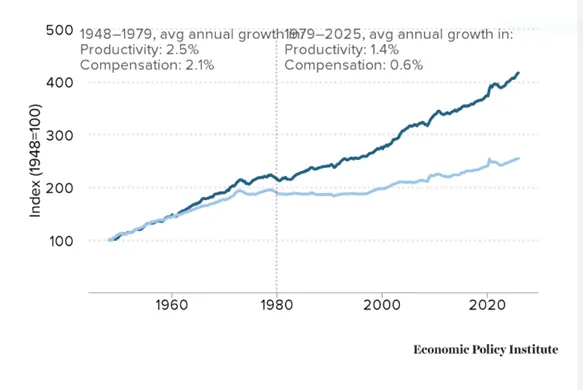
Furthermore and very importantly, one can equally argue that the West has “suppressed” wages too. Below is the famous graph that shows decoupling of output per worker (dark blue line) from wage per worker (light blue line). This is simply another way of saying that since the early 1980s, profits have risen in Western countries much more than labor incomes. Not only can it be listed under the rubric of wage compression, but the tables could be –and should be—turned by asking western capitalists why, if they want to seriously compete with China, they do not cut their own profits and thus make their products more attractive? But no, they do not like to talk about their profits, but they love to talk of other people’s wages.
Adam Smith, 250 years ago, put it very well.
“Our merchants and master-manufacturers complain much of the bad effects of high wages in raising the price, and thereby lessening the sale of their goods both at home and abroad. They say nothing concerning the bad effects of high profits”. (Wealth of Nations, Book I, Chapter 9, “Of the profits of stock”)
The problem is in essence very simple. Decentralized Western capitalists have been able to squeeze domestic labor for forty years and run outsized profits. But now they are faced by a centralized capitalist (which is in effect the Chinese state) who is even more efficient in squeezing wages and increasing productivity. That centralized capitalist is now driving out of business Western decentralized capitalists. This is why the latter have to move the heaven and the earth in order to stop the centralized capitalist from winning. But they have to do all of that while never mentioning the role their own profits play in it.
PS. It is interesting that the same evening when Michael Pettis and I had this discussion, I listened on NPR to a debate, conducted on a rather low level, by Senator Moreno and another gentleman who are co-sponsors of a bill to ban Chinese vehicle imports and other supply parts in the US. The fact that the debate was made under the auspices of the American Enterprise Institute made sure that the topic of high profits, which make many American goods uncompetitive, was never even mentioned. And how could it be mentioned when that very same American capitalists that make huge profits also fund the campaigns of American politicians?


Be the first to comment