If trade routes shift to avoid the turbulent Strait of Hormuz, Turkey could emerge as the real winner of the Iran War.
Adam Dehsabzi is a foreign policy analyst based in Washington D.C. He previously served as Research Assistant to Professor John Mearsheimer at The University of Chicago, where he completed his M.A. in International Relations. His research focuses on Middle Eastern security affairs, transatlantic relations, nationalism and minority self-determination.
Cross-posted from Responsible Statecraft
The outbreak of the U.S.-Israeli war on Iran and the closure of the Strait of Hormuz catalyzed an energy market shock that reverberated globally, creating “the largest supply disruption in the history of the global oil market,” accordingto the International Energy Agency.
The closure emphasized the strait’s function as one of the world’s most vital energy chokepoints, through which roughly 20% of global oil and liquid natural gas (LNG) passes. Iran’s retaliatory attacks and blockade, meanwhile, highlighted Tehran’s ability to disrupt supply chains, inflate currencies, and render the Hormuz as a commercially unusable trade corridor. The result of this crisis may well be a major rerouting of Eurasian trade.
Europe, which has hit hard by the strait’s closure, is particularly keen to support new corridors for commerce. At the recent G7 Summit, European Commission President Ursula von der Leyen argued that Europe must now forge alternative trade and energy routes to bypass Hormuz.
Two alternative trade corridors have been especially propelled.
The first is the Middle Corridor (or the Trans-Caspian International Transport Route), a multi-modal land, rail, and sea route between China and Europe that passes through Central Asia, the Caucasus, and Turkey.
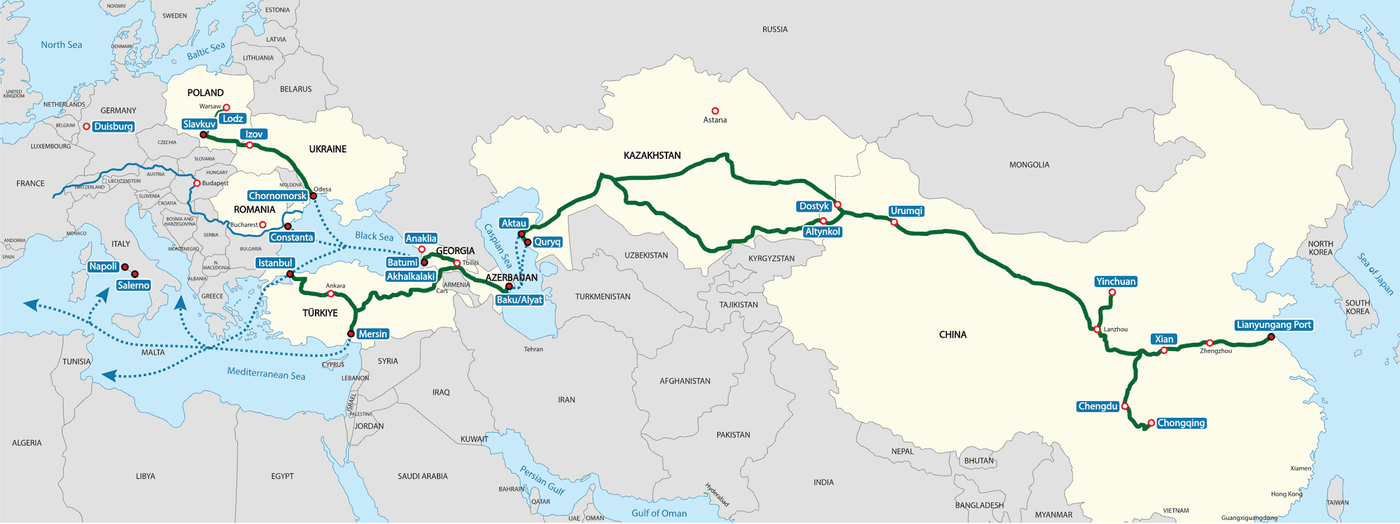
A map of the Trans-Caspian International Transport Route, known also as the Middle Corridor. (Tanvir Anjum Adib/CC BY 4.0)
The second is the Four Seas Initiative, a framework linking the Persian Gulf with the Caspian, Mediterranean, and Black Seas via a Syria-Turkey transit corridor.
As Europeans fret, other states see new possibilities. The closure has presented an opportunity for traditionally smaller players in Central Asia, the Caucasus, and the Levant – three regions directly adjacent to Iran – and a breakthrough for Turkey’s sphere of influence in Eurasia.
In Central Asia, Kazakhstan has perhaps emerged as the primary beneficiary of both Iran’s closure of the strait and Russia’s invasion of Ukraine. In a landlocked region that has long relied on trade with Russia via the Northern Corridor, the Middle Corridor provides Kazakhstan with an enormous opportunity to deepen ties with the U.S., wean off dependence on Russia, and harvest the economic fruits of its vast reserves of critical minerals, which are crucial for the modern tech transition. In November 2025, Kazakhstan signed29 MoU’s with the U.S. valued at $17 billion.
In the Caucasus, Azerbaijan has also capitalized on the Northern Corridor’s decline and the Strait of Hormuz’s closure. Since signing a peace deal with Armenia in 2025, Baku has sought to transform its geopolitical identity and emerge as the region’s primary power. A key component of the peace deal was constructing a corridor between Azerbaijan’s two non-contiguous territories via Armenia (known as the Trump route thanks to his role in brokering the agreement). The route unlocks Azerbaijan’s trade block and enables undisrupted regional integration between Central Asia and Turkey. In 2025, Azerbaijan formally joined the C5 summit as the first non-Central Asian state, turning it into the C6.
In the Levant, post-Assad Syria has tried to position itself as a potential energy transit state and as the next alternative to the Strait of Hormuz, a vision endorsed by U.S. envoy to Syria Thomas Barrack. The Four Seas initiative provides Damascus with a prime opportunity to realize this vision. Ultimately, since the formal lifting of most U.S. sanctions in 2025, Syria’s new leadership is determined to stimulate its post-war economy and reconstruction (estimated to cost $216 billion by the World Bank) via transit revenues.
Turning Syria into a stable connector of the region is in the interest of the Gulf, too. States there perceive the Four Seas Initiative as a way to avoid the vulnerability of Hormuz. In June, Iraq and the U.S. released a joint statementcommitting to the rehabilitation of the defunct pipeline between Kirkuk in Iraq and Baniyas on the Syrian coast, a crucial precedent to illustrate the possibility of Gulf-Mediterranean connectivity.
But no state stands to gain more from these shifts than Turkey, which lies at the intersection of both of these alternative trade corridors.
Ankara is positioning itself as the indispensable transit intersection between Europe and Asia, profiting simultaneously from Europe’s scramble to replace Russian energy, the Gulf’s search for export routes that don’t transit Hormuz, and the push by Central Asian states to remove their economic constraints through overland corridors. Turkey is leveraging overlapping crises to entrench itself as a hub that no Eurasian power can route around.
While the Middle Corridor enables Turkey to realize its pan-Turkic aspirationsby deepening social and economic ties between Central Asia and Azerbaijan, the Four Seas initiative facilitates its neo-Ottoman soft-power ambitions by reinforcing Turkey’s influence in the Gulf and Levant and consolidating a Sunni axis that can balance against Iran’s Shia crescent.
Unlike Europe, the United States has not suffered significantly from the Strait of Hormuz’s closure. This is largely due to its world-leading domestic oil and natural gas production. Yet, both the Middle Corridor and Four Seas Initiative present Washington with an opportunity to undermine Tehran’s leverage over a crucial maritime trade route (as well as the Red Sea), weakening its ability to threaten the economies of adjacent regions.
For Washington, both alternative trade corridors would ultimately accomplish three compounding strategic objectives: emancipate European energy sovereignty from Russian and Iranian dependence; enable American commercial dominance in the Middle East’s most strategically leveraged infrastructure; and establish a durable geopolitical framework that rewards alignment with the West.
At present, the Four Seas Initiative has received congressional and diplomatic support, including from Sen. Jeanne Shaheen (D-N.H.), Rep. Joe Wilson (R-S.C.), and Barrack, who also serves as the U.S. ambassador to Turkey. The U.S. has also taken a variety of concrete steps to support the Middle Corridor, namely brokering a peace deal between Azerbaijan and Armenia, as well as modernizing Kazakhstan’s ports and Georgia’s railway infrastructure.
While the rerouting of trade through these alternative corridors may serve several U.S. strategic interests, it also undermines long-term stability in the Middle East by freezing Iran out. For an order to last, all regional states must have an incentive to uphold it; severing Iran from the region’s economic trade architecture will render that order unsustainable.
Regardless of these potential downsides, there is little doubt that international commerce will look far different after this war. For decades, the world’s dependence on a single, 21-mile-wide strait was treated as an immutable fact of global trade. But as the Strait of Hormuz reopens, the world that depended on it may be closing.
The corridors now being championed as alternatives will not dissolve geopolitical tensions, but they will relocate them.
Both the Middle Corridor and the Four Seas Initiative will pass through some of the world’s most volatile territories. As new chokepoints gain prominence, the looming question is whether the powers that control them will seek to wield the same leverage that Iran did over the strait.


_02.jpg)
Be the first to comment