
Can nations not work hard and continue to prosper?
Branko Milanović is an economist specialised in development and inequality. His new book, The Visions of inequality, was published October 10, 2023.
Cross-posed from Branko Milanović’s blog Global Inequality and More 3.0

“Lunch atop a Skyscraper”. Image: Wikimedia Commons
Recently, a debate about the number of hours of work people do in different countries has taken very clear political overtones. Trumpista economists like to point to the strength of the US economy, and to the decline of the European welfare model, by showing that the gap in incomes between the US and West European countries has either remained the same for the past several decades, and even increased for many. For example, in 1980, the ratio of GDPs per capita between US and France (calculated in dollars of equal purchasing power) was 1.2 to 1; today, it is 1.5 to 1. Since the recovery after Covid Europe has hardly grown at all. US economy has rebounded much more strongly. If we use the data from household income surveys, adjusted for the generally lower cost of living in Europe, the gap, in favor of the United States, is very large. In 2023, US average per capita income was almost 50 percent higher than the French. Even at the median, the gap is 30 percent in favor of the United States.
Several days ago, German Chancellor Friedrich Merz, after coming back from China and specifically visiting Shenzhen, came up with a Trumpista-like message: European welfare state is unsustainable; we must work harder. Europe is on the decline and will be overtaken by countries where people work many more hours. In China, they work 9-9-6 (from 9 am to 9pm, six days a week), in Europe they work 35 to 40 hours a week. (And Germany is notable by a small number of working hours.)
Arguments in favor of not working hard. The answer to the Trumpistas has been provided by American liberal economists and commentators. Paul Krugman argued that European productivity per hour worked is on a par with American, and in some cases even higher. The fact that Europeans freely choose to work less, and accept to have lower income (measured in terms of material goods and services) in favor of more free time, is an indicator of more “civilized” life. Europeans are saying “no” to the continuous rat race, and “yes” to the pleasant life that healthily combines work, and family and friends. Thomas Piketty has recently made the same point. European combination is superior.
Arguments in favor of working hard. The first set of arguments looks eminently sensible. Human objective is not production of steel for the sake of steel (as Stalinism was rightly accused of having believed), but production of useful things from steel, and attainment of abundance that would free us from the drudgery of work.
However, there is a different set of arguments that support Trumpistas and Merz’s point of view. The world is a competitive place. Not only do countries that do not develop economically fall fast behind their competitors, they become second- or third-rate economic and military powers, and their populations leave to work elsewhere. Their technologies become obsolete. It is a fact, noted by all economists and political scientists, that economic power is correlated with political and military might. So if many European citizens continue to choose watching operas and going to picnics with friends while Chinese and Indians are doing it less frequently, Europe will decline. The position of its population in global income rankings will drop (as has already been happening; see Chapter 1 of The Great Global Transformation). Europeans may continue enjoying picnics but they will have to sell their homes that overlook the Grand Canal to the Chinese and Indians, and instead of travelling for vacation to Thailand, they would have to stay much closer to home. There is clearly an argument for working hard grounded both in relative power of nations, and relative standard of living of people in any given nation. People in the Netherlands are rich because the Netherlands had accumulated large riches through hard work of its past inhabitants and their external conquests. Today’s inhabitants enjoy these advantages of the past but they will not last forever.
A retrospective look helps Trumpista-Merzian argument. Capitalism became a dominant system not because people loved to work but because most people were forced to work. Dutch economic historian Jan de Vries has written a well- documented book where the Industrial Revolution is shown to have been in fact an “industrious revolution”. Annual number of working days in England prior to the Industrial Revolution was around 100; it jumped to more than 300 at the peak of the Industrial Revolution. The number of annual working hours increased from 2500 to 3300. (Data on working hours are from Gallardo Albarr, “A composite perspective on British living standard”, Groningen Growth and Development Centre, 2017; data on annual working days are from Jane Humphries and Jacob Weisdorf. “Unreal Wages? Real Income and Economic Growth in England, 1260–185”, p. 6.) The graph below illustrates the similar increase in France. People worked, on average, 50 days more in 1800 than three centuries earlier. (From Leonardo Rudolfi, The French economy in the longue durée).
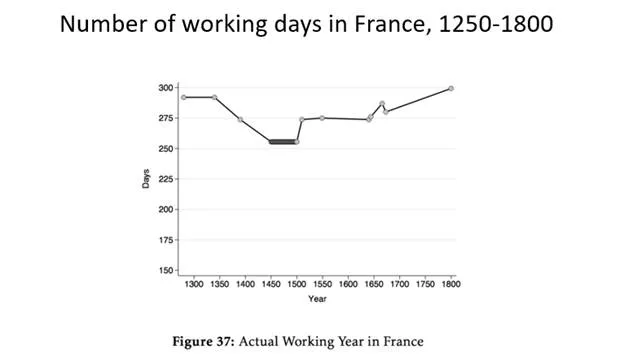
Peasants much preferred to work hard only during the sowing and harvesting seasons and to spend most of the year doing nothing or participating in numerous village festivities, than to be driven into, and huddled in, the “satanic mills”. But they were forced there through enclosures, creation of poorhouses (which served the same function as Gulag would serve two centuries later), and were thus virtually chased off the land, and even branded on the forehead if they refused to work and preferred vagrancy. But that made the Industrial Revolution possible, and capitalism the dominant system worldwide.
For competition is not only between different countries but also between different systems. Taking Krugman and Piketty’s idea further, one could argue that socialism was an extremely pleasant system because people never worked effectively more than two or three hours per day (“we pretend to work, and they pretend to pay us”). Foreign visitors could see shortages, but they could not see the pleasure provided by non-work. A doctoral dissertation contrasting work in a Serbian-operated FIAT factory in the 1970s with an almost identical factory in Turin, finds that workers in socialism worked less than half of the time compared to the Italians. Since total production of the Serbian plant was about a half of the Italian, one can rapidly deduce that Serbian productivity per hour was about the same and that socialist workers had more free time than their capitalist counterparts and hence must have led a much more pleasant life. But this would be a wrong conclusion. Capitalism handily defeated socialism, and the main reason for its victory was precisely that it produced more goods and that people preferred to feel materially richer compared to not working hard.
So working hard vs. not working hard wins at the individual level, nation-state level, and civilizational (or mode-of-production) level; the latter by making systems (say, today’s Chinese state capitalism) dominating others politically and militarily.
What would Keynes say? Let’s go further. What would Keynes say in this debate. In fact, he joined it. In a 1930 lecture he delivered in Madrid, “Economic possibilities for our grandchildren”, he precisely envisaged the world that may be similar to that of today’s Europe where people would enjoy relative abundance, sufficient to “satisfy the Old Adam in most of us” and would work fifteen hours a week, spending the rest in other, cultural and social activities. But was Keynes right? Probably not: he severely misdiagnosed the nature of capitalism. It is a system that (as Schumpeter observed) cannot be stationary. Capitalists will not invest unless they expect a net positive return (on average). If there is a positive return, some of that money will be reinvested, making the rate of growth of the economy positive. To keep that growth on, capitalists must permanently produce new wants. They cannot just stop. Were capitalism to stop producing new goods, and were the wants of people suddenly to be satiated, capitalism would come to an end. If everybody is happy with what they have, how are capitalists to make more money? What Keynes overlooked is that capitalism can never become a satiated society of abundance. They key word is “satiated”. It can create a world of many products and services, of huge abundance, but it cannot allow that that abundance makes people “satiated”, for otherwise the system will end.
Perhaps that Keynes wished to see the end of capitalism? It is a possibility too. But if he had in mind the continuation of capitalism, his advice, or hope, of working 15 hours a week, was incompatible with the key features of the system.
What would Marx say? Was he in favor of working or not working hard? Marx’s view was (obviously) quite sophisticated. He thought that human freedom begins only when the drudgery of hired labor and division of labor end. Hired labor could never be the work desired by any free individual. Workers under capitalism rent out their labor power and forego any agency in a process where they are simple cogs. Thus the objective of any hired laborer (that is, the objective of any worker under capitalist conditions) is to work less. As Marx writes: “The worker therefore only feels himself outside his work, and in his work feels outside himself. He feels at home when he is not working, and when he is working he does not feel at home” (Economic and Philosophic Manuscripts of 1844).
What will happen under socialism? Will it be a system of total abundance, without hired labor, where “associated producers” will exert control over their own work, alienation disappear, and leisure become common? Not really. And that’s where Marx parts ways with those who believe that the ultimate objective of human existence is freedom from work. Marx believed that work is eminently a human need. It is under the systems of coercive labor (slavery and capitalism) that that need becomes vitiated because people are forced to work at tasks over which they have no input or agency, and which they therefore hate. But the individual is a homo faber. To express themselves, people need to work. In the realm of freedom it is our work that defines us and makes us human. It is not us sunning ourselves on the beach or going to soccer games. It is, as Marx writes, world such that “[while] each can become accomplished in any branch he wishes, society… makes it possible for me to do one thing today and another tomorrow, to hunt in the morning, fish in the afternoon, rear cattle in the evening, criticise after dinner…without ever becoming hunter, fisherman, herdsman or critic.” (The German ideology “) It is work in freedom which is our ultimate objective. As long as there is a system whose core feature is competition between individuals, nations and indeed systems, people and nations that work hard will dominate people and nations that do not work hard. It is an illusion to believe that opting out of competition is feasible if we want to maintain our position in that world.



Be the first to comment