
For years we have heard from mainstream media about the imminent collapse of the Russian economy, Instead we are witnessing the collapse of the Ukrainian economy
Ian Proud was a member of His Britannic Majesty’s Diplomatic Service from 1999 to 2023. He served as the Economic Counsellor at the British Embassy in Moscow from July 2014 to February 2019. He recently published his memoir, “A Misfit in Moscow: How British diplomacy in Russia failed, 2014-2019,” and is a Non-Resident Fellow at the Quincy Institute.
Cross-posted from Ian’s Substack “The Peacemonger”
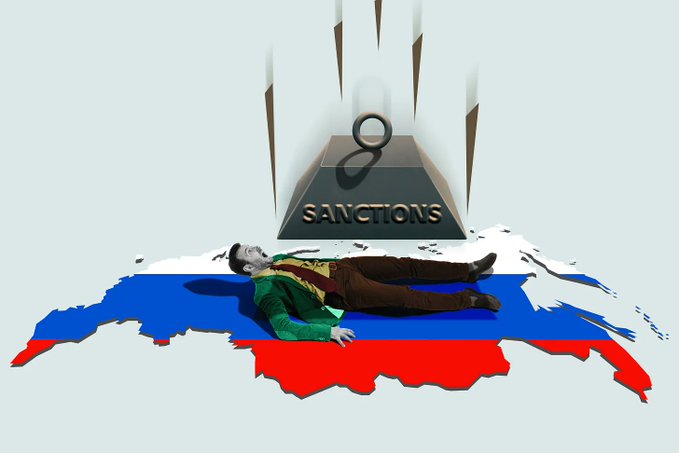
I’ve been hearing since 2014 about the imminent implosion of Russia’s economy, but this has never looked likely to happen.
In a remarkable recent article in the UK’s Telegraph newspaper, Ambrose Evans-Pritchard makes the remarkable claim that the ‘balance of advantage is shifting in favour of Ukraine,’ on the basis that Russia may soon go into economic meltdown. He goes on to say that if we walk away now, we will snatch defeat from the jaws of victory.’
However, and conveniently, he does not elucidate how Ukraine is gaining the supposed upper-hand, nor how an implausible victory over Russia might be achieved. That is because there is no evidence to support his claims.
Evans-Pritchard’s CV doesn’t show any obvious subject matter expertise on Russia. But this should come as no surprise from a newspaper – the Telegraph – whose Ukraine watcher team is stuffed with Russophobes and ex-British military types who have a vested interested in maintaining the delusion of eventual Russian defeat.
Take Dom Nicholls, who co-hosts the telegraph’s Ukraine: the Latest podcast, which grandly describes itself as the ‘world’s most trusted and award winning podcast on the war,’ even though Nicholls’ CV suggests absolutely zero subject matter expertise on the issue of Russia. His podcast never departs from the UK government line that Putin must be defeated eventually, and that only more pressure will do the trick. Nor does he allow the podcast to drift too far into real evidence about the ability of Russia to fight on longer than Ukraine can fight on.
Then take Hamish De-Bretton Gordon, retired Colonel and Chemical weapons expert with even less expertise than Dom Nicholls, who, in any case, has no Russia expertise. He regularly posts fantastical articles with titles such as ‘Putin is eating his own supporters,’ and ‘Putin will be quaking in his boots today.’
It doesn’t matter that they have no understanding of the strategic balance of power in the Ukraine war. Facts and analysis are entirely redundant for people whose top, indeed, only priority is to peddle the latest lines from the Ministry of Defence on Whitehall. This is not journalism it is government propaganda. The BBC, which in any case is a state-owned broadcaster, is bad enough in its one-sided reporting, but the Telegraph is more sinister because of its infiltration by pseudo-government operatives covering as experts.
Characteristic of most western media commentary of the in Ukraine and, indeed, of the Ukraine crisis since it started, has been the complete lack of comparison.
Focus is always and only on the negative impacts of conflict on Russia itself. And, indeed, there have been negative consequences. Russia is subject to over 20,000 economic sanctions, locked out of most trade with the west, excluded from political dialogue as an article of diplomacy, cut off from most international sports and cultural events, hundreds of thousands of its troops killed or injured since the war started, its regular citizens increasingly restricted in their movements within Europe.
The economy of Russia today looks vastly different from that in 2014 when the crisis started. As President Putin recently pointed out, economic growth is sagging from its early war highs which were stimulated by a massive fiscal splurge. Interest rates and inflation remain worryingly high, labour shortages in some industries are growing, the population continues to age, and it remains over-reliant on fossil fuel exports.
Some of these issues are long-standing, while others have become more acute since the war began. Yet, these manifest limitations are never juxtaposed against the even greater challenges that Ukraine faces, which you will seldom hear mention of in the Telegraph.
The weight of western foreign policy, bolstered by willing pro-war reporters in the media, is that breaking Russia’s petroeconomic model will force Putin to back down, and that sanctions are helping to do just that.
So, let’s take a look at Ambrose-Pritchard’s key argument that Russia’s oil exports are collapsing on the back of Trump’s recent sanctioning of Rosneft and Lukoil. This might be persuasive if true and if Ukraine’s exports were somehow performing much better.
Yet, the early evidence suggests otherwise. US sanctions on Rosneft and Lukoil do appear dramatically to have reduced their volumes of trade. However, there is also evidence, that trade has simply been diverted to other Russian exporters of oil, with no significant net effect. Diversion, which has been widely reported by the media, is and has been a Russian tactic to minimise sanctions impact for over a decade, after all.
Bear in mind that Russian oil has been sanctioned in one way or another by the EU since 2014, and that there has been a progressive shutting down of gas exports since the war in Ukraine started. You would therefore expect that the total value of Russia’s exports had fallen.
Except that it hasn’t.
Since 2014, the average quarterly value of Russian exports has been a fraction above $100 bn. This takes account of the huge surge in export values shortly before the war started and throughout 2022 on the back of soaring oil prices. In the four quarters from Q4 2021 to Q3 2022, Russian exports averaged $150 bn (or $50 bn per month), 50% higher than the long-term average. But on the flip side, it also averages out against troughs, in particular after the oil price collapse of 2016 and during COVID.
In the first two quarters of 2025, Russian exports have come in at $98 bn, $2bn below the long-term average, although, in fact, identical to the two-year period from Q4 2019 through Q3 2021. So, no golden bullet evidence here of sanctions having a more than marginal impact at best, given Russia’s export pivot towards Asia and the global south.
In any case, the value of exports is a less helpful reference than the overall trade balance, i.e. the difference between exports and imports. It doesn’t matter how big a country’s exports are if they are importing more.
Let’s take a historical look back to the start of the Ukraine crisis in 2014. Russia’s quarterly current account surplus – its balance of exports over imports – has averagfed $17.9 bn. Right now it is lower, at $11 bn with oil prices falling and imports higher than average. In 2022, Russia pulled in its highest ever current account surplus, with a quarterly average of $59.5 bn, when oil prices were soaring.
However, the key point is that Russia is able to stay in surplus every year and hasn’t experienced a full-year current account deficit since 1997, and even then it was less than $1 bn.
Consistently exporting more than it imports, Russia has built its international reserves over time, giving it resilience against external economic shocks and pressure. Russia’s international reserves have steadily grown from around $400 bn in late 2014, to $725 bn now. Even if western powers expropriated all of the approximately $300 bn in immobilised assets, Russia would still possess more than it had in 2014, the year the Ukraine crisis started.
In a quite bizarre comment, Evans-Pritchard says ‘Putin can keep selling Russia’s reserves of gold, all the way down to the Tsarist double eagles at the bottom of the vault beneath Neglinnaya Street,’ (the location of Russia’s Central Bank). This hints strongly, that Russia is on the verge of running out of gold, right?
And yet, Russia’s reserve stock of monetary gold has grown from $132 bn when the war started in 2022, to $299 bn today, which includes an increase of $17bn in October 2025.
I don’t say this out of any desire to prove Russia to be right, but rather from a determination to let our analysis of the situation to be driven by data, not vacuous sound bites.
The ridiculous announcements in the Daily Telegraph lack credibility precisely because they consciously and intentionally avoid hard evidence about Russia while avoiding all mention of Ukraine’s difficulties. Readers are invited to believe that Ukraine is doing just fine, and that if we just keep pumping money in, they will eventually win.
So, let’s look at Ukraine in comparison. Since 2014 through 2024, it has consistently imported more than it exports, with an average yearly trade deficit of $13.1 bn. During the first three full years of war, that rose on average to $25.6 bn, and in the first ten months of 2025, it is already at $39.8 bn. Expressed another way, Ukraine exported $24 bn less in 2024 than it did in 2021 and imported $2.5 bn more. War and European restrictions on the import of cheap Ukrainian agriculture have hit the value of its exports hard. That might bounce back when the war ends, even though Evans-Pritchard wants it to continue.
But, even so, Ukraine’s current account has shown an average deficit of $2.8 bn since 2014; the figure is so much lower than the trade balance because of big inflows of foreign donations, in particular in 2015 and in 2022, which led to a current account surplus in those years. Critically, while Ukraine had a current account surplus of $8bn in 2022, it slumped back into deficit in 2023, with a shortfall of $9.6 bn which rose to $15.1 bn in 2024. In the first 10 months of 2025, the deficit already stands at $26.9 bn.
That means Ukraine will need at least $30 bn in foreign exchange this year just to keep its currency afloat. The only credible way right now in which Ukraine can easily fill the hole in its international reserves is to receive donations from western nations. And as we are starting to see, in respect of Europe’s faltering efforts to agree a bizarrely named ‘reparations loan’, that is proving increasingly difficult because of Belgian and European Central Bank resistance.
So, War hungry pundits in the Telegraph talk about the imminent collapse of the Russian economy are only deflecting attention from the real problem. When the western money stops flooding into Ukraine, the country may quickly find itself having to devalue its currency and, in so doing, deal with spiralling inflation, high interest rates and a sovereign default.
Of course, Ukraine is already bankrupt, as it refuses to make payments on its existing debt while nonetheless asking for more loans. Western IFIs have conveniently turned a blind eye to this right back to 2015 when Ukraine defaulted on a loan it had received from Russia. They’ve done this under pressure from western governments who also, no doubt, drive outlandish Telegraph headlines about Russia’s imminent implosion.
The sad truth is, people like Evans-Pritchard need the war to continue so they have something to say. They certainly couldn’t care a jot about Ukraine itself.


Be the first to comment