
A balanced report from the launch of new left-wing party in the UK at the weekend, which was racked by divisions between its leading figures.
Imran Mulla is Middle East Eye’s UK political correspondent, covering both British foreign policy and domestic politics. He has written for BBC Hindi, Conservative Home, The Critic and Varsity among other publications. His first book, The Indian Caliphate: Exiled Ottomans and the Billionaire Prince, will be published by Hurst in 2025.
Cross-posted from Middle East Eye
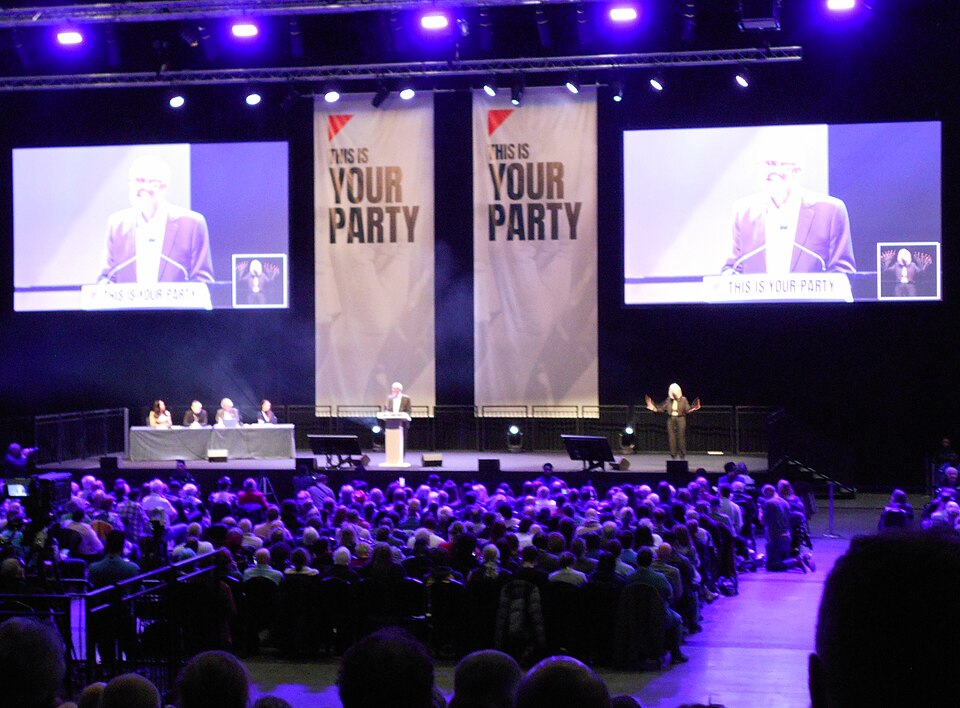
As thousands streamed into Liverpool’s Exhibition Centre this weekend, Zarah Sultana chose to stand outside in the biting wind and cold.
The Your Party founding conference had already begun and Jeremy Corbyn was giving his opening speech.
But Sultana, supposedly co-leading the founding process with him, appeared instead as a Trotsky-esque leader in exile. Fittingly, she was dressed in a bright red suit.
It began raining and I suggested that we stand closer to the conference building, where there was some shade, but the 32-year-old continued talking.
She told me she was confident the UK‘s newest political party could still pull through.
“The second that we are able to go out into our communities, knock on doors and organise,” she said, “we will see shifts in the polling because obviously that is our job to move the polls, not just accept them as they are.
“And I believe that we have a world to win, and this party will be the start of the anger.”
But shortly afterwards she announced that she was boycotting the conference until her scheduled speech the next day, in solidarity with members of the Socialist Workers Party (SWP) – who were refused entry because Your Party rules dictate you can’t be a member of both parties at once.
Sultana calmly walked away as a group of journalists ran after her.
“She’s very welcome inside the conference and she’s speaking tomorrow,” a party spokesperson said shortly afterwards.
Inside the mercifully warm conference venue Corbyn – whose team seemed to be running the show – struck a hopeful tone.
When I interviewed him over the summer, the party, not yet existent, was polling above ten percent and hundreds of thousands of people signed up. Corbyn had told me he was confident the party would transform British politics and be “a lot of fun”.
But since then the party has been wracked by bitter factional disputes.
Two of the party’s MPs, Adnan Hussain and Iqbal Mohamed, left in the two weeks leading up to the conference.
Corbyn told me he had received “very nice messages” from both of them that morning, “wishing us well, wishing the conference well and wanting to work together in the future.”
He is understood to be on far better terms with the two MPs who have left than with Sultana herself. “We offer something democratic and exclusive,” he told me, explaining why he thinks it is vital the party succeeds.
“A lot of people in this country feel completely ignored by the major political parties.”
High enthusiasm
The conference itself was a classically left-wing affair.
There were about 3,000 attendees out of a 55,000-strong membership. By contrast, this year’s Labour Party conference was slick and professional but lacked energy; Reform’s was flashy and bombastic; the Liberal Democrat conference felt like a garden centre; and the Green conference was full of old friends hugging each other and singing leader Zack Polanski’s praises.
Your Party was different. The inside of the venue was drab and decorations were minimal. Stalls in the main hall were devoted to Palestine solidarity, anti-racist groups and the Campaign for Nuclear Disarmament.
This conference ran almost solely on the enormous energy of attendees.
The party faithful moved excitedly in droves through the venue. They were more diverse than at perhaps any other party: elderly activists in overcoats and kefiyyehs, young women in woolly jumpers and keffiyehs, bearded Pakistani men in blazers and women in hijabs.
They were centre-left liberals, democratic socialists, anarchists, communists, anarcho-communists and Trotskyites. You couldn’t walk for ten seconds without being handed a political pamphlet.
This extraordinary coalition had amassed largely because of the Israeli genocide in Gaza and perceived British complicity in it, which provoked a storm of outrage against Labour at the 2024 general election and contributed to the unprecedented election of five independent MPs who overcame local Labour machines.
Since then the number of independent councillors has exploded and a party has formed around the MPs – the Independent Alliance – and Sultana, who left Labour in July.
All the independents campaigned on a general anti-establishment platform and have since collaborated in parliament on key domestic issues, like opposing Labour’s two-child benefit cap.
But following the departure of the two MPs, the mood began to change.
Most of the Your Party members I spoke to were furious at the infighting, which they said risked destroying what they saw as the last chance to build a movement that could stand up to Nigel Farage’s anti-immigrant Reform UK which is topping the polls.
The party faithful I spoke to at the conference had differing views on how the party should be run.
Some were diehard Corbyn fans; others were Team Zarah. But they all agreed on one thing: the stakes were too high for the party to fail. It had to get its act together.
“As a child,” one elderly lady told me, “I was very poor. I was homeless, and the only reason that I managed was that we managed to get a council house, and we managed to survive and thrive and went to university.
“I joined the Labour Party when I was 16. I left last year when I was 71 because the Labour Party is no longer the party for ordinary working class people.
“We have to build a healthy party. It’s not about individuals, it’s about policies to help the poor and the oppressed. It’s about international politics to support Palestinians against atrocities in Gaza.”
A democratic founding
And this conference, it was clear, would determine the party’s identity. Members would vote firstly on what to name it – For The Many? Slightly clunky. Our Party? Likely to regularly confuse television audiences. The Popular Alliance? Maybe a premature claim.
In the end members settled on keeping the name Your Party. At least this means the conference banners can be reused in future.
But the most important vote was on whether to elect a single leader – Corbyn had publicly backed this option – or to have a collective leadership of the members, Sultana’s favoured option.
No one I spoke to really understood what the second option would look like, but many argued it was the most democratic.
An older idea to have Sultana and Corbyn serve as co-leaders was dead – everyone knew the two weren’t even on speaking terms.
Often the mood of the conference was excited. The members were enthused. They called each other comrade and booed in unison at every mention of Keir Starmer.
They chanted “Free Palestine” during Corbyn’s opening speech and cried “shame” when Reform came up.
But infighting kept breaking out.
This started at an event the night before, which saw Corbyn reciting Mahmoud Darwish and talking about the power of poetry. At the start a man was ejected for unclear reasons. “I’m being evicted!” he yelled.
“Let him stay!” someone else shouted.
“Sabotage! MI5!” thundered Len McKluskey, the former general secretary of Unite and ally of Corbyn, who was on stage. Next to him Corbyn sipped water and waited for the commotion to subside.
Similar rancour continued during the debates on various party issues on Saturday.
“You are all very welcome to participate in comradely debate,” the members were told, but when it was clarified that they would have to queue up to speak and could not simply shout from the floor, numerous members began shouting from the floor in protest.
A debate began on whether to allow dual membership, pertinent for the expelled Socialist Workers Party members. Multiple people spoke in favour of allowing dual membership, and the chair struggled to find someone to represent the opposite side.
When a member was finally selected to speak against allowing dual membership, he immediately confessed to the crowd that not only did he actually support dual membership but that “I am myself a member of the Socialist Workers Party”.
The trans debate
One major issue that kept rearing its head was trans rights, which had caused a battle between Sultana and Hussain, who left the party earlier this month, saying it was intolerant.
In September Hussain had said that “women’s rights and safe spaces should not be encroached upon” and that “safe third spaces should be an alternative option”.
He added that trans women are “not biologically women, hence trans women”, echoing the Supreme Court’s ruling earlier this year.
Sultana responded by suggesting Hussain had no place in the party, declaring: “There is no room for socially conservative views in a left-wing socialist party. Period.”
I asked Sultana whether she still stands by that uncompromising position.
She rowed back on it, telling me that “there are socially conservative people in all communities, in the trade union movement, in all parts of society, and we are seeking to reflect the whole country and seek their votes.
“So obviously, even our membership will reflect that broad base. I don’t deny that. I think it’s important to highlight that as a socialist party, we have to centre the most marginalised.”
She continued: “We see a ruling class that divides our communities. It divides Muslims against trans people, against disabled people, against refugees and against migrants.
“We have to show that solidarity is how we fight back, and we have to build coalitions and work together. And if there are people that do not recognise that, then I think that’s an important thing to call out.”
Sultana was arguing that social conservative views on issues like trans rights could be used as a ruling class attempt to divide marginalised people.
But she also clarified: “We are here to build an inclusive party. And of course, my analysis is not where everyone else is in terms of building solidarity and building coalitions.
“But it’s important that this party allows people to feel included, to feel represented, and that they have to centre the most marginalised in terms of fighting against the powers that attack us.”
But is a progressive position on trans rights non-negotiable? “I think a progressive position on trans rights that recognises that trans rights are human rights is the socialist position for a socialist party,” Sultana said.
When I asked Corbyn about the dispute, he said he had “no worries” about a potential wedge between some Muslims and sections of the left: “We’ve got to recognise what the scourge is of racism in our society, what the scourge is of Islamophobia and, above all, recognise the diversity of our society is not a problem, not a negative.
“It’s a plus,” he added. “And let’s be happy for that. And so I spend a lot of time with all of our communities trying to bring people together, recognising diversity as a strength, not a weakness.”
Teething issues
In a debate on Saturday afternoon a member, Eryn Browning, stood up to denounce Hussain and Mohamed as transphobic. Hussain firmly denied this on social media and pointed out that Browning had previously been expelled from the Scottish Green Party over accusations of sexual misconduct.
Later that day I asked Shockat Adam, MP for Leicester South, whether he regretted how the party had turned out.
“Has it been the most perfect start? No,” he said. “But tell me any party or any organisation that has been formed without some kind of bumps on the road.
“Let’s look at the history of the Labour Party. Any political party is going to have issues at its birth.”
He added that “sometimes definite differences is a real sign of political maturity. We need to come together on the major points. The country needs us.”
And on the party being a broad church, he advocated “fundamental principles that we do not be prejudicial against anybody, we do not discriminate [against] anybody, and we respect everybody’s opinion, whether that opinion is socially conservative or socially un-conservative.”
Adam has no plans to leave the party. “If we are part of a larger system, if we are part of a political system, those changes are a lot more achievable than an individual.
“Not to say that being an independent still can’t be part of that change. But to make wholesale changes, to be part of a political system, a political party will be much, much more achievable.”
The issue of trans rights also triggered debate at a fringe event in Liverpool’s Hilton hotel on Saturday evening hosted by the Your Party Muslim Network and attended by Sultana and the other two remaining Muslim MPs, Adam and Ayoub Khan.
“This is about bringing Muslims who are not engaged with the political process into Your Party,” the chair, Khalid Sadur, said, explaining the network’s purpose.
“This isn’t about supporting one faction or another, it’s about the members.” Sultana applauded loudly and the rest of the crowd followed.
During Sultana’s address, in which she said the party should welcome everyone, she was interrupted by a 5 Pillars journalist, Robert Carter, who asked “what about socially conservative types?”
The event looked like it was descending into chaos. Two volunteers marched to the front, where Carter was sat. Others stood up and shouted that he was misogynistic, which prompted further disagreement. Eventually everyone settled down.
The debate over social conservatism, clearly, is just as live an issue among Muslims as it is in the party in general.
Ammar Waraich, a speaker at the event, told me separately he thought Your Party could succeed “in areas where, for some reason, the Green Party doesn’t have good penetration”.
MPs Adam and Khan have regularly been misrepresented and smeared in the mainstream press as single-issue pro-Gaza MPs, although in reality they have campaigned in parliament on a wide range of topics.
Often I got the sense speaking to members that some of them also believed the mainstream image of the MPs.
But their speeches to the membership on Sunday surely put this misperception to rest. Adam drew enthusiastic applause with his calls for economic justice and wealth redistribution.
He launched a ferocious attack on Tory leader Kemi Badenoch, who labelled the independents sectarian and alien. Tory policies are alien to Britain, he declared to enormous applause.
“I am proud to be a British Muslim and I see no contradiction between the two,” he declared.
“We are proud contributors to the country… we are not a homogenous group of people.”
Implicitly addressing the debate over social conservatism, Adam put the case for a liberal, live-and-let-live pluralism to the crowd.
He urged “mutual respect, non-discrimination and tolerance of people of all beliefs”, to scattered applause.
The clock is ticking, Adam insisted. Reform and the far threat threatens Britain.
There is no choice, he argued, but for people who may disagree on some issues to come together to confront that threat.
A broad-church party
The vision of a broad-church party focused on appealing to as many people as possible and drawing the previously disengaged into politics, favoured by Corbyn, Adam and Khan, faced off against Sultana’s vision.
Her approach eschews compromising on moral principles and focuses on empowering existing left-wing movements. Less compromise, more unabashed radicalism.
And it was this vision which decisively won on the conference’s second day.
In a first blow to Corbyn, members voted in favour of allowing dual membership, which means small left-wing parties like the SWP will likely form effective blocs within the party.
And in a second, decisive blow, members voted – by a tiny margin – for collective leadership and not a single elected leader, which had been Corbyn’s preferred option.
Now the party will have no figurehead. The exact structure that will emerge remains to be seen but this vote ensures there will be no Polanski effect – his election as Green leader over the summer has given the party enormous support and a decisive identity.
Conflict and factionalism could be constant.
Significantly, on both major issues central to determining the shape of Your Party – dual membership and leadership structure – members backed Sultana’s and not Corbyn’s vision.
To be sure, only a minority of members actually voted. But this will likely always be the case, and this active section of the membership is sure to define the party.
On Sunday afternoon Sultana marched onto the main stage and was given a hero’s welcome, like a leader returned from exile, by the members.
Corbyn sat at the desk beside her podium as Sultana basked in a standing ovation.
Then she started to speak. She made a perfunctory gesture of respect towards Corbyn and accurately described Your Party as “the largest socialist party in the UK since the 1940s”.
Then she got down to business. This was a victory speech. “Some would say that the decision to adopt the collective leadership model is a win for me,” she said. “It is not, it is a win for you.”
She launched into an attack on “the expulsions, the bans”. Corbyn was visibly disgruntled as Sultana described the move to expel SWP members as an “attack on members and this movement”.
Stingingly she said “these actions come straight out of the Labour right’s handbook”.
She continued: “The members will not stand for this. The movement will not stand for this. And I will not stand for this.” The crowd roared their approval.
Sultana condemned the “rentiers” in Britain who are “parasites”.
She called for Starmer and other Labour ministers to be sent to The Hague over what she called their complicity in Israel’s genocide.
She declared that “I am an anti-Zionist and if we fight for it, this will be an anti-Zionist party.” Corbyn has declined to describe himself as anti-Zionist. The members gave Sultana a standing ovation.
‘Oh, Zarah Sultana’
Corbyn’s speech on Saturday had drawn an enthusiastic response but now the atmosphere was positively electric.
The crowd hung onto Sultana’s every word. She spoke loudly and proudly; her cadence was almost musical.
She declared that “refugees are welcome here and trans rights are human rights” to thunderous applause.
She denounced “Andrew Mountbatten Windsor” in a segment on the awfulness of the monarchy. “Who’s he?” asked a young man near me – who clearly hadn’t followed Prince Andrew having his title stripped from him.
The republicanism was followed by a call to “replace capitalism with socialism”. The crowd went wild. Even Corbyn clapped for a few seconds.
Privately a key figure in the party’s founding process told me afterwards they worried such rhetoric would play well among members, but not in all of the communities in which Your Party might aim for electoral success.
MPs like Adam and Khan performed electoral miracles by overturning entrenched Labour majorities in their constituencies, which were diverse and largely working class.
They achieved this with their own locally specific approach, and political positions that might often be seen by the average Your Party member as heterodox and even unacceptable.
The lack of a clear identity could allow both for Sultana’s radical politics and other, locally specific, visions to coexist and complement each other.
But much of the membership seems increasingly at odds with MPs like Adam and Khan – and indeed Corbyn.
In the old days, when Corbyn was leader of the Labour Party, the classic chant was “Oh, Jeremy Corbyn”. It sounded everywhere, from the conference hall to protests to Glastonbury.
On Sunday a new chant went up: “Oh, Zarah Sultana”. She finished her speech to a final, extended standing ovation. Corbyn stood up too and applauded, then quickly walked off stage.
She followed a few paces behind him as the crowd continued to chant her name. Corbyn turned right and disappeared behind a black curtain. Sultana turned left and sat among the members.


Be the first to comment