
Binary thinking in the argument over whether the US or Israel is driving the illegal war on Iran obscures far more than it illuminates. The truth is the dog and the tail are wagging each other
Jonathan Cook is the author of three books on the Israeli-Palestinian conflict, and a winner of the Martha Gellhorn Special Prize for Journalism. His website and blog can be found at www.jonathan-cook.net

The joint US-Israeli war on Iran has thrust back into the spotlight a divisive debate about whether the dog wags the tail, or the tail wags the dog. Who is in charge of this war: Israel or the United States?
One side believes Israel lured Trump into a trap from which he cannot extricate himself. The tail is wagging the dog.
The other believes that the US, as the world’s sole military super-power, is the one that writes the geo-strategic script. If Israel acts, it is only because it serves Washington’s interests as well. The dog is wagging the tail.
Certainly, the idea that the tail, the client state of Israel, could be wagging the dog, the military juggernaut that is the US, seems, at best, counter-intuitive.
But then again, there is plenty of evidence that suggests advocates for the tail wagging the dog scenario may have a case.
They can point to the fact that Trump launched this war of choice on Iran despite winning the presidency on an “America First” platform in which he promised: “I’m not going to start a war. I’m going to stop wars.”
His secretary of state, Marco Rubio, openly stated that the administration was rushed into war, finding itself apparently unable to restrain Israel from attacking Iran.
Jonathan Kent, Trump’s top counter-terrorism official, noted in his resignation letter that the administration “started this war due to pressure from Israel and its powerful American lobby”.
Addressing the Israeli parliament last October, Trump appeared to confess to being under the thumb of the Israel lobby. As he praised himself for moving the US embassy from Tel Aviv to the illegally occupied city of Jerusalem, he repeatedly pointed to his most influential donor, the Israeli-American billionaire Miriam Adelson, before observing: “I actually asked her once, I said, ‘So, Miriam, I know you love Israel. What do you love more, the United States or Israel?’ She refused to answer. That means, that might mean, Israel, I must say.”
A video from 2001 shows Israeli prime minister Benjamin Netanyahu, caught secretly on camera, telling a group of settlers: “I know what America is. America is a thing you can move very easily, move it in the right direction. They won’t get in the way.”
Former US President Barack Obama, who ran up against Netanyahu repeatedly as Obama tried and failed to limit the expansion of Israel’s illegal settlements, thought the same. In his 2020 autobiography, he wrote that the Israel lobby insisted that “there should be ‘no daylight’ between the US and Israeli governments, even when Israel took actions that were contrary to US policy.”
Any politician who disobeyed “risked being tagged as ‘anti-Israel’ (and possibly anti-Semitic) and confronted with a well-funded opponent in the next election”.
Messy arrangement
But any rigid, binary way of framing the relationship between the US and Israel obscures more than it illuminates.
I addressed this issue in my 2008 book on Israeli foreign policy, titled Israel and the Clash of Civilisations: Iran, Iraq and the Plan to Remake the Middle East. My conclusion then, as now, was that the relationship between Washington and Tel Aviv was better understood in different terms: as the dog and the tail wagging each other.
What does that mean?
Israel is Washington’s most favoured client state. It must, therefore, operate within the “security” parameters for the Middle East laid down by the US.
In fact, part of Israel’s job – the reason it is such an important client state – is because it has, until now, been able to enforce those parameters on others in the region.
But the story is more complicated than that.
At the same time, Israel seeks to maximise its ability to influence those parameters in its own interests, chiefly by shaping military, political and cultural discourse in the United States, through the many levers available to it.
Zionist lobbies, both Jewish and Christian, mobilise large numbers of ordinary people to support whatever Israel claims to be in both its and US interests.
Mega-donors like Adelson use their wealth to cajole and intimidate US politicians.
Think-tanks with murky funding write legislation on Israel’s behalf that US politicians wave through.
Legal organisations, again with opaque funding, weaponise the law to silence and bankrupt.
And media owners, all too often in Israel’s camp, mould the public mood to stigmatise as “antisemitism” anything that opposes Israeli excesses.
This makes for a very messy arrangement.
Disappearing Palestinians
The trouble with the idea that the US simply dictates to Israel – rather than that the two are constantly bargaining over what constitutes their shared interests – becomes apparent the moment we consider the two-and-a-half-year genocide in Gaza.
Israel has long had a fervent desire to disappear the Palestinians, whether through ethnic cleansing or genocide.
It wants the whole of historic Palestine, and the Palestinians are an obstacle to the realisation of that goal. Should the opportunity arise, Israel is also keen to secure a Greater Israel that requires grabbing and annexing substantial territory from neighbours, particularly Lebanon and Syria – as it is doing again right now.
After the Hamas attack on 7 October 2023, Israel seized on the chance to renew in earnest the ethnic cleansing of Palestinians it began in 1948, at the state’s founding.
It carpet-bombed Gaza, creating a “humanitarian crisis”, to force Egypt to open the floodgates into Sinai, where it hoped to drive the enclave’s population. Cairo refused. As a result, Israel tried to increase the pressure by slaughtering and starving the people of Gaza. In legal terms, that constituted genocide.
But the idea that the US was deeply invested in Israel carrying out a genocide in Gaza, or directed that genocide, or had any particular interest in the genocide taking place, is hard to sustain.
Washington – first under Biden, then under Trump – gave Israel cover to carry out the mass slaughter of the Palestinian population, and armed and financed the genocide. But that is very different from it having a geostrategic interest in the mass slaughter.
Rather, the US is and always has been largely indifferent as to the fate of the Palestinians, so long as they are contained. They can be locked up permanently in occupation prisons. Or ethnically cleansed to Sinai and Jordan. Or given a pretend statelet under a compliant dictator like Mahmoud Abbas. Or exterminated.
The US will bankroll whichever option Israel believes best serves its interests – so long as that “solution” can be sold by pro-Israel lobbies to western publics as a legitimate “response” to Palestinian “terrorism”.
What Israel could get away with changed on 7 October 2023. The US was prepared to approve Israel shifting from a policy of intermittently “mowing the lawn” in Gaza – short wrecking sprees – to the incremental levelling of the whole of Gaza.
In other words, Israel worked all its levers to persuade Washington that it was the right time for it to get away with genocide. It sold to the US the plan that Gaza could now be destroyed.
To present that as Washington’s plan is simply perverse. It was decisively Israel’s plan.
That doesn’t diminish in any way US responsibility for the genocide. It is fully complicit. It paid for the genocide. It armed the genocide. It must own it too.
Israeli attack dog
A similar analysis can be applied to the Iran war.
The US and Israel share the same larger policy towards Iran: they want it contained, weak, unable to exert influence. But they do so for slightly different reasons.
Israel demands to be regional hegemon in the Middle East, an invaluable client state with privileged access to Washington policymakers. Its supremacy and impunity, therefore, depend on Iran – its only plausible rival in the region – being as weak as possible and incapable of forging effective alliances with armed resistance groups such as Hizbullah in Lebanon.
Equally, Washington wants Israel unthreatened, leaving its ally free to project US imperial power into the Middle East.
But it has a more complex set of interests to consider. It needs to ensure that the Arab monarchies remain compliant, and it does so by both wielding a stick – threatening to unleash the attack dog of Israel on them should they disobey – and proffering a carrot – promising to shield them under its security umbrella against Iran so long as they stay loyal.
The ultimate goal is to guarantee unchallenged US control over the flow of oil and thereby the global economy.
In other words, the US has to weigh far more interests in how it deals with Iran than Israel does.
Unlike Israel, Washington has to consider the effects of an attack on Iran on the global economy, to assess any impact on the dollar as the world’s reserve currency, and protect against rival powers like China and Russia exploiting strategic missteps.
For those reasons, Washington has traditionally preferred maintaining a degree of stability in the region. Instability is very bad for business, as is being demonstrated only too clearly right now.
Israel, by contrast, regards its struggle against Iran in existential terms. Many in the Israeli cabinet view it as a religious war. They are not interested in simply containing Iran – a decades-old policy they believe has failed. They want Iran and its allies on their knees, or at least in so much chaos that they cannot pose any kind of challenge to Israeli regional hegemony.
That point was highlighted by Jake Sullivan, Joe Biden’s former national security adviser, this week in an interview with John Stewart. He cited recent comments to him by Israel’s former military intelligence lead on Iran, Danny Cintrinowicz, that Netanyahu’s aim is to “just break Iran, cause chaos”. Why? “Because,” says Sullivan, “as far as they’re concerned, a broken Iran is less of a threat to Israel.”
In other words, Israel wants to engineer instability in Iran, which is sure to spread instability across the region.
Weaving mischief
Those two agendas, as should be clear by now, are not easily compatible. Which is why Netanyahu has spent decades working every lever at his disposal in Washington to create an appetite for war.
Had war been self-evidently in US interests, his efforts would have been superfluous.
Instead Israel has had to deploy its lobbies, marshal its donors and recruit sympathetic columnists to slowly shift the public mood to the point where a war was conceivable rather patently dangerous.
And most importantly of all, Israel nurtured an intimate, ideological alliance with the neocons – hawkish, zealously pro-Israel US officials – who long ago gained a foothold in the inner sanctums of Washington.
Each recent administration has been a cat-fight over whether the neocons or more “moderate” voices would win out. Under George W Bush, the neocons dominated, leading to the invasion of Iraq in 2003, Israel’s short war on Lebanon in 2006, and a failed plan to expand the war to Syria and then Iran. I documented all of this in Israel and the Clash of Civilisations.
Under Obama, the neocons were forced to take more of a back seat, which is why his administration was able to sign a nuclear deal with Iran that held until Trump ripped it up in 2018, during his first term as president. Biden, as with so much else, dithered.
In Trump’s second term, the neocons seem to be firmly back in charge, again weaving their mischief. The result – an illegal war on Iran – is likely to be a strategic catastrophe for the US, and a potential, if short-lived, victory for Israel.
Secret power
So isn’t this the same as saying the tail wags the dog?
No, not least because that assumes the visible realm of US politics – the President, the Congress, the Senate, the two main political parties – are the sole repositories of power in the system.
Even in this visible sphere, support for Israel has dramatically waned since the Gaza genocide. As the illegal war on Iran grows ever more costly, both in treasure and lives, support for Israel among US voters is going to fall off a cliff.
Israel is for the first time a deeply partisan issue, dividing Democrats and Republicans, as well as a generational divide between the young and old. It is even splitting the MAGA base Trump depends on.
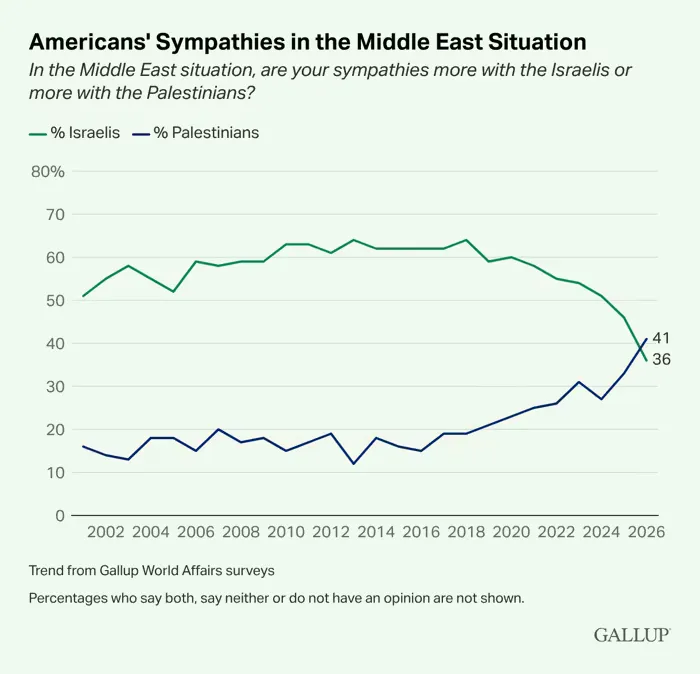
This political polarisation will continue to get much worse, ultimately freeing braver figures in US politics to start speaking out in franker terms about Israel’s nefarious role.
But power in the US isn’t just wielded at the formal, visible level. There is a permanent bureaucracy, with an institutional memory, that operates out of sight. We have gained brief glimpses of its covert operations from the work of Wikileaks, Julian Assange’s publishing platform for whistleblowers, and from Edward Snowden, the whistleblower who revealed illegal mass surveillance by the US state of its own citizens.
Both suffered serious consequences for their efforts to bring a little transparency to a profoundly corrupt system of secret power. Assange was locked away in a London high-security prison for many years as the US sought to extradite him on trumped-up “espionage” charges, while Snowden was forced into exile in Russia to evade arrest and long-term incarceration.
That bureaucracy – sometimes referred to as the Deep State, or the military-industrial complex – doesn’t play or fight fair. It doesn’t need to. It operates in the shadows.
Were it to so choose, it could undermine the Israel lobby, and thereby curtail Israel’s influence over the visible realm of US politics.
It could effectively do to the leaders of the lobby – AIPAC, the Anti-Defamation League, the Zionist Organisation of America, the Conference of Presidents of Major American Jewish Organisations, Christians United for Israel, and others – what it did to Assange and Snowden.
It could, for example, influence public discourse to begin questioning whether these groups are really serving US interests or acting as foreign agents. That would, in turn, free up space for the media and legislators to call for tighter restrictions on these groups’ activities, requiring them to register as such.
The permanent bureaucracy is doubtless capable of doing much darker, underhand things too.
The fact that it hasn’t chosen to do any of this yet suggests Israel’s goals are not seen so far to be significantly in conflict with US goals.
But that could be about to change. In fact, the current, all-too-public debates about Israel driving the US into a war against Iran – an idea already seeping into popular consciousness – may be the first salvoes in the battle to come.
If the war on Iran turns out to be a catastrophic misstep, as it gives every appearance of being, there will be a price to pay – and leading US politicians are likely to scramble to shift the blame on to Israel. It may be that they are already getting in their excuses.
The all-too-visible freedom Israel has enjoyed in Washington to buy, bully and silence could soon become a central liability. It will not be hard to argue that a system so clearly open to manipulation that the US could be bounced into a self-sabotaging war needs to be remade, to prevent any repeat of such a disaster.
This may be the biggest lesson Washington learns from the war on Iran. That it is time to stop the tail wagging so vigorously.
Although my posts are freely accessible, they are reader-supported. If you liked this one or any of the others, please consider sharing it with friends and making a donation to support my work. You can do so by becoming a paid Substack subscriber, via Paypal or my bank account, or alternatively setting up a monthly direct debit mandate with GoCardless. A complete archive of my writings is available on my website. I’m on Twitter and Facebook.

Be the first to comment