
There has never been a fascist taboo in post-Franco Spain as there has been in Germany, but the prevalence of fascist nostalgia and rhetoric used to be limited to a tiny fringe. Now it’s becoming mainstream again.
Katie Hudson is a PhD Candidate at the University of Edinburgh. Her research looks at imperial nationalism, specifically how empire has shaped national identity and foreign policy framing in the UK, Spain and the Netherlands.
Cross-posted from LSE EUROPP
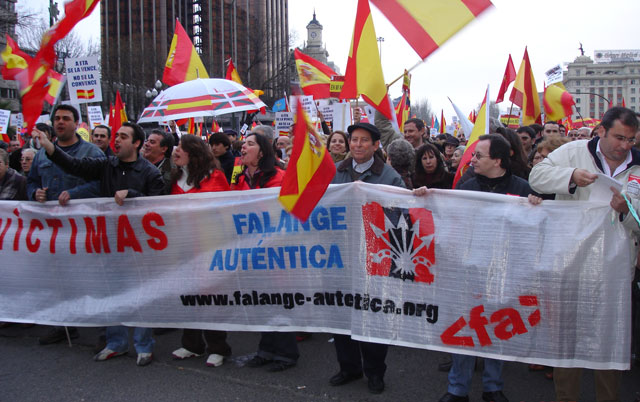
Every year in August, the city of Alicante, Spain, holds “Fiestas de las Urbanizaciones” (parties of the apartment complexes/neighbourhoods). At last year’s event, a plethora of nationalist rhetoric was apparent across the three short days of community celebrations.
Some of this rhetoric could be considered relatively banal, such as the flying of Spanish flags, the singing of “Viva España”, and orchestral renditions of “Moros y Cristianos”. Others, however, took on a more far-right flavour, offering a unique lens to understand how local political culture can become radicalised.
Chants of “Pedro Sánchez, hijo de puta” were heard in the late-night parties in complexes across the city. This is a phrase that has been used throughout Sánchez’s premiership, most recently to voice discontent regarding the ongoing corruption scandals plaguing Pedro Sánchez’s government.
Activities in one fiesta saw boys aged 12-15 form a sports team, labelling themselves the “Machirulos” (sexists), and proudly painting their flag with “España con Franco” (Spain with Franco, in reference to former dictator Francisco Franco). Posing for their team photo, they happily spelled out “FRANCO” with their arms.
This is not an isolated event. When speaking with residents, they recalled that in previous fiestas, children painted a flag depicting a small boat and a person of colour drowning, much to their own amusement.
Misogyny and Francoist nostalgia
Such actions provide but one snapshot of the political reality in Alicante today – a constituency with 12 congressional deputies, currently boasting a right-wing Partido Popular (PP) majority, and an overall right-wing majority of 7-5 deputies.
Beyond Alicante, it reflects a regional and national transformation in which the far-right party VOX soared in popularity at the last election, and the PP won a majority across all three constituencies in the Autonomous Community of Valencia.
In an illuminating interview after the release of Netflix’s Adolescence series, Spanish psychologist Jesus Moreno notes this exact phenomenon throughout Spain: the rise of misogyny and a Francoist nostalgia among Spanish male youth. This startling trend warrants attention, even if it is currently only present amongst specific subsets of young people across Spain.
Indeed, these local anecdotes are indicative of a national (and European) trend in which younger generations of Spaniards are more conservative than those before them. “Machirulos” reflects a growing opposition to feminism, with VOX labelling feminists as “feminazis”, and releasing a 2023 campaign poster in which the feminist and LGBTQIA+ flags were shown in a trashcan.
Such behaviour, however, cannot only be attributed to the political right. Since the summer of 2025, Sánchez’s Socialist Party has faced numerous allegations of sexual harassment, including claims involving senior party members.
At a press conference in December, party secretary Rebeca Torró apologised for the handling of the complaints and pushed back against claims of a cover-up. While the outcome of the accusations is still unclear, they have certainly undermined Sánchez’s 2018 claim of leading the “most feminist government in history”.
The normalisation of far-right narratives
Displays of Francoism are also not surprising. Survey data has shown that young Spanish men are increasingly sympathetic towards authoritarianism. VOX takes an openly favourable stance towards Franco’s legacy, which provides a convenient figurehead for a multifaceted narrative of stability, national unity and traditional values.
This is a strategic remembering of an idealised past in which imperial Spain was a builder of “western civilisation”. In April of last year, VOX deputy Sergio Rodríguez wished the Balearic Parliament a happy “Victory Day”, referencing the 1939 victory of the Nationalists in the Spanish Civil War.
In the case of the fiestas, the name “Machirulos” remained unchanged, and upon being questioned by his mother about holding a “viva Franco” poster, one boy cheekily responded that it read “viva Francia” (long live France). Indulgent laughter ensued – a moment in which the persistence of Francoist nostalgia converges with schoolboy humour.
The normalisation of such behaviour highlights the process in which narratives of the far right can be reproduced at the micro-level, even amongst the youngest demographic. Given the current political landscape, this may become increasingly significant in the coming months as Sánchez’s socialist government navigates consecutive corruption allegations and sexual misconduct scandals.


Be the first to comment