
China’s strategic patience remains consistent despite being confronted by the wildness of a Trump-led United States.
Wenjing Wang is a research intern with the East Asia Program at the Quincy Institute for Responsible Statecraft. Wenjing holds an M.A. in Asian Studies from Georgetown University and a B.A. in Economics from DePaul University.
Cross-posted from Responsible Statecraft
Entering 2026, as President Donald Trump draws global attention to Venezuela, Iran, and Greenland, Beijing has been oddly included in debates over these issues.
Commentators have argued that they could create potential friction between the United States and China over regional influence in Latin America, the Middle East, and the Arctic. However, Beijing so far has largely adopted the “wait and see” approach and has instead been busy with rallying efforts to ensure a good start to its 15th Five-Year Plan and continuing anti-corruption campaign, especially in the military. Over the last weekend, two more members of China’s Central Military Commission were put under investigation, including the senior-most general Zhang Youxia.
While China tends to act assertively in what it regards as core sovereignty and security issues, including Taiwan and the South China Sea, it has reasons to be more reserved on issues beyond Asia.
On the one hand, China’s reservation could be attributed to the simple fact that it has few benefits to gain from intervening, despite having signed strategic partnerships with countries like Venezuela and Iran. In the case of Venezuela, while some argue that China is the creditor and has economic interests, namely oil, in Venezuela, the China-Venezuela economic ties had already chilled before the U.S. capture of Nicolas Maduro. The partnership itself does not guarantee that China will take active actions to help Venezuela amid the crisis.
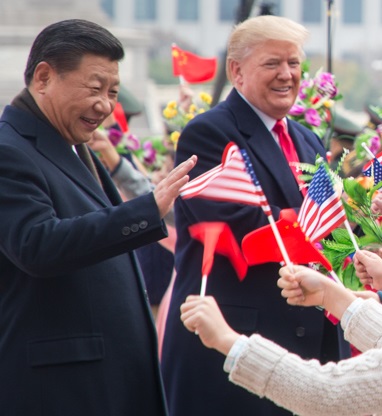
Moreover, given the one-year truce reached during the Trump-Xi Busan Summit last year, it is unlikely that China would take substantive actions to confront the United States on issues falling outside its bilateral agenda.
Rather than being entangled in contentious issues beyond Asia, China is more likely to prioritize addressing domestic economic challenges over anything else. Indeed, China seems to be a beneficiary of the strained relations between the United States and its traditional allies. Alongside a series of policies and measures to boost domestic consumption and strengthen self-reliance, Beijing hosted several foreign leaders and signed cooperation documents and memorandums with countries including South Korea and Canada. China and the EU also reached a breakthrough on EVs amid the Greenland crisis.
There are also self-imposed limitations on what China could do. Since the early years of the People’s Republic, Chinese foreign policies have adhered to the Five Principles of Peaceful Coexistence. If the principle of “mutual respect for sovereignty and territorial integrity” undergirds China’s claims over Taiwan and other disputed territories, then the principle of “mutual non-interference in internal affairs” enables China’s practical approach toward different types of regimes, but with great restraint.
While Trump could initiate a military operation in Caracas, urge the Iranians to keep protesting, and vow to purchase Greenland, under claims of national security and interests, China could not initiate similar strategies or tactics under the principle of non-interference. Rather, China would tailor its approach accordingly once unrest in countries like Venezuela and Iran has been resolved, prioritizing post-crisis engagement over direct involvement.
This approach explains China’s restraint in recent geopolitical tensions. China has condemned the U.S. for capturing Maduro and his wife, taken a cautious approach toward Iran, defended its activities in the Arctic, and stressed the advocacy of the U.N. Charter and international law, but nothing beyond low-cost rhetoric.
The principle of non-interference inevitably constrains the toolkits China could use under these circumstances. Critics might point to China’s increased use of economic coercion and propaganda infiltration, as seen in the continuously intensified Sino-Japanese relations. After Japanese Prime Minister Sanae Takaichi remarked that a Chinese attack on Taiwan could pose “an existential threat” to Japan last November, China launched a series of campaigns against Japan, including the ban on dual-use goods, travel warning, and the use of public opinion, psychological, and legal warfare.
However, these measures are mostly wielded in direct bilateral relations and issues that China regards as red lines, such as Taiwan. By contrast, China has been more cautious in wielding similar coercive tactics against unrest in third countries beyond its core interests, where such actions would more clearly violate its non-interference principle.
And, besides its economic strength and so-called grey zone tactics, China does not possess military parity with the United States, ruling out the option of military operations to police the world.
China neither wants to, nor can, take a greater responsibility for issues beyond its interests. However, if disruptions to the international order continue, China may face a major test of its restraint, and be tempted to expand its global influence through coercion and force amid heightened great power rivalry.
The latest series of Qiushi, the official theoretical journal of the Chinese Communist Party, published an analysis of the U.S. National Security Strategy(NSS), stating that the strategic adjustment in the NSS signals “the beginning of a long-term, protracted war of attrition.” China has to maintain strategic composure and resolve, it said.
Beijing is aware of the test it is facing. Rather than learning the lesson of “might makes right” from the United States, China is more likely to remain strategically restrained by claiming adherence to the Five Principles of Peaceful Coexistence and by adhering to the U.N. Charter and international law. The caveat, however, is that if the United States shifts its focus to Asia by becoming actively involved in ongoing Sino-Japanese tensions or Cross-Strait issues, China’s strategic calculus could change markedly.



Be the first to comment