
The modern western political class is incapable of understanding that money and reality are too different things
Cross-posted from Aurelien’s substack “Trying to understand the world”
Ideas for these essays develop in strange ways. I was in the process of ordering a new book by the English philosopher, psychoanalyst and former Anglican priest Mark Vernon, who has written interestingly on Dante and William Blake among others. This new book is partly about the life and work of Owen Barfield, the least-known and least successful of the Inklings, the group that included Tolkien, Lewis and Williams, but who is generally reckoned to be the philosophical force of the group, and a great influence on all of them. Listening to Vernon describing his book on a podcast, I was struck by his reference to one of Barfield’s own books, Saving the Appearances, subtitled “A Study in Idolatry.” Where had I heard that phrase before, and in what context?
Well, it turns out, not really to my surprise, that I had come across it in a discussion of Greek Philosophy, and especially Plato. “Saving the Appearances,” is one translation of the Greek sōzein ta phainomena, which some prefer to translate as “conserving the phenomena.” The general idea is that the explanation for something has to take account of every phenomenon that exists, whether obviously relevant or not.
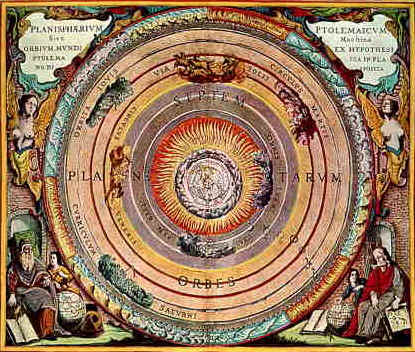
Where I had heard about the idea was in ancient cosmology where, as everyone knows, the Greeks and their successors spent around two thousand years trying to derive a model of the universe that depended upon perfect circles. Tradition (let’s not go there) ascribed to Plato the task then given to astronomers to reconcile the actual movements of the heavens, which were quite well understood by his time, with the fact that, nonetheless, the orbits of heavenly bodies had to be circular. But why? I hear you ask. We know that the orbits are in fact elliptical: why couldn’t the Greeks simply accept the evidence of their eyes and get on with other things? The answer has to do with what we think the fundamental underlying structure of the world is.
For the Greeks, and others who followed them, it was mathematical and geometrical. Thus, the phrase supposed to have been inscribed above the entry to Plato’s Academy: “Let no-one ignorant of geometry enter here.” And the effects of this way of thinking lasted a long time: for a millennium after Plato, an educated person was supposed to have mastered—among other things—arithmetic, geometry, music and astronomy. (Makes you think doesn’t it?) This way of thinking is Idealist (most people have heard of Plato’s Forms) and holds that perfection exists only in the invisible divine realm. The apparent, observable structure of the universe could not, therefore, be used as evidence to deduce its real nature. Indeed, the reverse was true. And because the circle was the perfect form, all observations and phenomena had to ultimately be reconciled with that fact, no matter how complicated the manipulation of the Phenomena needed to be. Here is a good short account of how the tried to do it. Today, of course, we snigger at such efforts, even while the shelves of our bookstores are increasingly filled with books by cosmologists and theoretical physicists explaining that nothing they know about the universe makes any sense any more.
My argument here is that the legacy of this kind of a priori, closed-circle reasoning has had a much greater effect on western culture than we might imagine, and that this method—starting from an arbitrary position and doing whatever violence to facts is necessary to fit them in—not only underlies a lot of our general culture today, but even influences much of what passes for political thinking, not least by those who don’t believe they are using it.
Any belief system suffers from the problem of Appearances or Phenomena, and the more ambitious the system, the worse the problem. Monotheistic religions have been particularly prone, because of the all-enveloping nature of their claims. For example, the early Christian Church had to deal with the “Phenomena” of the differences between the Gospels in the New Testament of the Bible, notably about the nature of the Trinity, and whether it was a unity, and if so how. This argument split the Church from the beginning, since some of the statements of Jesus implied that he thought of himself as human, others the reverse. Now this isn’t surprising if you’ve ever looked at what we know of the history of biblical composition and transmission, but nonetheless once the Canon was established, and taken to be entirely and without exception the revealed Word of God, then immense time and effort had to be put into trying to reconcile everything to the dominant doctrine: the conclusion, in other words was fixed, it was only the supporting evidence that remained to be manicured. Similarly, the dogma that every event in the New Testament had to be prefigured in the Old Testament, (because obviously) required enormous efforts over many centuries to bring the Appearances into line with underlying reality. This continued until the rise of modern biblical scholarship in the nineteenth century made it redundant, but in its time it engaged some of the best minds in Christendom. (I had to read my way through Calvin’s 1558 attempt once, for reasons that needn’t concern us here.)
But the problem is pervasive. So in the Old Testament, in the Tenth Chapter of the Book of Joshua, the prophet orders the Sun and the Moon to stand still, to provide more light for the smiting of the enemies of Israel. Now clearly, reasoned the Church, the Sun and Moon could only stand still if they had perviously been moving. Therefore, according to holy scripture, the Sun must move around the Earth. If the Appearances, appeared to contradict this theory, they must be brought into line with it. The Church was well aware that a single breach in its conceptual walls, a single recognition that a story was myth rather than history, or indeed that it related what happened as it appeared to the Israelites, and the floodgates would be opened. This indeed proved to be the case as the Church slowly retreated over the centuries from the idea that it possessed The Truth. The structure of the heavens was, for obvious reasons, a particularly sensitive topic, and the discoveries of Galileo were perceived as a mortal threat to the unitary theory of the cosmos. As Brecht (who knew all about the pressures of orthodoxy) has one of the Cardinals say to Galileo in his play, if the telescope shows things that can’t exist, it can’t be a very good telescope.
The Christian Church carried out a slow, pre-emptive retreat before the advancing forces of secularism, as Charles Taylor has demonstrated at some length. It progressively abandoned most of its traditional teaching in favour of a watered-down humanism, which led many to question what its continued purpose was, exactly. But Islam did not do this: it retains, for example, the formal hostility to Evolution that Christianity eventually gave up, and in some communities anti-Darwinism is very powerful: some schools in certain parts of France have had to stop teaching Evolution because of threats made against teachers. And in general, whilst western scholars of Islam have started to deconstruct the texts along the lines of the Biblical scholars of the nineteenth century, orthodox Islam frowns on such things. Yet one more reason why the secular West has been unable to understand Political Islam.
If the problem were restricted to religion, it would be less serious, but in fact other parts of contemporary life reflect the same logic. Now recall that understanding of the universe in Christianity and Islam is not achieved by research and hypothesis, but deduced from precepts of faith. It is the job of facts to align themselves accordingly. Now when this impulse is secularised, it leads to the imposition of rules that are believed to be irrefutable, not because they are revealed, but because they have been scientifically proved, and there is thus no appeal against them. The great modern example, of course is Marxist-Leninism; which claimed at all stages to be a scientifically-based set of theories and precepts, capable of explaining all historical developments. The problem, once more, was reality, as it turned out that this scientific approach could not cope with the actual variety and complexity of life. I remember reading a fascinating interview with a former Soviet media correspondent in Washington, not long after the end of the Cold War, whose main professional challenge, he said, was to try to reconcile the need to give his readers at least some impression of what was actually happening in US politics, without offending the sensibilities of his own political controllers. Thus he was obliged to write articles about how shadowy groups of financiers chose the two candidates and then the President, and retrospectively justifying the eventual winner as of, course, the candidate that the capitalists must have wanted all along, although he knew it was always more complicated than that. The mechanistic, materialist approach to politics that the Soviet media exemplified was influential on the international Left as a whole, and is still found in scattered pockets there today. If you read the speeches of the older generation of Russian leaders today like Putin and Lavrov, who grew up within such a totalising intellectual framework, the remaining influence is clear.
It’s arguable in fact that one of the reasons for the collapse of the Soviet Union was that it was trapped in a highly deterministic, pseudo-scientific world-view which stopped it from seeing what was under its nose. Lenin’s assertion of the link between imperialism and capitalism was simply assumed to be true, and not needing anything so vulgar as evidence, and historians have traced in the records how much this distorted Stalin’s thinking in the 1930s, and for that matter how far it confused historians of the Left in other countries. But it was “true.” (Oh yes, Althusser again, and his argument that facts are ideological productions, dependent on theory for their validity.) The point is that, if you believe that the class-struggle is the essential engine of history, and that other things are trivial in comparison, you will fixate on class-based elements of problems even if they are minor, and you will even see class struggles where none exist. This was particularly true of Afghanistan, where we have extensive records of what the Politburo discussed, and it’s clear that they never really managed to reconcile the rigid Marxist-Leninist framework that they were working in, with the complexity of the situation in the country itself. So one of the main arguments against withdrawal was that it would “betray the Afghan working class.” There was, of course, no Afghan working class.
We don’t hear much about “Marxist-Leninist Military Science” these days, but it governed the way the Red Army trained and fought since the 1920s. Once more, it was based on the idea that the reality of war was fundamentally mathematical, and that battles would be won by the side that did the technical calculations correctly, since warfare was at bottom, a science. It was called Correlation of Forces and Means (COFM), and in theory could tell you how to win a battle: so far as we can gather, fundamentally the same approach is in use in the Russian Army today. It can’t be said to have distinguished itself practically either in the invasion of Finland or in the first year of the German invasion, but the underlying scientific theory was never questioned.
In modern western societies, the Platonic approach has had the most effect; and done the most harm, in the area of economics. This may seem strange if you take a historical perspective: after all, when I was studying economics, it was a very practical, down-to-earth subject, which dealt for the most part in quantifiable inputs and outcomes. It was anything but Platonic. The story is a familiar one, though; in the 1980s, economics was taken over by Martians with pocket calculators, and later with personal computers, who fancied themselves as mathematicians, and wanted to give economics the status of a hard science. Thus, they progressively created the equivalent of a Ptolemaic universe in Economics, forbidding, as Plato had done, non-mathematicians from entering. This has been going on continuously for some decades now (the expected rash of suicides after 2008 never occurred) and it is fair to say that economists now inhabit a parallel universe consisting entirely of numbers and equations, where they are convinced that Everything is Fine. If there are Appearances that seem to belie this, well they must be dragooned into the conclusions of the calculations somehow. Of course, to the extent that western countries no longer have real economies, and now largely live off the crumbs from mysterious rituals carried out by the computers of finance organisations, there’s a certain kind of weird appropriateness to this situation. When the “wealth” of someone like Bezos is calculated not in land, possessions, or even money in the bank, but in the judgements of people who buy shares in his company about how much they can sell them for, we are indeed in a different world.
This distance from the real world was obvious almost immediately when such ideas were tried in practice in the UK in the early 1980s. Mathematical theory, we were told, held that inflation was a monetary phenomenon, and could be dealt with by controlling the money supply, and that would be done by raising interest rates so that it was too expensive to borrow, and so there was less money in circulation. (Nobody could explain why putting up interest rates, and therefore costs, was going to reduce inflation.) The consequence of previously-unheard-of interest rates and a consequent overvaluation of the Pound was that much of British industry simply disappeared and unemployment went roaring up. This wasn’t supposed to happen: never mind said the economists, our calculations prove that after a short period of pain, thing will look wonderful. That didn’t happen, of course, and inflation, unsurprisingly didn’t come down either. But the calculations said it must, and I remember reading a portentous article, in The Times I believe, explaining that the lags between interest rate movements and inflation rates were “long and variable,” which is a nonsense if any kind of causative mathematical relationship actually exists, and is just another way of admitting that the original theory was wrong. The same argument was made about increased government spending, which had been scientifically shown to increase inflation, at least if you believed the equations. At one stage in the 1980s, the Treasury was using an economic model which assumed that any increase in government spending would have no impact on the economy except to increase inflation, because it increased the supply of money.
No failure, however great, has weakened the vice-like grip of the mathematical economists on the policies of governments, because they deal after all in Platonic Ideals, not in boring reality, and so can never be proved wrong. Even today, issues such as trade liberalisation or the consequences of immigration are believed settled, because mathematical laws have been found that predict certain outcomes, at least in theory. And the result is that mathematical economics has drifted so far away from events in the real world that it has largely lost the tools it once had to explain what’s actually happening down here. When economists tell us that living standards are rising, they are not, by their own assumptions, telling lies. They are talking about the results of the equations they use, based on the assumptions that they believe to be theoretically proven. They have nothing to say to a family of four struggling to make ends meet. They are as far removed from reality as would be a bunch of Ptolemaic philosophers trying to advise NASA.
One way in which you can cope with the Appearances, of course, is by changing their definition, and make them look like something else. Now to be fair, many of these concepts—that of money itself, unemployment, inflation, economic growth—have different definitions, often because they are used for different purposes. The GDP Deflator, for example, measures price changes in all goods and services produced in the economy, where the Consumer Price Index measures changes in what we pay in the shops. Nonetheless, and as with all top-down allegedly scientific theories, the theory must be right, so the facts need to be changed if necessary to cohere with the theory, usually by redefining things to death. There was a political crisis in Britain a year or two into Thatcher’s reign, when unemployment, still calculated on the old system, approached two million. Needless to say the government needed to act, and it duly did, by repeatedly changing the definition of unemployment to lower it substantially. These definitions have now changed so many times that I’ve seen credible estimates that real unemployment in Britain is between eight and ten million, measured with traditional methods.
Economics was once a pragmatic field of study, and as such it was extremely useful. An economics textbook was like a manual for a car, and applied economics for governments was relatively straightforward, because it meant keeping the car going in the right direction at the right speed, and checking the brakes and tyres. By contrast, today’s economic textbooks are works of ideology, if not actually theology, which tell us how the world is Ideally supposed to be, but are as useless in real life as a nineteenth-century road map. They speak to us of gods to worship and rituals to perform, and of an ultimate reality which we can never approach.
It follows naturally from the above that the modern western political class is incapable of understanding that money and reality are too different things. They are not educated in reality: few have ever done a manual job or repaired a car (can you even do that any more?), and in their experience they pay money and things just happen, whether it’s meals, taxis, home help, next-day parcel delivery or political influence. They assume, as did the Platonists, as did the medieval Church, that you can map the Ideal onto reality, and if that doesn’t happen (say, the parcel you ordered gets lost) it’s reality’s fault.
It follows in turn that all solutions to real-world problems are basically financial solutions. The first instinct of governments during the Covid crisis was to announce that lots of money would be spent: “whatever it takes”, said Mr Macron loudly. As a former banker, there was no reason why he should have realised that you can only buy things that are actually available to be bought. Back in the days when Keynes famously inverted Say’s notorious Law (‘“supply creates its own demand”), it could be plausibly argued that if the government needed something in a hurry, then industry would generally be prepared to supply that demand. This was never an invariable law, because if demand increased a company might simply put its prices up rather than invest in higher output: it seemed a safe general principle, nonetheless. But Keynes was writing in the days when countries were largely self-sufficient, before the theologians of finance had designed a beautiful, frictionless transnational economic cosmos, and dazzled politicians had implemented it, like medieval Princes bowing before the Church. In reality, the Appearances, like de-industrialisation, lack of skills, lack of manufacturing capability, even the practical difficulties of importing masks and paracetamol, made nonsense out of the idea that if you have the money anything can be bought, but so far it seems the lesson has not been learned.
And certainly not in the case of Ukraine. I was interested to hear about the “initiatives” of the European Commission over the last few years, wondering if they had somehow discovered a new source of weaponry or manpower to continue the fight. No, all these manoeuvres were just clever wheezes to make more money appear. (And by “money” in the modern sense we mean ones and zeroes in bank accounts, not something you can take out and spend.) The assumption was clearly that, if only money could be made available, weapons and other support would follow along naturally. And for a certain type of economic mystic, this does seem to be what they actually think. After this, of course, came the complaints: we sent all this money to Ukraine, where did it go? Well part of the answer is that it was spent in Europe itself, part of the answer is that it wound up in tax havens and apartments in Paris, but the majority of the answer is surely that you can only buy what is for sale, and only in the quantities that can be constructed and delivered. (Experts in Supply Chain Economics knew this, of course, but they dealt with grubby real-world issues and so were not consulted.) Ultimately, what the EC did was like sending someone to a starving village handing out banknotes.
And it’s curious, but not really surprising, that economic theology was expected to decide the outcome of the War, or at least the struggle between Europe and Russia. After all, it was frequently said, Russia had a GDP the size of Belgium or Italy or something. How was it possible that such a country could defy the combined economic might of the United States and the EU? This was, to say the least, a curious argument. After all, GDP, was once a useful enough measure when western countries made things and grew things. But these days, when measured by Purchasing Power Parity, around 80% of US GDP consists of “Services,” which include health insurance and financial speculation. For the EU it averages around 70%. The idea that stock-market activity and Taylor Swift concerts can be weapons of sorts against Russia is so bizarre that only a mathematical economist could have dreamt it up, but it perfectly expresses the notion that all that really matters is money, because money is the ultimate reality. Tanks, guns and aeroplanes trail after, submissively, as mere Appearances. Somewhere, no doubt, is to be found the argument that because GDP= notionally lots of money, we should be able to afford far more tanks, guns etc. than the Russians, just as Mr Bezos, for example, can afford to buy infinitely more Ferraris every year than Mr Blair, multi-millionaire though the latter may be. Except that the number of Ferraris made every year is limited, (some 8,500 according to insiders) and many are reserved years in advance. The same is even truer of weapons, where lead-times are in years, if not decades, where production capacity is limited, and raw materials and skilled manpower may not even be available. The sobering reality is that for most systems, Russia has a greater productive military capability than the West has, or is ever likely to have, no matter how much you play with GDP figures. And let’s not even mention China.
As I say, economics was once a useful discipline, and in the hands of dissident economists like Steve Keen, Ha-Joon Chang and William Mitchell, it still can be. But its mathematical philosophers have not only brought about the ruination of entire economies with their spells and incantations, they have presumed to apply the same Idealist methodologies to the attempted resolution of a whole series of other problems, from war and conflict to personal relations, with results that make me increasingly feel that economists should have to pass an examination of some sort before they are allowed to write about issues outside their immediate field of specialisation.
I don’t want to turn this into a jeremiad against economists (I can’t remember how to do jeremiads, if I ever knew), but it’s true that Platonic Idealism has taken over what was once a useful and accessible field of study. That said, other systems of thought, both elite and popular display some of the same characteristics, so I’ll briefly run through some other examples as well.
Modern science, as an activity and a system of thought, is in many ways a Platonic system (if philosophers will forgive me.) Now I’m not proposing to get here into theories of paradigms, progress by funerals, or whatever, but simply to note the obvious fact that modern science begins from what it sees as well-established, mathematically invulnerable and infinitely repeatable rules. The Phenomena of the world should correspond to the overarching cosmic view, and if they don’t they need somehow to be wrapped into it, even by being dismissed as mistakes, forgeries or the result of bad observations. The reaction of scientists to alleged Phenomena that do not fit into this Idealistic cosmic paradigm is essentially the same as that of Brecht’s Cardinal to the Moons of Jupiter: there can be no point in studying something that cannot exist.
Now I don’t want to be unfair, and it’s quite true that new discoveries are made, theories are revised and in many areas science can be said to “advance.” That said, it’s hardly a secret that scientific fraud is worryingly widespread, that the field has its own vicious internal politics, that experiments do not always replicate, that apparently fixed scientific constants change slightly over time, for example. And for that matter major evolutions in doctrine can be smuggled in under the cover of classical verbiage: the idea that acquired characteristics can be inherited, familiar to Darwin, was the gravest heresy in twentieth century biology, but has recently appeared once more under the code-name “epigenetic inheritance”—ie, inheritance based on something other than genetics. The overall result is that science forfeits public sympathy because it presents itself in practice not as guided by pragmatic theories and experiments, but rather by fealty to an overarching, ultra-materialist cosmography into which apparently recalcitrant Appearances have somehow to be shovelled. Researchers like Biologist Rupert Sheldrake, and many lesser-known figures have quietly been performing carefully-controlled experiments for decades that show, not that science is wrong, but there are things that science has yet to take account of, though there’s no sign so far that it will. And for that matter, stop the first passing quantum physicist and they will readily explain how far even other scientists have failed to internalise the significance of their work after a century has passed. (Which is why popular books on the subject make popular books on Buddhism seem mundane and straightforward by comparison.)
It’s understandable that scientists would be alarmed at some element of their cosmography coming into question: like Joshua ordering the Sun to stand still, where do you stop? But whilst (almost) everyone would accept, for example, that it’s necessary to have a sceptical approach towards claims about things such as artificial gravity or perpetual motion, brutal dismissal of, say, types of parapsychology of which most people have had at least some personal experience, just appears insulting and arrogant. And it’s not always effective: the popular American mathematician and journalist Martin Gardner spent most of his life engaged in a pitiless crusade against what he called “pseudoscience,” accusing others freely of cheating and dishonesty, but whereas some of his targets were reasonable (Velikovsky for example) in practice he savaged anything that transgressed the boundaries of his rigid nineteenth-century materialist views. Ironically he turned scepticism itself into a religion, with its own commandments. In the process, as some of his detractors were quick to point out, he was obliged to invent explanations for observed events that were so complex and counterintuitive that William of Occam would have preferred “supernatural” explanations, just on grounds of simplicity.
Medicine as a discipline has always had a Platonic ideological structure: almost literally, in fact, in its pre-modern incarnations. But what emerges from talking to any Doctor today is the formulaic and protocol-driven nature of much modern medicine, assisted by the irruption of information technology into healing. (You may have seen a nurse in a hospital her eyes fixed on her iPad mounted on a trolley, and not looking at the patient at all.) Although, once more, I want to describe rather than criticise, I think it’s just a fact that medicine as a field of practice considers itself to be a repository of proven scientific wisdom, incorporating a nineteenth-century mechanistic view of the universe and insisting for example, on an absolute distinction between body and mind such that one cannot influence the other.
Yet in this case, you can argue that the situation is actually more promising, and that pragmatic techniques that actually work are slowly making their way into medical practice in different countries. Somewhat shamefacedly, hospitals are experimenting with acupuncture and Traditional Chinese Medicine, as well as hypnosis and related techniques, not least because they are cheap and effective when compared to drugs. To someone like me who has followed the progress of what used to be called “alternative” medicine for fifty years now, there’s a mordant satisfaction in watching the medical profession being forced into retreat on the subject, one tiny step at a time. But of course I, and a lot of middle-class educated people, don’t really care what they do, in the end. What is important is what works for you. And there are some promising signs of pragmatism out there. In France there is a tradition of people called “coupeurs de feu” or literally “fire cutters.” Historically, they were gifted with the power to heal burns at a distance or by laying on of hands. More recently they have been used extensively by hospitals to help patients who have undergone radiotherapy, with generally very good results. These individuals (and the gift is handed down within families) traditionally demand nothing for their services. More generally, whether, and if so how far, the discovery of the equivalents of the Moons of Jupiter is going to actually force the medical establishment to change its thinking, only time will tell.
As individual human beings, we are not necessarily exempt from these pressures either. Especially in times of crisis, people instinctively turn to Platonic Idealist narratives, because they can be ingurgitated whole, and do not need to be adjusted as the facts change. (Indeed, for them it’s less about facts changing and more about changing the facts.) I find it disturbing that controversies in our time increasingly resemble arguments about competing world systems in the Renaissance, where all nuance is banned, in spite of the fact that in history, just as much as in the world today, nuance matters desperately. We now have two “sides” on the Ukraine crisis, for example, each of which begins from an Idealist world-view, and for whom any Phenomena that appear to contradict it are dismissed as propaganda or the lies of foreign intelligence services.
With enough ingenuity, of course, anything can be made to cohere with anything. If you are familiar with the Middle East, parts of Africa or the Balkans, you’ll know that there’s a self-serving myth of weakness and domination by outside forces which acts, among other things, as a universal alibi for the political class. I remember being told maybe a dozen years ago now that the French Intelligence Service was responsible for the overthrow of the Tunisian dictator Ben Ali in 2011. When I mildly pointed out that the French had supported Ben Ali up to and beyond the end, and the Foreign Minister had lost her job as a result, there was only a micro-second of hesitation before the inevitable reply: “that just shows how well-disguised the plot was, then.” And I can’t remember how many times I’ve been told that Princess Diana was murdered by “British Intelligence MI6,” because she had an Egyptian boyfriend and there was the risk of a Muslim King in Britain, or something. Such assertions, to repeat, are not assembled from facts of probatory value, but from idealist assumptions about the nature of the world: facts are brought into line as necessary or just ignored when not needed.
I think this is wrong and dangerous, but I suspect I am in quite limited company. In these essays, and in occasional comments I make elsewhere under various names, I try to talk only about what I know and have experienced, and try to pass on observations and suggestions that I think might be helpful. I’ve become used to being lectured by people on how wrong I am, that things I saw didn’t happen, that things I know didn’t happen nonetheless did, and so forth. But this is how it has to be, if the Idealist narrative is to be retained. I naively thought people would be interested in factual clarifications, but in reality they tend to see them as threats: as new planets discovered by a telescope, among the existing stars.
In the end, it seems we would rather go out and look up at the night sky convinced that the apparent motion of the stars and planets conceals a deeper reality of spherical motion. The anxiety caused by the overthrow of the Ptolemaic system, and its replacement by the “New Philosophy” that John Donne so worried about, was severe and long-lasting and we are still suffering from it. How much we wish to return to its embrace, if not literally, then through some Idealist scheme of the world that enables us to relegate the mere Appearances to the subordinate place they deserve.



Be the first to comment