
Did imperialism just reappear yesterday?
Branko Milanović is an economist specialised in development and inequality. His new book, The Visions of inequality, was published October 10, 2023.
Cross-posed from Branko Milanović’s blog Global Inequality and More 3.0
In an interesting article appropriately entitled “Contra el imperio” El Pais’s columnist Antonio Muñoz Molina gives an abridged review of the past half-a-century of international politics, and indeed of political disappointments of the left. The article is written under the shadow of the returning imperialism. It opens by quoting the author’s partner who says they have to go back to fighting imperialism as they did in their youth. It ends on a similar note: a call to fight the (implied) imperialism of Trump, Putin, and Xi Jinping. Most of the article is composed of a list, or one would even say a litany, of the errors of the anti-imperialist left of the author’s youth. Everyone who is 50+, and a fortiori older, remembers all these events perfectly well. I actually remember all of those cited in the article, some perhaps better than I remember the events that took place several months ago.
It is a critique of the left that, Molina writes, began by reading Lenin’s “Imperialism, the highest stage of capitalism” and Mao’s “Red book” and thereafter focused solely on criticizing American imperialism. It left aside, ignored, or supported, and in the best cases, was insufficiently critical of the “left-produced” calamities such as massive exodus of South Vietnamese population after North Vietnam and Vietcong won the war; it ignored Soviet invasion of Czechoslovakia or failed to take a clear anti-Khomeini stance during the Islamic Revolution. Even worse, leftists supported the oppressive regimes in any Third World country (Vargas Llosa is helpfully quoted there), be it Cuba, Zimbabwe or China.
These are the usual liberal critiques and hardly new. They have practically remained unchanged since 1917: just the number of the events where they could be applied has increased. However, not to show himself entirely blind to the events of the past thirty years, Molina somewhat half-heartedly –it seems– extends the critique to the democratic left’s insufficient rejection of neoliberal oligarchies of Latin America, that at home live in heavily protected compounds but, after buying expensive villas in Miami and Madrid, enjoy the pleasures of more equal and richer societies. (Perhaps Vargas Llosa could have been cited in that context too.) Not to be forgotten, the excesses of post-Communist privatization that benefitted mostly the Communist cadres are mentioned as well.
The reader nevertheless wonders, What is the point of the article, other than for the litany of mistakes, or “mistakes”? Is the left that was permanently wrong for some fifty years, now when the world has turned imperialistic again, in need to go back to the values of his youth? To Lenin’s “Imperialism…”? It is unclear if this is the message, and I honestly doubt that it is. But the only other message that could be imagined is that one should find refuge in what may be called intellectual narcissism where one is always politically right, but irrelevant, and naïve. Is this combination of vanity and naivete desirable?
With that thought, the critiques that Molina freely dispenses begin to lose their power. Take the case of Vietnam. Should the left not have supported Vietnamese Communists in their struggle against US imperialism because they did not care much about democracy? Or should the left not ignored Khomeini’s theocracy? The answer can always be “yes”, but the issue is that, in the real world as opposed to the world of intellectual dreams, the international context matters. And there is also the issue of the lesser evil. Certain struggles deserve to be supported either because the side that is supported is considered a lesser evil of the two, or because the struggles have to be seen in the global context. To give an example: the war between USSR and Germany 1941-45 can be, and should be, seen only in an international context. It makes no sense to declare one’s neutrality because Stalin’s regime was in some cases as repressive, and in many cases even more repressive, than Hitler’s. This is not the grounds on which we decide whether to support one or another. The decision has to be taken within the global context, namely what the victory of one or the other side would mean for the world.
It is equally meaningless to criticize people for not supporting policies or ideologies that are simply not on the table of possibilities. Our preferred option may not be available at all. It is not on the menu. If we are in Tehran in January 1979, the options on the menu are continuation of a comprador dictatorship by a vainglorious autocrat, theocratic government, Communist takeover, or extreme leftist Third World regime. Liberal democracy is not on the menu. Molina may wish that it should be; but it simply was not. One has a choice: to continue to live in a world of phantasy and to remain always consistent and “correct”—and thus irrelevant; or to choose what he or she believes to be, at a given moment in time, a lesser evil.
In fact, every example given by Molina has to be addressed in its context. Consider the Khmer Rouges. They came to power after overthrowing US-installed dictatorship of Lon Nol; but Lon Nol came to power because Americans decided to invade Cambodia to stop the flow of weapons that along “the Ho Shi Minh trail” were supplied to the North Vietnamese. So one’s decision to support North Vietnam or Cambodia or Sihanouk is not made in the knowledge of what it would lead to, but entirely on what are the conditions at the time one decides to support that option. The ascent of the Khmer Rouge does not invalidate the correctness of the decision to support Cambodia in its supply of arms to the Vietcong. A litany of mistakes becomes ahistorical.
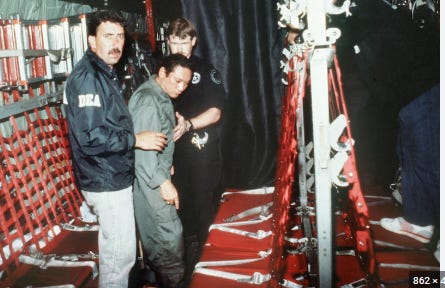
It is also unhelpful. When we decide what is the best approach today, we can accuse Trump and Putin of respectively American and Russian imperialisms, and Xi Jinping of not respecting human rights. But in the world as it is, we have to decide based on the historical context and on the lesser-evil principle. The war in Ukraine needs to end. Russia will control the territory which no one in the world would recognize and this will go on for an indefinite future. Trump (and Biden too) have moved America to policies that establish more firmly its dominion over the Western hemisphere and focus on countering China globally. Speaking of the abduction of Maduro and threats to Greenland as if they represented a total novelty in the behavior of the United States is simply wrong. Before Maduro was abducted, so was Noriega—and with many more victims and 20,000 US troops attacking the country with no authorization by any international body. Before Greenland was threatened, so was Iraq, and again with many more victims too.
What seems new in “Contra el imperio” is really not new at all. We have dealt throughout the past century with various imperialisms. At times, some were supported because (in the view of the left) they were better for the world or because they domestically represented lesser evil among the options that were on the offer. The situation is not any different today. Empires were with us during the neoliberal era too. They were not invented yesterday.
* Molina’s example is moreover not technically entirely correct because the Khmer Rouge government was later, after it was overthrown by the Vietnamese, supported by the US, not by the “anti-imperialist” left.


Regardless of what one wants to define imperialism as, it’s ludicrous to compare the weapons of American imperialism as comparable to any other country, from the ones Trump laid bare – control of the world’s energy supplies, payment systems, international currencies, worker and resource exploitation, war crimes at will, espionage, blackmail and threats to the entire world to prevent independence in any strategic resource – to the ones he didn’t as such – CIA/NED sponsored propaganda NGOs and “journalism”, weaponized IMF and the World Bank, support of terrorist organizations, endless bribes in money and institutional careers, sanctioning of dissenters, curtailment of international institutions.
A leftism made of sacred cows that considers the context irrelevant in the pursuit of virtual signaling purity is, at best, useless. But often a surprisingly good grift.
Politics is almost always a career choice. if idealism is the driver, the idealism and/or the idealist in question cannot survive the system for long.
Government, whatever the excuse, is always a business model-Legalised blackmail, exploitation and more.