
When words are mischaracterised and those mischaracterisations can be upheld by courts and lead to people going to prison, freedom of speech is under serious threat.
Rayan Freschi is a CAGE researcher based in France. He authored CAGE’s report “We are beginning to spread Terror” which unveils the existence of a state-led anti-Muslim persecution in France.
Cross-posted from Middle East Eye
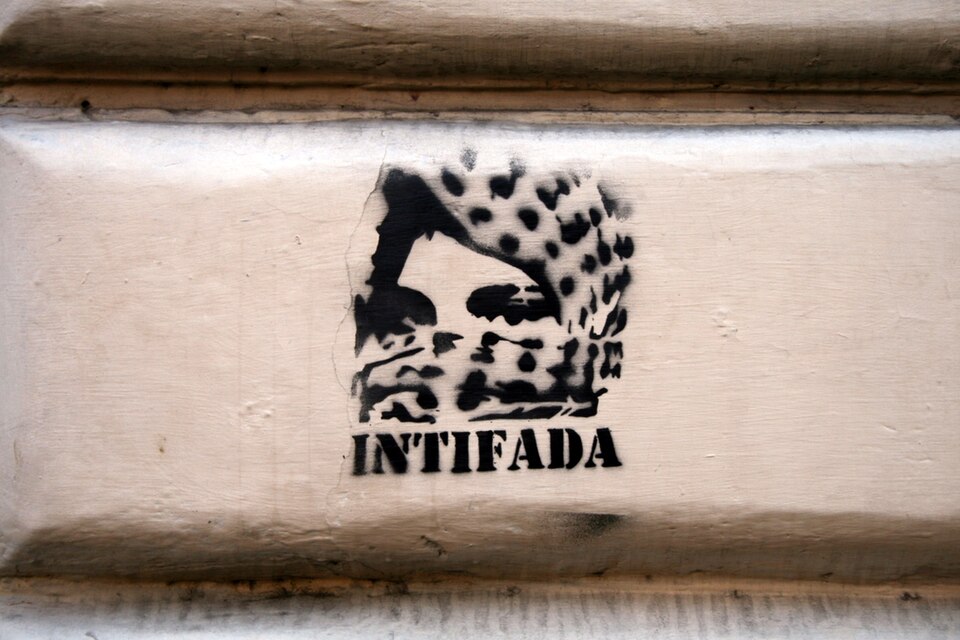
Will French courts ban the word intifada?
This Orwellian question has been at the core of a legal dispute since October 2024.
Elias d’Imzalene, a founding member of Urgence Palestine, was charged with “incitement to antisemitic hatred and violence”. The speech was given in Paris in September 2024 during a political gathering where pro-Palestinian voices declared their renewed intent to mobilise against the genocide.
“Are we ready to carry out an intifada in Paris? In the banlieues? In our neighbourhoods?”
When d’Imzalene uttered these words, he could not have known that a native informant was secretly recording everything. The informant gained recognition as an “insider” who exposed Muslims as inherently violent and antisemitic through literary works celebrated by Islamophobes.
After publishing extracts of the speech on his X account and declaring that “intifada” actually meant “civil war”, the state initiated legal proceedings against d’Imzalene. A number of Zionist organisations openly supportive of the Israeligenocidal government declared their intent to join as plaintiffs in the case.
A first trial resulted in a suspended sentence and a fine. D’Imzalene appealed his conviction, and a second trial was held in January 2026.
The prosecution of d’Imzalene is part of a wider effort in France to criminalise Palestinian solidarity by treating the language of anti-colonial resistance as antisemitic hatred and violence, a move backed by Islamophobic and pro-Israel groups and reinforced by foreign lobbying.
Criminalising dissent
What does intifada mean? And what does it mean when it is used by Muslim activists like d’Imzalene?
In their initial ruling, judges determined that the term carries a self-evident violent and antisemitic connotation due to its exclusive reference to two Palestinian uprisings in the late 1980s and early 2000s, as fixed in collective imagery.
This line of reasoning – identical to that promoted by the informant and the Zionist plaintiffs – is indicative of the institutionalisation of colonial and Islamophobic narratives within the French judiciary.
First, it discards the colonial nature of the Zionist state and its brutal history, conveniently depicting legitimate Palestinian anti-colonial revolts as acts of gratuitous violence rooted in antisemitism, falsely connecting the word intifada to anti-Jewish hatred.
Second, the judges chose to overlook the rich polysemy of the term, which has historically been used to describe peaceful strikes far more often than acts of political violence.
In the context of pro-Palestinian movements, Muslims and non-Muslims alike in France and elsewhere have used the word for decades to promote anti-colonial dissent and support the legitimate claims of the Palestinian people.
Accusing d’Imzalene of advocating antisemitic violence depicts politically active Muslims as irrationally violent while denying any sound basis for their grievances, a narrative promoted by the Orientalist Bernard Lewis in 1990.
Despite attempting to cover itself with a varnish of neutrality by relying on a Larousse dictionary definition – one of the leading French lexicons – as decisive proof, the ruling nonetheless revealed itself to be deeply politically motivated and rooted in structural coloniality and Islamophobia.
A decisive fight
Underpinning d’Imzalene’s prosecution was a political climate that pressured the state to pursue charges, supported by a racist narrative posing as “expertise”. The works of Islamophobic figures such as Florence Bergeaud-Blackler, whose intellectual credibility has been severely challenged by many respected researchers, played a central role in this framing.
Bergeaud-Blackler, who gained prominence through her successful Islamophobic essays, raised concerns about the use of the word intifada and frequently portrays France as a vulnerable target of “Islamist entryism“.
Moreover, a recent investigation by Mediapart exposed the role of the United Arab Emirates in shaping these discourses. Leaked documents show that the Emiratis have lobbied intellectuals like Bergeaud-Blackler to infect French body politics with Islamophobic conspiracy theories.
These efforts in France, identified as a “target country”, are in line with Zionist objectives. According to the leaked note, “the political environment is increasingly favourable to stronger surveillance of the Muslim Brotherhood and Islamist networks”.’
In this climate, Muslims who are politically active and fully immersed in the anti-genocidal struggle must therefore be silenced. This revelation underscores the UAE’s complicity in the ongoing genocide in Gaza, extending to the criminalisation of anti-genocide voices beyond the Middle East.
During the appeal, the arguments advanced by the Zionist plaintiffs remained consistent with those presented in the first trial. In their view, calling for an intifada in Paris means calling for the death of Jews.
D’Imzalene received significant backing from grassroots movements such as Urgence Palestine, as well as from established political figures, including France Unbowed MP Ersilia Soudais.
This case represents the current Orwellian strategy of stripping language of its potential for dissent, thereby foreclosing a political horizon of justice and liberation.
The court’s decision is expected by the end of the year. A conviction would set a dangerous precedent, effectively outlawing the public use of a word that, for many, best expresses the Palestinian struggle.




Be the first to comment