
Venezuela is neither evidence of the failure of socialism nor does the Venezuelan regime have to be defended as an example of socialism, because Venezuela has never had a truly socialist economy, something Hugo Chavez was at pains to point it.
Michael Roberts is an Economist in the City of London and a prolific blogger.
Cross-posted from Michael Roberts’ blog
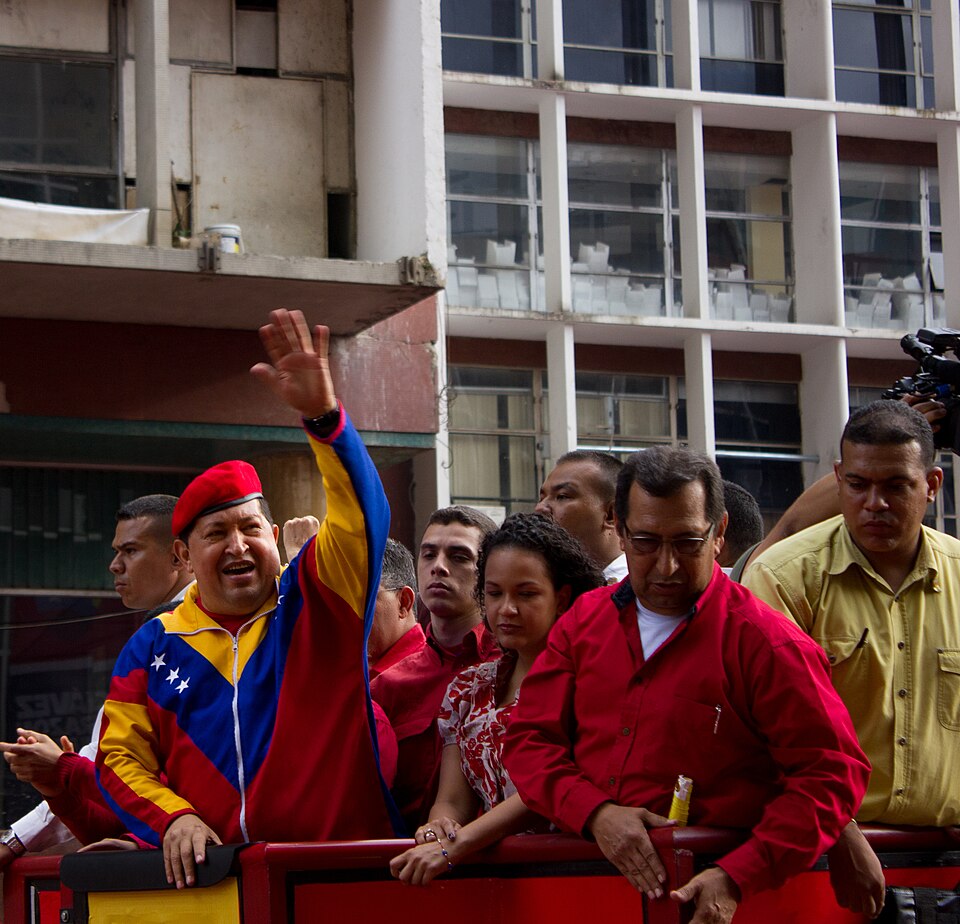
The kidnapping of Venezuela’s President Maduro and his wife by US military forces, the subsequent takeover by the Vice President Rodriguez and her agreement to allow the US to control Venezuela’s oil export revenues and to bring in US energy multi-nationals to invest – all this signals the end game of the Chavista revolution that began over 25 years ago. So it is very opportune that a new book has been published on what happened in Venezuela to reach this point.
Called Venezuela in Crisis and published by Haymarket Books, this book brings together “some of the most important Marxist, socialist, and anti-capitalist thinkers in Venezuela, representing a range of left political traditions and organizations.” These Spanish language writers have been translated so that English speakers can read the arguments and experiences of those on the left in Venezuela. Some contributors served in Chávez’s cabinet and have now become critics of the Maduro government. “Bringing these voices to an English-speaking audience will allow readers to engage with the current debates and perspectives of the Venezuelan left”.
The book has been edited by Anderson Bean from North Carolina Agricultural and Technical State University, who has written before on Venezuela. His introductory chapter provides the reader with the essence of the chapters in the book. Bean starts by pointing out that through the 2000s, the Chavista-Bolivarian revolution in Venezuela was an inspiration for others in the so-called Global South, perhaps even more so than the Cuban revolution of the 1960s. The election of Hugo Chavez in the 1998 election, after decades of corrupt, pro-capitalist, pro-US governments, was a burst of fresh air. In the subsequent years, the Chavez presidency “improved Venezuelans’ material well-being, brought greater social equality, and empowered sectors of society that were traditionally excluded from the political process.”
Bean argues that there were three key components of the Chavez presidency: first, the rewriting of the constitution to promote of broad citizen participation and comprehensive human rights protections; second, the redistribution of oil profits through various social programs which reduced official poverty levels by 37.6% and ‘extreme poverty” by 57.8%. By 2008, Venezuela also had the highest minimum wage in all Latin America, and inequality in the country dropped to one of the lowest in the Americas. By 2011, Venezuela was the second most equal country in the Western Hemisphere; only Canada had lower levels of inequality. And third, which Bean reckons was the “most transformative”, was the transfer of power to the popular sectors through the creation of new forms of popular assemblies and experiments with workers’ controls and community councils.
But from 2013 onwards, things began to go wrong, big time. From 2013 to 2021, Venezuela’s GDP fell 75%, inflation reached 130,000% in 2018, the highest in the world! The percentage of households classified as poor increased from 48.4% in 2014 to 81.5% in 2022. The monthly minimum wage at US$2.23 then was the lowest in all Latin America. Indeed, the monthly minimum salary was just US$0.15 a day, eight times less than the World Bank’s then limit for absolute poverty of US$1.25 a day. That compared with a monthly minimum wage under Chávez of US$300, over 60 times higher.
The collapse in real incomes and the sharp rise in poverty in the 2010s led to a migration crisis. Since 2016, millions of Venezuelans have fled the country seeking work abroad in order to send money back home. Today, the number of Venezuelan refugees and migrants worldwide is estimated to be around 7.7 million, or 20% of all Venezuelans. Venezuela now has the highest number of displaced people in Latin America and the second highest in the world, just behind Syria.
What explains this collapse from inspiration to nightmare? Bean says there were two causes. The first was US sanctions imposed on Venezuela, coupled with several attempts by the US state, in collaboration with the domestic Venezuelan right-wing opposition, to undermine the Venezuelan economy, in order to carry out regime change. US imperialism saw Venezuela as a threat, with Chavez’s renationalisation of the oil industry; and Chavez’s attempt to build trade relations with other Latin American countries outside the orbit of US-led trade agreements, while looking for support in trade and investment from the likes of China. The very early success of the Chavista presidency was anathema.
Indeed, in 2002, the US, in collaboration with the Venezuelan business class, attempted a coup to overthrow Chávez. He was removed from office for forty-seven hours, before being reinstated by mass popular mobilizations. From late 2002 to early 2003, the US supported an oil lockout to bring oil production to a halt with the stated goal of forcing Chávez to resign. In 2014, the US backed the Venezuelan right-wing again in violent street protests called the guarimbas, demanding ‘la salida’, or the “exit,” of Maduro. The US, again in collaboration with the sections of the Venezuelan right wing, attempted yet another coup in January 2019, when Juan Guiadó unconstitutionally declared himself president of Venezuela. After the January coup failed to overthrow Maduro, Guiadó tried again in April 2019, but was thwarted once more.
These attempted coups failed, but a litany of economic sanctions were imposed. Under Trump’s sanctions, US institutions and citizens were prohibited from trading in Venezuelan debt. All government assets were frozen. The country was prevented from restructuring its foreign debt or payment schedules. Payments sent by countries participating in its program for preferential payment of oil were blocked. The sale of billions of dollars in trade credits were banned. Sanctions also closed off Venezuela to its most important oil market, the US, and properties held abroad were confiscated, like the US-based Citgo, which the state depended on for sources of income. These measures led to a loss of $6 billion in oil revenue in just 2018 alone. Sanctions froze $17 billion of the country’s assets and cost the country around $11 billion in export losses in 2019, or $30 million a day.
The Washington, DC–based Center for Economic and Policy Research published a 2019 report detailing the effects of US sanctions on Venezuela. Between 2017 and 2018 alone, the sanctions killed an estimated 40,000 Venezuelans and plunged many more into precarity. Over 300,000 people were put at risk because of the lack of medicine and health care, including 80,000 HIV-positive Venezuelans who have gone without antiretroviral drugs for years now. Additionally, obtaining needed cardiovascular medicine or insulin is a challenge for the 16,000 Venezuelans who need dialysis, the 4 million with diabetes and hypertension and the 16,000 people who have cancer.
But the writers in this book are at pains to argue that the collapse in Venezuela cannot be laid solely at the door of US imperialism and its sanctions. Despite the harm that the sanctions have wrought in Venezuela, the other major component was the economic mismanagement and neoliberal program of the increasingly authoritarian Maduro government. Mainstream capitalist economists claim that the collapse of Venezuela was the result of socialism; while many on the left claim that the Maduro regime had to be defended as an example of socialism. Both sides are wrong. Bean and the other writers in this book do not accept that Chavez (and Maduro after him) had established a socialist economy, or even that Venezuela was on the ‘road to socialism’.
As I argued in my own posts on Venezuela, Chavez’s relative success in improving the lot of most Venezuelans was founded on the boom in commodity prices during the 2000s. With the price of oil and natural gas high, even a modest increase in royalties and taxes created a huge influx in government revenues. This extra revenue enabled Chávez to increase social spending, create various distribution programs and improve the standard of living of the majority of Venezuelans.
But, as Bean points out, Chavez was able to do this without touching the Venezuelan capitalist sector. “There was no real meaningful transformation of social property relations, no transformation of the international division of labor, and no challenge to the prerogatives of transnational capital.” Private capital still dominated in Venezuela throughout the presidencies of Chávez and Maduro. The overwhelming majority of the means of production remained in the hands of the private sphere and the capitalist class. In fact, under Chavez, between 1999 and 2011, the private sector’s share of economic activity actually increased from 65% to 71%. The production and distribution of the majority of goods and services, including key industries like major food import and processing operations, pharmaceuticals, and auto parts, are still controlled by the private sector.
Even in instances where the state did own the means of production, for example, the state-owned oil and natural gas company Petroleum of Venezuela (PDVSA) and the concrete and asphalt industries, it is the state bureaucracy that controls and makes all decisions in these industries, rather than the workers. Indeed, as Chavez put it himself: “Who would think to say that Venezuela is a socialist country? No, that would be to deceive ourselves. We are in a country that still lives in capitalism, we have only initiated a path; we are taking steps against the world current, including towards a socialist project; but this is for the medium or long term.” Most important, as I also argued, there was no break with the country’s dependence on the export of minerals and hydrocarbons. Venezuela’s dependence on oil exports increased during the Chávez and Maduro era, leaving the country as a ‘one-trick pony’ beholden to global financial and oil markets.
The ‘compromise’ with Venezuelan capital finished with the end of the commodity boom in 2013. By 2015, commodity prices had hit a twelve-year low. This change also coincided with the death of Chavez and his replacement by Maduro. Maduro was faced with the dilemma. As Bean puts it: “ Now in a situation of austere state revenues, who was going to pay for the crisis? Was it going to be labor and regular working people, the social bases that supported and voted Chávez into power? Most important, “was there going to be a conflict with capital that had been delayed for years?”
The answer soon became clear. As one chapter by Venezuelan economist Luis Salas put it: “There is not much difference between the economic program of the [right-wing] opposition and that of the [Maduro] Government. . . .The only difference with the opposition is that the Government wants to reach agreements with the Russians, the Chinese or the Turks; and the opposition, with the Americans and Europeans. They are capitalist alliances, but with different partners.” As Roberto López argues later in the book,”[T]he inauguration of Nicolás Maduro as president in 2013, meant the almost total abandonment of the anti-neoliberal program, and the return of the same economic policies implemented in the last decade of the twentieth century. Maduro maintained the same radical discourse as his predecessor and presented his government as a genuinely “workerist” and “socialist” one. However, in office, he has implemented a real change of economic course, opening the doors to neoliberal policies, in a framework of growing authoritarianism.” This too was my view in my post at the time.
In 2016, the Maduro administration opened the Orinoco Mining Arc for mineral exploitation. And in 2021 Maduro introduced Special Economic Zones (SEZs) for capitalist businesses, free of taxation and regulation. In 2018, the Maduro presidency abolished the right to strike. With the so-called Anti-Blockade Law in 2020, Maduro effectively suspended the constitution and granted authority to the executive branch for steering the economy. Maduro dropped the living wage policy adopted under Chavez and introduced a ‘hate speech’ law that established prison sentences of up to twenty years for speeches against the government. The government also privatized major branches of industry, including oil, iron, aluminum, gold and diamonds, “Many of these privatizations targeted the very same industries that Chávez had previously nationalized, in effect carrying out a reverse appropriation that restored former state-owned assets to capitalist ownership.”
But perhaps worst of all is the cronyism. Under Maduro, the Venezuelan state has turned into a piñata, where a political-military caste distributes resources, privileges and financial benefits to secure loyalty and maintain its hold on power. The Maduro administration looked to compromise and reach agreements with the business sectors, including Fedecámaras— the big business organization that had played a key role in the failed 2002 coup against Chávez. The voices of any working class organisations were ignored.
It is the conclusion of this book’s writers from the left in Venezuela that among observers in the advanced countries of the Global North, there has been a tendency “to unwittingly lend credibility to a regime that uses the language of socialism to obscure its own oppressive and anti-worker practices. By failing to reckon with the realities of Venezuela’s crisis, such positions inadvertently sideline the struggles of the Venezuelan people, who are fighting both the consequences of the Maduro government and the suffocating sanctions imposed by the United States.” It is not socialism that failed in Venezuela, but the failure to apply socialist policies to end the sabotage of the capitalist sector in the country and to unite the working class organisations in the struggle against US imperialism.
Now in February 2026, the Rodriguez administration is prostrate before US imperialism. The Trump administration has been clever and cautious; it has not yet replaced Maduro with the right wing, free market, Nobel peace prize winner (sic), Maria Machado, for fear of generating a tumult and even civil war. Instead, it is steadily forcing Rodriguez into acceding to all its demands in preparation for elections later that can then bring in a completely pro-US regime. Appearing alongside Rodríguez at the Miraflores presidential palace last Wednesday, US energy secretary Chris Wright said: “We want to set the Venezuelan people and economy free.” A poll by Gold Glove Consulting this week found that Machado would win a landslide victory in a fresh vote, with 67% favouring her against 25% for Rodríguez. Seventy-two per cent of respondents felt Venezuela was “moving in a positive direction” after Maduro’s capture.


Be the first to comment