
Orwell’s dystopian novel has something to say about present-day geopolitical dynamics, as well as surveillance and dissent.
Emrah Atasoy is an Associate Fellow of English and Comparative Literary Studies and Honorary Research Fellow of the Institute of Advanced Study (IAS) at the University of Warwick.
Jeffrey Wasserstrom is Professor of Chinese and World History at the University of California, Irvine.
Cross-posted from The Conversation
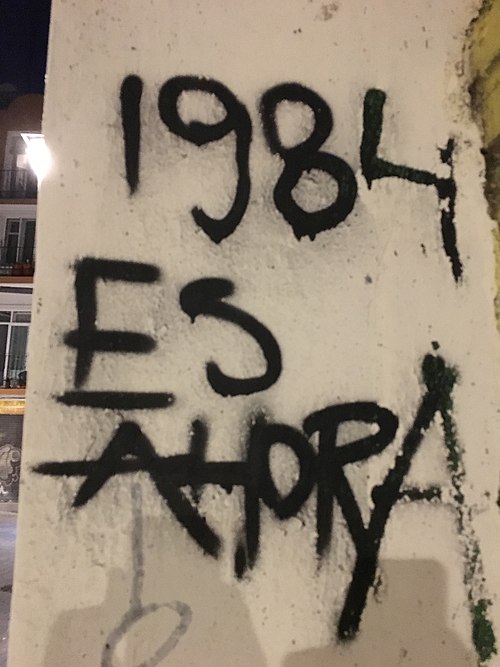
There’s nothing new about calling George Orwell’s most influential novel prescient. But the focus has usually been on his portrayal of the oppressive aspects of life in Oceania, the superstate in which Nineteen Eighty-Four is set.
Today, however, a different feature – which as recently as 2019, some critics dismissed as “obsolete” – is getting more attention: its vision of a world divided into three spheres, controlled by autocratic governments that constantly form and then break alliances.
In 2022, Vladimir Putin initiated Russia’s full-on invasion of Ukraine. This year began with the US mounting a raid on Venezuela and snatching its president, while Donald Trump speculated about US actions against various other countries in Latin America and Greenland. Meanwhile, Xi Jinping regularly repeats China’s intention to “reunify” with Taiwan – by force if necessary.
“Orwell-as-prophet” commentators began showing more interest in the superstate idea early in the decade, often leading with references to Putin’s imperial ambitions. This trend became more pronounced when Trump’s second term began.
Last year, American historian Alfred McCoy led with a tripolar reference in his Foreign Policy essay: “Is 2025 the New 1984?” A Bloomberg report on the Trump-Putin summit in Alaska last August was headlined: “It Looks Like a Trump-Putin-Xi World, But It’s Really Orwell’s”. The article described Nineteen Eighty-Four’s fictional model of global affairs as “prophetic”.
Many observers now see Big Brother-like leaders wielding power in Washington, as well as in Moscow and Beijing. In her first essay of 2026, Anne Applebaum wrote in The Atlantic that: “Orwell’s world is fiction, but some want it to become reality.”
The American journalist and historian noted a dangerous desire of some for “an Asia dominated by China, a Europe dominated by Russia, and a Western Hemisphere dominated by the United States”. Social media is awash with comments and maps in the same vein.
Orwell’s influences
Analysts have claimed that elements of Orwell’s portrayal of politics inside Oceania paralleled various parts of dystopian novels written before Nineteen Eighty-Four. They cite, in particular, the potential influence of Jack London’s The Iron Heel (1908) and Aldous Huxley’s Brave New World (1932) – works Orwell discussed in a 1940 essay.
Then there’s Yevgeny Zamyatin’s novel We (1921), which Orwell wrote about in 1946, and Arthur Koestler’s Darkness at Noon (1940), which he wrote about in 1941. Both inspired him with their criticism of the real Soviet Union.
Could these or other utopian and dystopian texts – such as Ayn Rand’s Anthem (1938), Sinclair Lewis’s It Can’t Happen Here(1935), and Noël Coward’s play Peace in Our Time (1946) – have given him ideas about future geopolitics?
In fact, most of the works mentioned downplay or ignore international issues. Koestler focuses on one unnamed totalitarian country, Zamyatin and Huxley on a single world-state, London and Lewis on an America transformed by a domestic tyrannical movement, and Coward a Britain conquered by Hitler.
Two other novels provide partial precedents. The first is The War in the Air (1908) by H.G. Wells, an author Orwell read throughout his life. It has a tripolar side, depicting a war between Germany, the US and Britain, and a Chinese and Japanese force. The second is Swastika Night by Katharine Burdekin (writing as Murray Constantine).
Orwell never referred to Swastika Night in any publication, and his most prominent biographer, D.J. Taylor, has claimed there is no definitive evidence that he read it. However, as it was a Left Book Club selection and he was a Left Book Club author, Orwell would at least have known about it. The novel describes a world divided into two rival camps, not three, but portrays allies becoming rivals. The competing superstates are Nazi Germany and imperial Japan, who were on the same side when the book was written.
In his own words
The most satisfying place to look for inspiration for Nineteen Eighty-Four’s geopolitical vision, though, is in Orwell’s own experiences and non-fiction reading. Before the 1940s, Orwell spent a lot of time learning and writing critically about three oppressive systems: capitalism, fascism and Soviet communism.
In terms of capitalism, working as a colonial police officer in Burma in the 1920s left him disgusted with what he called the “dirty work of empire”. Living in England later led him to write works on class injustices such as The Road to Wigan Pier (1937).
In terms of fascism, he wrote scathingly about Hitler and Franco. Orwell was also appalled by accounts of repression under Stalin. His time fighting in Spain reinforced his dark view of Moscow and he saw erstwhile allies become arch-enemies as the anti-Franco coalition broke down, and the Soviets began treating groups that had been part of it as villains.
Second world war news stories had an impact as well. In 1939 and 1941 respectively, newspapers were full of reports of Moscow and Berlin signing a non-aggression pact, and then of Moscow switching sides to join the Allies.
And in a 1945 essay, Orwell mocked news of many people on the left embracing the fervently anti-Communist Chinese Nationalist Party leader, Chiang Kai-shek, once he was with the Allies – seemingly having forgetten their earlier disdain for Chiang’s brutal effort to exterminate the Chinese Communist Party.
But perhaps the most notable 1940s news story of all relating to Nineteen Eighty-Four’s geopolitics has been flagged by Taylor as one that broke in 1943. He notes that Orwell sometimes claimed a key inspiration for his final novel were the reports of Roosevelt, Stalin and Churchill talking at the 1943 Tehran conference about carving up the post-war world into three spheres.
Nineteen Eighty-Four has had extraordinary longevity as a go-to text for political commentary. There are many explanations for its staying power, but right now a key feature of it may be its relevance to thinking about both repression of dissent and Newspeak-style propaganda in many individual countries – and the unsettling geopolitical tensions in the world at large.


Be the first to comment