
A recently leaked “ecumenical framework concept” shows that even Germany’s churches are getting ready for war.
Pascal Lottaz is a (Swiss) academic in Japan, Associate Professor at Kyoto University, working on neutrality in IR. He also runs the YouTube show “Neutrality Studies”, where he explore world politics with various guests.
Cross-posted from Pascal Lottaz’s Substack
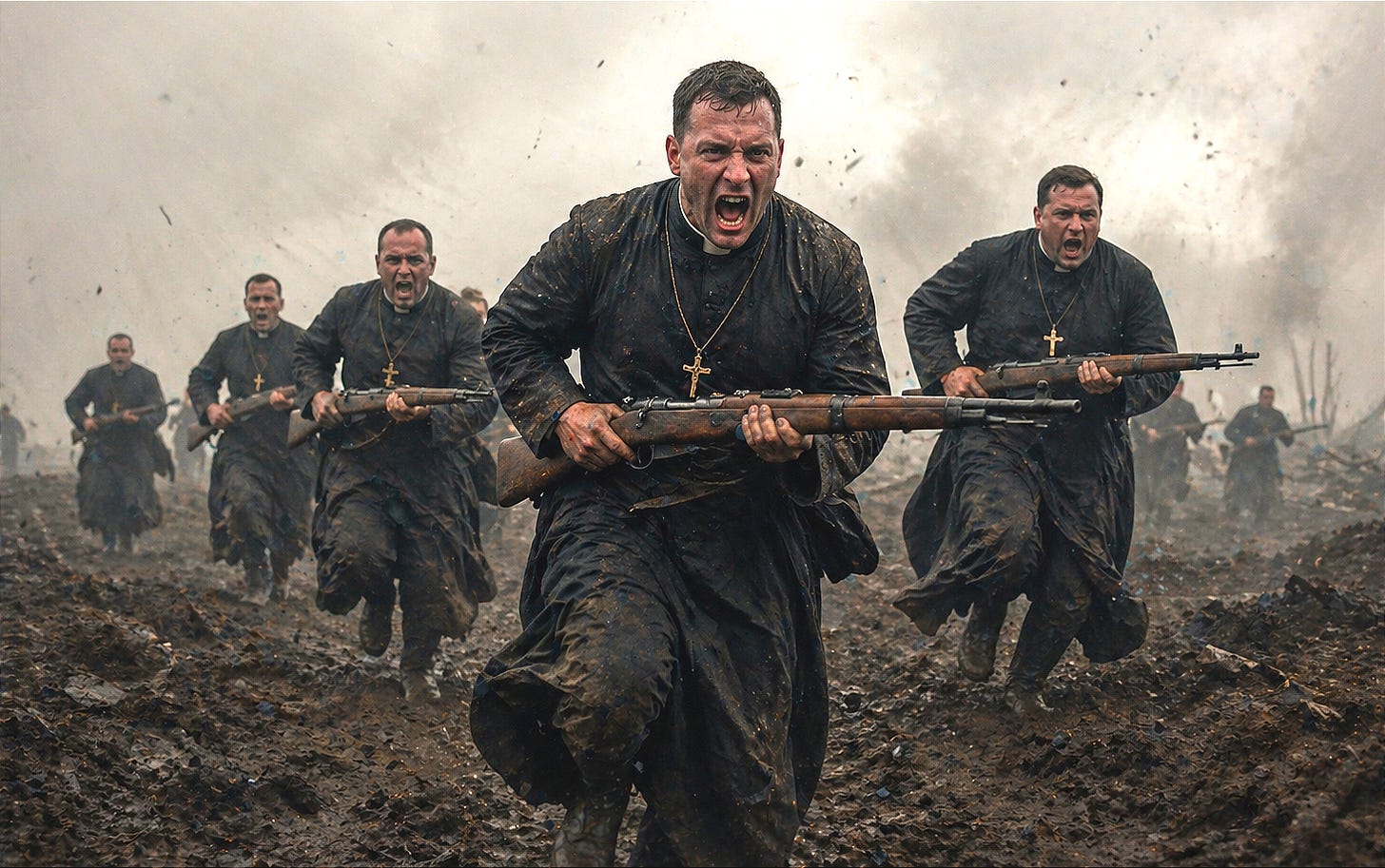
In the following I’m linking to the so called “ecumenical framework concept” that Dr. Ulrike Guérot shared with me in a recent talk (German version here, English version coming soon). It’s a scary read, because it shows how far the war-psychosis has already gone in Germany. Summary by AI, full paper (in German) here.
Summary
Dated September 2025, the “ecumenical framework concept” is considerably more than a document of pastoral planning. It is a sober preparation document for the eventuality of war — and as such, a telling indication of how seriously German institutions, including the churches, now regard the possibility of military conflict in Europe.
The document’s starting point sets the framing for everything: according to the assessments of all relevant actors from the military, intelligence services, and academic research, Russia could be in a position to attack NATO territory before the end of this decade. Germany is already preparing institutionally for this scenario — through a National Security Strategy published in 2023, a Bundeswehr operational plan for Germany, and framework guidelines for comprehensive national defense. The churches’ framework concept is explicitly presented as a contribution to this broader societal preparedness logic, which the state has consolidated under the concept of “integrated security,” in which ecclesiastical actors are expressly designated as civil-society partners.
The concrete demands of the paper are radical. It calls for the systematic preparation of all fields of church pastoral care — from parish and hospital chaplaincy to military, police, and prison chaplaincy — for scenarios involving large numbers of wounded soldiers, fallen combatants, prisoners of war, and refugees. The churches are not expected to improvise; rather, they are called upon to establish crisis management teams now, to keep notification chains current, to clarify lines of responsibility, and to train personnel in advance. The guiding motto is telling in its directness: “In a crisis, know your people.”
Particularly revealing are the concrete scenarios for which the document prepares the churches. In the alliance case — assessed as the most probable scenario — Germany would function as a logistical hub for NATO forces. This entails the transit of troops and materiel through German territory, the repatriation of large numbers of wounded and fallen soldiers, refugee movements from Eastern Europe, and potential attacks on critical infrastructure and cyber systems. Drawing explicitly on lessons from the war in Ukraine, the document anticipates that casualty figures will be very high. Hospital chaplains are expected to prepare for triage situations; emergency chaplains for mass traumatization events; parish chaplains for accompanying bereaved families on a scale previously unknown in peacetime Germany.
The paper further demands close institutional coordination between church structures and state authorities at both federal and state levels. Church offices attached to state governments are to function as permanent institutional interfaces. At the federal level, the establishment of an approximately ten-member ecumenical crisis staff is under consideration. The churches are to know precisely who holds supervisory authority in an emergency — over emergency chaplains, hospital chaplains, and church employees who simultaneously serve in volunteer fire brigades or the Federal Agency for Technical Relief. This clarity is anything but self-evident; it presupposes extensive legal and organizational preparatory work.
Taken as a whole, what this document makes visible is a society that is — at the institutional level — preparing for war, without publicly naming it as such. Churches are being called upon to become part of a national preparedness infrastructure. While the paper is careful to assert that it does not touch the peace-ethical commitments of either church, it nonetheless enacts a substantial operational reorientation in practice: away from an abstractly peace-ethical posture and toward concrete crisis planning within a state-coordinated framework of comprehensive national defense.
For Germany, this means that preparation for a possible war is no longer a purely military affair. It now increasingly permeates all societal institutions — reaching all the way down to the individual parish.


Be the first to comment