
Persian civilisation is a cornerstone of human civilisation: what Trump wants to destroy is humanity itself.
Soumaya Ghannoushi is a British Tunisian writer and expert in Middle East politics. Her journalistic work has appeared in The Guardian, The Independent, Corriere della Sera, aljazeera.net and Al Quds. A selection of her writings may be found at: soumayaghannoushi.com and she tweets @SMGhannoushi.
Cross-posted from Middle East Eye
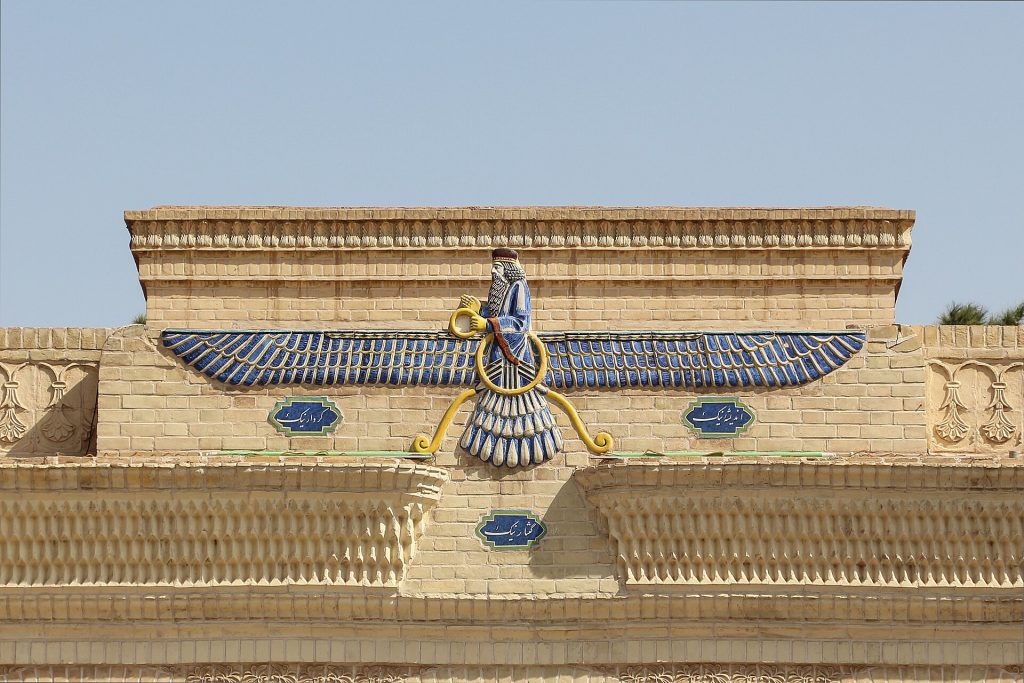
So US President Donald Trump wants to return Iran to the “Stone Ages where it belongs“.
A line intended to project force and intimidate.
Instead, it reveals something far more telling: not strength, but a profound illiteracy of history, of civilisation, and of the very region he threatens to dismantle.
Little does the brutish real estate mogul, confined to the shallow logic of deals and property, understand that Iran, historically Persia, was shaping the foundations of organised civilisation long before the modern West existed in any meaningful form, and centuries before the United States was born.
This is not rhetorical flourish. It is a historical fact.
In the sixth century BCE, under Cyrus the Great, Persia established one of the largest empires the world had ever seen, stretching from Central Asia to the Mediterranean. It developed systems of governance, taxation, infrastructure, and communication that would later shape imperial models, including Rome.
The Cyrus Cylinder articulated principles of religious tolerance and the protection of communities, concepts that stand in stark contrast to the language of annihilation now being invoked.
Engines of civilisation
Persia did not vanish with antiquity. It endured conquest, absorbed upheaval, and regenerated itself with remarkable continuity. The campaigns of Alexander the Great did not erase it. Nor did the devastation wrought by Genghis Khan.
What was shattered was rebuilt. What was fractured was reassembled.
It found new expression under the Abbasid Caliphate (750–1258 CE), within the orbit of a rising and radiant Islamic civilisation. Baghdad may have been the imperial capital, but its energy coursed through a constellation of Persian cities at the forefront of human development. Nishapur, Rayy, Merv, Balkh, Tus, and Isfahan were not peripheral outposts. They were engines of civilisation.
They produced scholars, physicians, poets, and mathematicians who shaped entire disciplines. Poet, mathematician, and astronomer Omar Khayyam in Nishapur, Abu Bakr al-Razi in Rayy, and Ferdowsi in Tus represent only a fragment of this intellectual landscape.
These cities were bound not merely by trade routes, but by the circulation of ideas, manuscripts, and scholars, forming a dense and dynamic ecosystem of knowledge.
At the heart of this world stood institutions such as Bayt al-Hikma (the House of Wisdom), where Greek, Persian, and Indian knowledge was translated, studied, critiqued, and expanded, later helping to form the foundations of the European Renaissance.
It was here that Muhammad ibn Musa al-Khwarizmi formalised algebra and gave the modern world the concept of the algorithm. Ibn Sina produced medical works that would dominate European universities for centuries. Al-Farabi and Al-Ghazali engaged deeply with Aristotle and reshaped his thought.
At a time when Baghdad, Nishapur and Merv sustained complex urban life through advanced systems of water management, healthcare, and learning, much of medieval Europe remained rudimentary, defined by poor sanitation, overcrowding, and fragile infrastructure.
This is not polemic. It is a historical fact. And yet, this is the civilisation Trump aims to reduce to the “Stone Age”.
The danger lies not in the phrase itself, but in the logic that follows. Because this “Stone Age” is not metaphor, it is method.
A systematic destruction
It is already being ruthlessly enacted. Research centres lie in ruins. At Shahid Beheshti University, a major scientific hub in Tehran, advanced laboratories have been struck.
Across the country, universities, including leading engineering institutions such as the Iran University of Science and Technology, have been bombed.
Medical infrastructure has not been spared. The Pasteur Institute of Iran, central to vaccine development and public health, has been hit.
Laboratories, universities, and medical centres are not incidental casualties. They are targets. This is not accidental destruction. It is systematic.
A strategy not simply to weaken a state, but to dismantle the foundations of civilian life itself. To drag a society backwards by design.
In Israeli media spaces, the unthinkable is increasingly aired with disturbing ease. Panels have entertained, even joked about, the use of nuclear or neutron weapons against Iran, with the chilling premise that populations could be eliminated while infrastructure remains intact.
This is not strategy. It is the normalisation of annihilation.
The objective is not only the destruction of the present, but the erasure of the past. It is the demolition of history itself, and its rewriting.
In this worldview, Palestine is not the exception. It is the model.
The destruction of Palestine has always been accompanied by a narrative, a myth: “a land without a people for a people without a land”.
A place dense with history, culture, and civilisation recast as empty and waiting to be claimed. This is not historical error. It is colonial strategy.
This is how erasure works.
Not only by changing reality and redrawing maps, but by wiping out the past, rewriting history, and reconstructing memory.
Military power alone is never enough. It advances hand in hand with mythology. The logic of Amalek, not merely to defeat an enemy but to exterminate it.
A demonising discourse
At a recent White House gathering of evangelical leaders, the Book of Esther was invoked, casting modern Iranians as the heirs of an ancient enemy, before declaring that God has raised up Trump for this moment: to annihilate the wicked Persians and fulfil divine prophecy, Trump has gone further by justifying the destruction of civilian infrastructure by dismissing Iranians as “animals“; the same people he claims to liberate with his bombs.
Of course, once you strip a people of their humanity, anything you do to them becomes justifiable.
Two decades ago, during the Iraq war, the same demonising discourse was used of Arabs. Two years ago, during the Gaza genocide, of Palestinians. Today, of Iranians.
The war machine does not simply fight enemies. It manufactures them. It produces and reproduces its demons, its monsters; each one necessary to justify the brutality that follows.
Nor is this merely a reaction to Iranian defiance. A week into the war, Trump spoke casually of Iranians having “horrible genes“, not like “our own”, resurrecting the most violent language of racial extermination.
Layered onto all this is the old colonial doctrine once called the white man’s burden. Today, it is recast as an American and Israeli civilising mission imposed upon a region framed as backward, subhuman, chaotic, and expendable.
Trump draws from this instinctively.
To him, the Middle East is not a civilisation, but a ledger: oil, energy, trillions to be extracted.
And wherever there are centres of history, knowledge, and continuity, they are to be demolished, returned to the “Stone Age”.
And this logic does not stop at Iran.
Because to destroy Iran’s infrastructure, its energy systems, industrial base, and scientific institutions is to wreck the entire Gulf region, supposedly America’s ally and the guardian of its dollar.
Modern Gulf states, built on the oil boom of the 1970s, depend on deeply interconnected systems: energy flows, trade routes, financial markets, and infrastructure networks.
Strike Iran, and the shock reverberates around: ports, pipelines, markets, supply chains; all exposed. Not Iran alone, but its neighbours too are threatened with being dragged into the same abyss.
And if Iran, the state Trump threatens to demolish, is millennia old, these states are recent constructs, far more fragile, and far more vulnerable.
In the Middle East, “America First” is a myth.
The operative logic is “Israel first”.
A vision of managed collapse
American power is deployed in service of a broader regional vision articulated by Israeli Prime Minister Benjamin Netanyahu, his defence minister Israel Katz, and his national security minister, Itamar Ben Gvir.
A vision of fragmentation and managed collapse. A region broken into pieces. A landscape of wrecked entities where Tel Aviv rises as everything around it is driven into ruin, a single “city on a hill”, expanding in every direction, a “New Jerusalem” monopolising prosperity, while everything else lies shattered.
And yet, this model has already revealed its limits.
The United States toppled Saddam Hussein in three weeks. And then spent years trapped in the chaos it created.
What forced its withdrawal from Iraq and Afghanistan was not defeat in battle. It was the disorder it unleashed.
The United States and Israel have demonstrated that they are capable of immense destruction. They can assassinate, bomb, and level entire cities. But destruction is not success, or victory, nor is it worthy of applause.
You can pulverise a city, but you cannot subdue a people.
To speak of returning Iran to the Stone Age is not a mark of strength. It is a confession of political failure and moral bankruptcy.
Trump cannot return Iran to the Stone Age, because it has not been there for thousands of years.
What he is doing instead is dragging America into one.
Into an age of savagery.
Into the logic of the Stone Age.


Be the first to comment