
Another independent, progressive media outlet in Europe has bitten the dust. There are very few of us left now.
Cross-posted from Equal Times
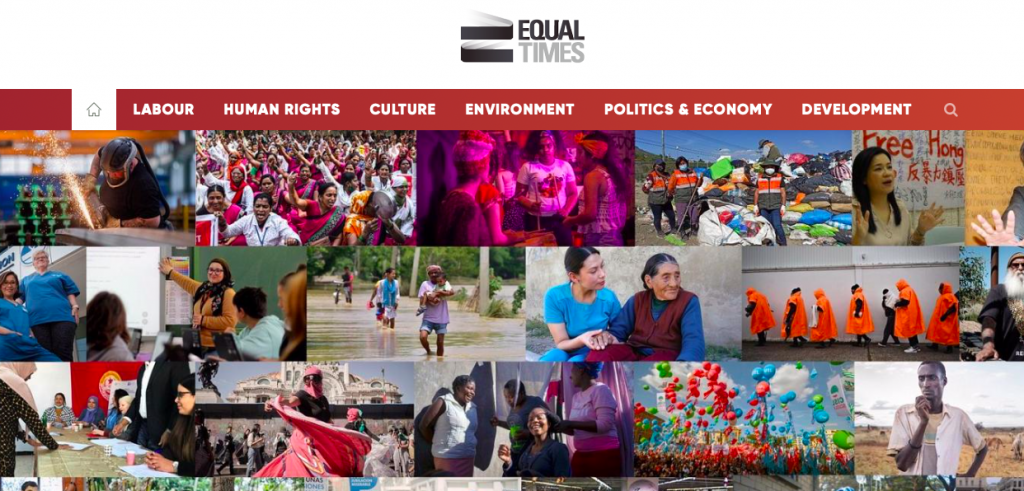
This is it. Our final article. Equal Times, the global labour news platform, will cease to publish as of December 2025. The website – which was, for more than a decade, an invaluable resource on the realities of work, society, fundamental rights, and more: the victories secured, the innovations introduced, but also the many indignities, injustices and stubborn anachronisms endured – will remain online, but no new content will be added.
We launched back in autumn 2012 with a simple mission to try and help fill “the worker-sized gap in the global news media”. At a time when trade unions were mostly talked about, sneeringly, in relation to the inconvenience caused by a strike or the perceived audacity of public sector pay demands, the International Trade Union Confederation identified the urgent need for worker-centred, social justice journalism. Journalism that would “give a real-life perspective on events and issues where established media simply follow the recipe set for them by corporations and high finance,” as the then-secretary general Sharan Burrow wrote in our launch article on 16 September 2012.
Since that time, we have published thousands of original articles in English, French and Spanish, working with an international network of over 1,000 journalists, photographers, trade unionists, researchers and civil society activists from every corner of the globe, expanding far beyond our initial focus to also explore human rights, development, environmental issues, politics and the economy, and culture. Although our primary format was always in-depth articles, over the years we published a variety of formats, including (but not limited to) opinion pieces, short documentaries and photo essays.
“Go slow and dig deep”
Our ethos was ‘go slow and dig deep’, committing – particularly after the initial launch – to abandon the grind of daily news production to focus on between two and six articles a week so that we could zero in on the stories that weren’t being published elsewhere and take the time to do them justice. As a journalist from our Spanish language network told us: “You have a unique vantage point on the problems that actually decide what kind of future of work we’re going to have: labour transitions, new inequalities, the pressure of technology on jobs, and how to stop the wealth gap from hardening into something permanent. You see all of that globally, rigorously, and through workers’ realities on the ground. That perspective is incredibly rare, and it’s the kind of perspective that can help shape real solutions.”
We didn’t publish stories based on how many clicks they would generate; instead, we were guided by the duty to ensure that the voices of working people, and other groups traditionally sidelined by the mainstream media, were etched on the public record and made widely available with free access and professional translations in English, French and Spanish.
Or read a deep dive into the obscure energy policy undermining the Paris Climate Agreement on the same website as a piece about labour market inclusion for people living with disabilities in Latin America and the degradation of translation work? Several of our articles have won awards, and many have had great impact: by winning and breaking hearts, changing minds, opening eyes and directly impacting policy.
We covered a truly expansive range of topics, from the battle to protect the right to striketo the multifarious impacts of the twin digital and energy transitions on the future of work. Our articles explored the care economy, workplace democracy, supply chains and trade deals. If you are looking for articles on the devastating impact of the overreach of corporate power on our lives, or the global fight for Indigenous, disability and LGBTQIA rights, for detailed coverage on the efforts to eradicate gender-based violence, genderand racial discrimination, you will find them on Equal Times. But if you also want to read about the glorious heritage of Peruvian potatoes, Iran’s burgeoning rock scene or the life and works of Burkina Faso’s first female author, you can also do that, because we wanted to acknowledge that the exploration of the world of work and working people cannot be done meaningfully without understanding the wider cultural, social, economic and political context.
Crucially, we were able to connect the dots: if, for example, the working class in Lisbon, Accra, Caracas and Miami are all struggling to afford decent housing, then maybe the issue goes beyond how much money young people are spending on coffee?
And perhaps if workers from the Philippines to the United States are under ever-increasing pressure to maintain their jobs – despite reduced wages, eroding rights, decaying working conditions and under the constant threat of occupational obsolescence – then maybe jobs aren’t disappearing because the march of technological progress makes it inevitable, but because the people with the power to do so are defining which jobs are socially useful and which ones are not.
“More than just a publication”
We were only a small editorial team, rarely more than three editors (one for each language), but everyone involved – the editors, the journalists and the translators – poured their heart, soul, knowledge and experience into this project. Although the topics that we covered were often heavy, we truly found joy in our work and in being in community with one another. And are deeply proud of the way in which we worked – with intention and with respect for the source, the subject and the messenger. As a journalist from our English language network said: “Equal Times was more than just a publication for me – it was a place where I found my voice as a journalist, at a time when other outlets might not have listened. Your openness, trust, and commitment to amplifying diverse perspectives gave me the confidence to tell stories that mattered, and I’ll always be grateful for that.”
Another, from our French language network, wrote upon hearing the news of our closure: “It wasn’t just Equal Times’ editorial line that I admired – it was also the fact that I felt respected as a worker, something that to me felt deeply tied to ET’s trade union background. Having spent years working as a freelance journalist, I have many horror stories about unscrupulous newsrooms exploiting precarious journalists, paying little, late, or not at all. It genuinely meant a lot to be able to trust a publication not to take advantage of us, as writers and photojournalists.”
ou will continue to have full, free access to our digital archive. Please explore it. It is our profound desire that our journalism can continue to inform, inspire and activate others.
The work is never finished. There is always so much more to bear witness to, particularly during this time of such profound change. So please continue to read and support progressive, independent journalism (see here for a list of suggestions). At a time when many businesses are convinced that they can replace people with AI, it has never been more important to support the endeavours that value and centre the work done by skilled, dedicated and committed people.
So thank you, dear reader, and goodbye for now. Your support sustained us, and we hope that the legacy of our work will continue to sustain you.
In solidarity and with gratitude,
Tamara Gausi (editor in English), Marta Checa (editor in Spanish) and Mathilde Dorcadie (editor in French)

Be the first to comment