
Starmer and the media need convictions to justify Palestine Action’s proscription as a terrorist group. Rajiv Menon KC spells out to the jury why it is a vital last defence against government tyranny
Jonathan Cook is the author of three books on the Israeli-Palestinian conflict, and a winner of the Martha Gellhorn Special Prize for Journalism. His website and blog can be found at www.jonathan-cook.net

My thanks to Craig Murray, former UK ambassador turned whistleblower, for alerting me to what he rightly calls “one of the greatest legal speeches – including historical speeches – I have ever read”. It is that indeed.
It was made by Rajiv Menon KC and is addressed to the jury in the current “Filton Trial” at Woolwich Crown Court. There, six Palestine Action-linked activists are being prosecuted over a break-in in August 2024 at a Bristol factory owned by Israel’s largest weapons manufacturer, Elbit Systems. The six used sledgehammers to smash killer-drones that were being built at the factory and sent to Israel for use in the Gaza genocide.
At the time of the break-in, Palestine Action was a legal organisation. Nearly a year later, the government of Keir Starmer declared it a terrorist group – the first time in British history that a non-violent direct action organisation has been proscribed.
The defendants, like other Palestine Action activists held on remand, have been treated as terrorists – with special, inhumane restrictions on them in prison – even though none is charged with a terrorism offence. That is the background to a prolonged hunger strike by three other activists – not those currently on trial – which is putting their lives in imminent danger.
The Filton Trial is being exploited for political ends by Starmer’s government, which is actively complicit in Israel’s genocide, as well as the establishment British media, which has sought to obscure the criminal nature of Israel’s actions. Both hope to use any guilty verdict as justification for Palestine Action’s proscription as a terrorist organisation.
As Murray points out, a separate High Court panel reviewing the legality of the government’s proscription decision has so far delayed its ruling. It is likely to be waiting for the Filton Trial to complete so it can seize on any guilty verdict to side with the government.
All will be pinning their hopes on the fact that one of the defendants, Samuel Corner, is charged with injuring a policewoman during a tussle over one of the sledgehammers that was being used to smash Elbit’s drones.
The goal has been to suggest that this incident was both intentional and indicative of a supposed, secret terrorist agenda by Palestine Action. That is patently laughable, but seems to have taken root among more impressionable sections of the public exposed to relentlessly skewed media coverage.
Mr Menon is the barrister representing Charlotte Head, who, like four of the others, is charged with three offences: aggravated burglary, criminal damage and violent disorder.
In his speech, he carefully unravels the prosecution’s – and, of course, the government’s – charge that the break-in was aggravated burglary. As Menon points out, for that to be true, Head and the others would have had to have harboured an intention to use the sledgehammers to hurt the guards when they broke into the factory. There is precisely no evidence that that was the case.
He also dismisses the claim of violent disorder against Head. For that to be true, she would have needed to have actively colluded with the others in using or threatening violence – violence that was not in self-defence or to defend someone else. This charge usually applies in circumstances such as pub brawls or football match fights. The test is whether a hypothetical “bystander of reasonable firmness” – someone uninvolved – would feel their safety was in danger from the fracas.
Again, Menon makes a compelling case that at no point was this true of Head, and suggests that the reason the video footage of the confrontation between the activists and the security guards looks so threatening is largely because one of the guards menaced the women, and twice assaulted an unarmed male activist, Jordan Devlin, with a sledgehammer.
But the most astonishing part of his speech relates to the third charge: criminal damage. The defendants have only one available defence against this. In legal parlance, it is called “lawful excuse”. It means that any criminal damage they caused can be viewed as lawful because it was designed to prevent the commission of a far graver crime – in this case genocide.
At one point in the trial a jury member sent a note to the judge, Mr Justice Johnson, asking this very question: “If we decide that they [the defendants] genuinely believe that they were performing life-saving action and were morally compelled to destroy weapons they believed were going to be used to kill civilians in what they believe to be an illegal genocide, would that amount to a lawful excuse?”
The judge, who repeatedly stifled efforts by the defence to air evidence of Elbit System’s involvement in the genocide, answered that the jury must not take into account such “lawful excuse”. In his words: “There is no evidence in this case of anything that is capable in law of amounting to a lawful excuse, so that is not something that you need to consider.”
Menon refuses to take this lying down and eloquently defies the judge’s ruling and does so in a way that skates close to, but carefully avoids, contempt of court.
He makes a rousing defence of the right of juries to reject judicial interference, and of their right to make up their own minds both on guilt and on factors that might mitigate guilt – and he does so at the very moment when Starmer and his ministers are seeking to eradicate the principle of jury trials.
All of Menon’s speech is worth reading, though it is very long. I append here just a small section: his direct challenge to the trial judge – with the most defiant passage highlighted in bold. It is a powerful defence of one of our fundamental rights, rights that are gradually being whittled away by growing establishment authoritarianism.
Rajiv Menon KC on behalf of defendant Charlotte Head, 8 January 2026:
Ms Heer [the prosecution barrister] in her closing speech, on much the same theme, told you that the defendants who had given evidence had not raised any real challenge to the charge of criminal damage. I’m sorry, but it is not right to say that the defendants who gave evidence did not raise any challenge. They did raise a challenge. They maintained that they had a lawful excuse. That was their challenge. But what’s happened is that His Lordship [the trial judge] has withdrawn that defence as a matter of law, and that’s the true position that we find ourselves in. Their challenge was lawful excuse and the court has withdrawn that as a lawful defence. So where does that leave you, the members of the jury?
You could be forgiven for thinking that His Lordship is in fact directing you, as a matter of law, to convict Charlotte [Head], who I’ll focus on for now, of criminal damage. But you’d be wrong to think that. His Lordship is not directing you to convict. In fact, not only is he not directing you to convict, but he’s also absolutely forbidden from doing so as a matter of law. The law is crystal clear on this point. No judge in any criminal case is allowed to direct a jury to convict any defendant of any criminal charge, whatever the evidence might be. That is the law.
Please remember that fundamental principle at all times when you retire. Please don’t misinterpret anything in His Lordship’s directions or summing up (which will follow the defence speeches) as amounting to a legal direction to convict. That would be a terrible mistake to make. I repeat, His Lordship is absolutely not directing you to convict, because he’s barred as a matter of law from doing so.
The jury has every right to be confused about this because it is confusing. You have every right to think that the distinction between withdrawing the only available defence to a criminal charge on the facts, and a direction to convict, is at best a distinction without a difference. You have every right to think that the two effectively amount to the same thing. But the fact of the matter is they are absolutely not the same thing. They are fundamentally different. Let me try and explain it.
If you look at the legal directions and the first section, headed Functions Of Judge And Jury, you’ll see it’s quite lengthy. I’m not going to go through it point by point, but I’d ask you to read it carefully when you retire. All the directions in this document are important, but I’d suggest that the directions on the function of judge and jury are particularly important in this case. The key point to summarise is that the facts, and the verdicts you return having considered the facts, are solely for you.
So nobody, not even His Lordship, can direct you as to what factual conclusions to reach. Nobody, not even His Lordship, can direct you to convict. It’s as simple as that. That’s the law. So, for the avoidance of any doubt about this, I am absolutely not asking you to disregard His Lordship’s legal directions. On the contrary, I’m asking you to follow them, in particular this section on functions of judge and jury, and remind you that nobody, not even His Lordship, can dictate to you what factual conclusions to reach in this case, nor direct you to convict the defendants of any of the charges they face.
Indeed, it was as long ago as 1670 that the independence of the jury was definitively established beyond question. William Penn and William Meade were Quakers. They were prosecuted for preaching to an unlawful assembly. It was a crime in 1670 (about 20 or 30 years after the end of the English Civil war) to have a religious assembly of more than five people outside the auspices of the Church of England. And William Penn and William Meade had preached to a group of more than five people on the streets of London. They stood trial at the Old Bailey before a judge and jury, and at the end of the evidence, the judge directed the jury to convict, but the jury refused to convict.
The judge was furious, and again ordered the jury to convict, stating that they would not be dismissed until they did so. The jury again refused to convict. The judge remanded the entire jury in custody for two days and ordered that they be denied all food and water. As the jurors were being taken from court to prison, William Penn, it is said, shouted out, “You are Englishmen, mind your privilege, give not away your right”, to which one member of the jury, Edward Bushel, replied, “Nor shall we ever do.” When the jury returned to court two days later, having not had any food or water for that period, the judge again ordered them to convict. The jury continued to refuse and returned a verdict of not guilty.
The judge fined the jury for contempt of court and remanded them in custody until the fines were paid. Eight jurors paid their fines, but four refused, and one of those was Edward Bushel, who then petitioned a higher court for what is called a writ of habeas corpus, which, if issued by the court, would result in his immediate release from custody. The higher court issued that writ, and Edward Bushel and the three others were released, establishing the right of a jury to return a verdict without fear of punishment from the trial judge.
This legal challenge by Edward Bushel has come to be known as Bushel’s case and is one of the most celebrated cases in British legal history. There’s a marble plaque inside the Old Bailey in central London, which reads as follows:
Near this site, William Penn and William Meade were tried in 1670 for preaching to an unlawful assembly in Grace Church Street. This tablet commemorates the courage and endurance of the jury, Thomas Veer, Edward Bushel, and 10 others who refused to give a verdict against them, although locked up without food for two nights and were fined for their final verdict of not guilty. The case of these jurymen was reviewed on a writ of habeas corpus, and Chief Justice Vaughan delivered the opinion of the court, which established the right of juries to give their verdict according to their convictions.
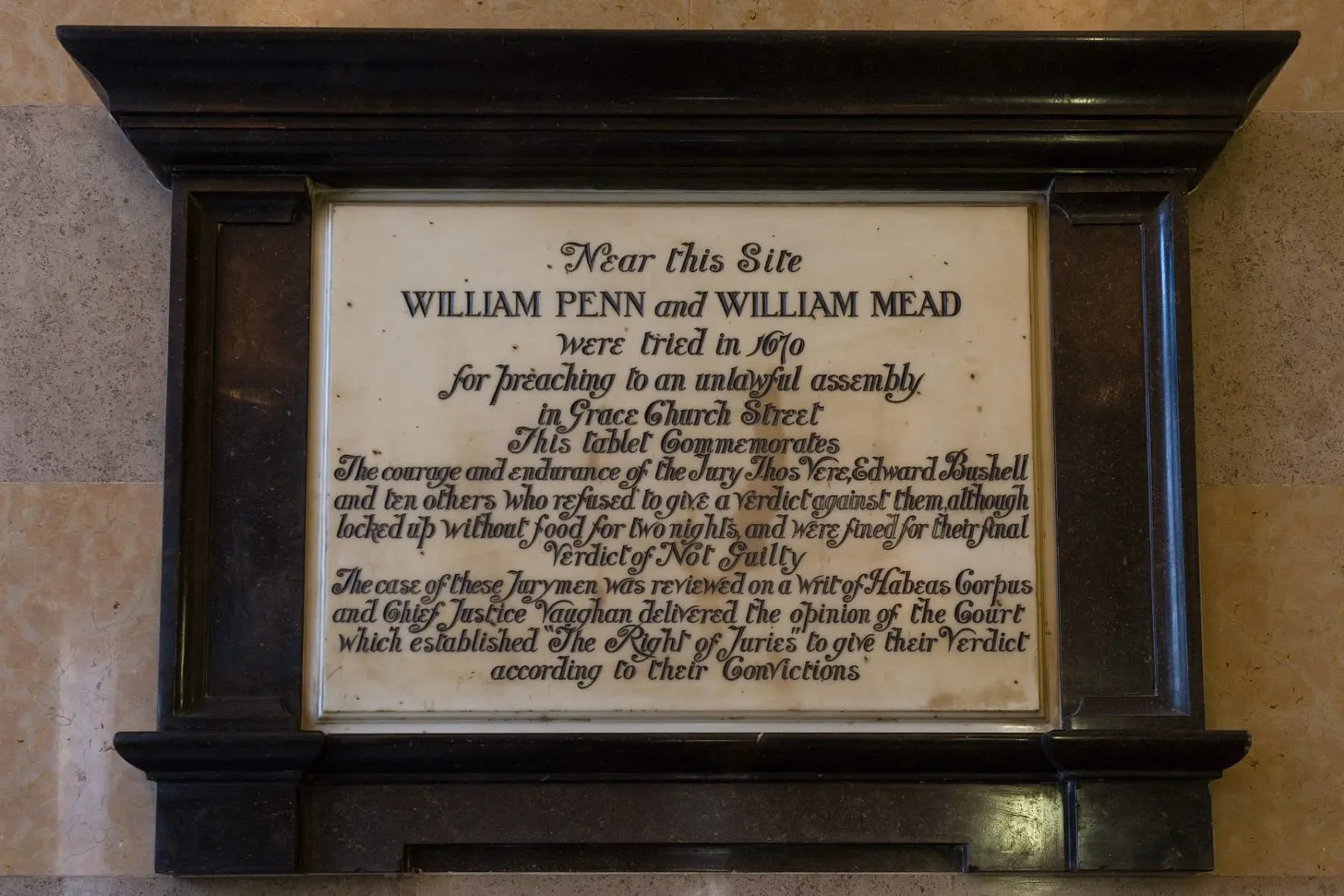
Putting that all together, members of the jury, you can find Charlotte and her co-defendants not guilty of criminal damage. It is a perfectly fair and proper verdict for you to return in this case. Please don’t think for one moment that you are somehow barred as a matter of law from doing so. Indeed, you should find Charlotte and her co-defendants not guilty of criminal damage. It will undoubtedly take great courage and independence, I accept, to do so. But the facts ultimately are solely for you. Please don’t forget that. And don’t worry – the good news is that we’ve moved on since 1670. There is no prospect of you being imprisoned or fined for the factual conclusions you reach or for the verdicts you return.
And that brings me, as far as criminal damage is concerned, to His Lordship’s summing up of the evidence, which will follow defence speeches. Now, I have no idea how he is going to pitch this, how he is going to approach his summary of the evidence. He might do what most judges do these days, namely sum up the evidence without making any comment, without expressing any opinion, without any edge, without any spin, without any innuendo, i.e. 100% neutrality. You may think that would be the fairest approach to take, given a trial judge is like a referee or umpire. But our system does allow judges to make comment and express opinion, even strongly, in certain circumstances. As long as the summing up remains balanced and impartial, as long as the fundamental right of every defendant to a fair trial isn’t undermined, as long as the jury is directed that you are entitled to reject any judicial opinion on the facts if you wish, as His Lordship has already directed you, and as long as any judicial opinion or comment is not wrongly expressed as a legal direction that you must follow. So if His Lordship does decide to express an opinion on the evidence, please do not, under any circumstances, misinterpret that opinion as a legal direction, because it is not.
Obviously, if you agree with the judge’s opinion, you may adopt it. But the opposite is equally true. If you don’t agree with the judge’s opinion, you may reject it. That is your right. That is your privilege, as jurors, because I repeat, you are the sole judges of the facts. Nobody, not even His Lordship, can direct you to convict in this case. So that’s what I say about criminal damage.
Please note: Craig Murray is pursuing a separate judicial review to the current English one in Scotland, which has a different legal system. There is a good chance he may be able to get Palestine Action deproscribed in Scotland, thereby making a mockery of its proscription in England and Wales.
In effect, he is defying the British government. We can be sure Starmer will throw everything he can at getting any countervailing Scottish ruling quashed. Murray needs money to make his case and defend us all from the government’s terrifying overreach. You can find details of how you can help in his article here.


Be the first to comment