
2025 is the first year that a million hectares were burnt in forest fires across Europe, but as the scale of the problem grows the scale of public resources to tackle it does not.
José Álvarez Díaz specialises in international news and development and has worked as a correspondent in China for more than a decade, focusing chiefly on the country’s main economic, financial and commercial hub, the Yangtze River delta, and the country’s relations with the rest of the world.
Cross-posted from Equal Times
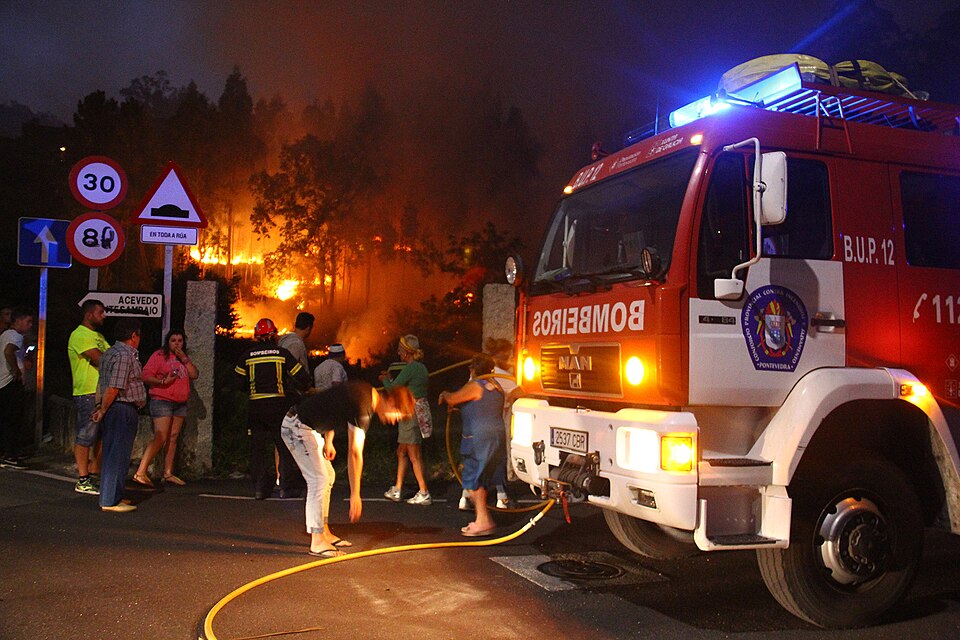
Forest fires are ravaging ever larger areas of Europe, summer after summer. Over a million hectares have burnt across the continent so far in 2025, more than half in Portugal (278,121 hectares burnt) and Spain (391,938 hectares burnt), where the fires that blazed in August and September exposed the plight of forest firefighters struggling with precarious work, inadequate resources and, in some cases, insufficient training. This scandalous state of affairs leaves these workers, and society as a whole, unnecessarily exposed to the potential dangers of summer fires that, with climate change, are becoming increasingly large, difficult to control and are reaching ever higher latitudes of the continent.
Europeans – and their politicians – are not yet fully aware, but these fires are no longer what they used to be. “Unfortunately, the tendency is towards ever more serious fires; not more in terms of their number, but much larger fires,” Roberto Cribeiro, an environmental officer for the Xunta (the regional government of Galicia, in the north-west of Spain) in the Ferrolterra region, tells Equal Times.
Cribeiro has more than three decades’ experience in the north-west of the Iberian Peninsula, the area with the largest eucalyptus plantations on the European continent. We travel for hours with him along the mountain roads of the Sierra de la Capelada, on the north-western coast of Spain, where the cultivation of these fast-growing and economically profitable trees – brought from Australia some 150 years ago and coveted by the timber and paper industry – has so far helped to contain the number of fires but has also introduced a major element of risk. “Eucalyptus is pyrophytic (it burns easily and survives flames, as an evolutionary strategy to eliminate other competing species),” explains Cribeiro.
The environmental officer laments rural depopulation and the lack of adequate land management, factors that make prevention increasingly difficult. He also warns that even Spain’s humid northern coast is no longer spared from the dreaded 30/30/30 conditions (high risk: over 30ºC, less than 30 per cent humidity and winds of over 30 km/h, common on the Atlantic coast) for an ever-increasing number of days each summer.
The risk of a Europe overwhelmed by flames
“The fires I fought in 2005 were not the same as those I fought in 2015, nor those I have fought this year in Galicia,” confirms Ángel Rubio, a forest firefighter with the Andalusian Regional Government, in southern Spain, and coordinator of Climate Action and Just Ecological Transition for the UGT labour union. “These fires make you think the worst about the future. I don’t know if more areas of Europe could be similarly affected, but we have seen simultaneous fires in Mediterranean countries, which has meant that lower-risk countries have had to assist by sending their resources. The EU mechanism has not yet been overwhelmed, but I don’t know whether we can rule out this scenario in the near future,” Rubio tells Equal Times.
“Europe’s large forest reserves are located in the centre of the continent, and if there’s a blocking anticyclone, with continuous heat waves and insufficient rainfall, you have the ideal conditions for a very complex scenario to unfold,” he explains.
Countries in central and northern Europe are not yet prepared for fires of this kind. “Let’s hope I’m wrong, but given the speed at which fires have changed so far this century, and how we in Spain have gone from dealing with forest fires to having to focus on protecting and evacuating populations, within just five or six years, I don’t think this unimaginable scenario is impossible. It’s something to think about, because the leaps have been exponential in recent years.”
With such precarious employment, fires cannot be extinguished in winter
The Iberian Peninsula has already experienced forest fires of Dantean proportions, like those seen in Portugal in 2017 and Spain in 2025. The latter led to weeks of social uproar, and the maxim “fires are extinguished in winter”, referring to the importance of prevention, was widely echoed in the media after light was shed on the untenable working conditions that firefighters have long endured and continue to endure: the shocking lack of job security and resources, temporary or seasonal employment. Not only is their pay unworthy of such dangerous work but they are also deprived of the equipment and often the training needed, as well as having to do literally exhausting shifts due to poor work organisation. For a country that has been increasing its forest cover for three decades (now 56 per cent of its territory), Spain only invests 0.08 per cent of its GDP in fire prevention and extinction. In addition, with this being the responsibility of the autonomous governments, it is managed and resourced differently from one region to the next.
“This level of precarity is a broken leg in the chair of land planning and management,” Anxo Pernas, head of the CCOO-affiliated forest firefighters union in Galicia, tells Equal Times. He points to incompatible approaches even in neighbouring communities governed by parties of the same political persuasion (right-wing, in this case): “In Galicia, we are leaning towards the public sector, while Castile and León is leaning towards the most voracious neoliberalism, with the management model in total decline”, based on privatisation, temporary contracts and radical cost savings. “As a public administrator, you cannot simply wash your hands of the matter and say that Castile and León cannot afford to maintain a fire prevention and extinguishing service all year round,” he insists, referring to the comments made in 2018 by the regional minister for the environment, for whom such a policy was “absurd” and a “complete waste of public money”.
“They only look at economic profitability, but the environment has a social use that is guaranteed by the constitution.” To protect it, we need “professional conditions, not minimum conditions”, not “to play around with a service that, to some extent, is little more than a voluntary outfit”. He also argues that Spain’s depopulated areas also need to be managed, because right now, investments are only made when the damage has already been done. “What do we gain by spending millions on firefighting when we don’t invest in prevention? We need to balance things out. If only the fire service could be idle all day but on standby all year round. Perhaps that would mean that there would mainly be very small fires, which would be extinguished. That would be good land management: preventing fires from becoming so large that, instead of working on extinguishing them, we have to focus on evacuating inhabited areas.”
Portugal leads the way, but much remains to be done
Although the trauma of the summer has led to some promising initiatives, many Spanish regions have not yet learned their lesson, unlike Portugal, the European country most affected by this problem to date. “The fires of 2017 led to a radical overhaul of the management model and gave rise to a structural reform of the system,” Bruno Reis, a firefighter from Covilhã and representative of the STAL local authority workers’ union, tells Equal Times. A single agency was created to unify fire prevention, extinguishing and the recovery of affected areas, as well as an integrated forest fire management system “to strengthen the professionalisation of civil protection agents, increase the number of permanent teams, modernise the technology and improve operational coordination”. The results were immediately visible, and “between 2018 and 2022, there was a significant reduction in the average area burnt and an increase in the effectiveness of our response on the ground”, explains Reis.
“A paradigm shift is needed, moving from an essentially reactive approach to a proactive and adaptive approach,” he says. The precarious nature of the work, he adds, “has a direct impact on the effectiveness and safety of forest fire prevention and fighting operations”: low wages, temporary contracts, the lack of adequate resources and exhausting work schedules cause chronic fatigue and high staff turnover, with the consequent “loss of accumulated experience”. The fact is that “mitigating precariousness should not only be seen as a labour issue”, concludes Reis, “but as a structural element affecting operational effectiveness and collective safety”.
Austerity kills. More firefighters are needed in the Mediterranean
After Spain and Portugal, both Italy (with 84,141 hectares burned) and Greece (with 47,819) have also experienced a 2025 of overlapping forest fires. In Italy, firefighters mainly deal with urban areas, and prevention in the mountains is left to volunteers and the Carabinieri, so coordination – at state level – is good, but job insecurity makes generational renewal difficult in this kind of work, explains Nunzio de Nigris, a union representative for Italy’s FP-CGIL public sector workers’ organisation. “Our most urgent issues are the shortage of staff,” which often means that resources have to be moved from one region to another, depending on the emergencies, “and the lack of safety equipment”, which complicates the task of decontamination after firefighting operations.
In Greece, where “dozens of fires broke out across the country every day” this summer, although only a few developed into large-scale fires, the main problem is the “excessive overtime, due to continuous states of emergency and the allocation of illegal shifts,” Nikos Lavranos, president of the POEYPS federation of firefighters’ unions tells Equal Times. Greece is running short of hands: although it has around 15,500 permanent firefighters and 2,500 seasonal reinforcements, at least 3,500 new recruits will be needed over the next two to three years to replace those who are leaving. “In the end, firefighters extinguish fires with whatever means are available, but the practice of unpaid overtime must stop, and there must be a comprehensive legal framework to guarantee their health and safety at work, to reduce the number of deaths and injuries we have unfortunately witnessed again this year,” Lavranos says. “Climate change leaves no room for complacency,” he stressed.
Speaking from Brussels, Pablo Sánchez Centellas, local and regional government, firefighters and public services officer at the European Federation of Public Service Unions (EPSU), agrees: “This year in Europe we have had a record one million hectares burnt. Year after year we see the surface area of forests destroyed increasing, yet the public investment needed in local and regional public services doesn’t follow,” he points out. “We need a serious commitment from the public authorities and an end to austerity measures that put a limit on the employment of the public service workers dealing with these tasks. We continue to denounce that ‘austerity kills’, and not just workers but also the environment and the planet,” he concludes.
This article has been translated from Spanish by Louise Durkin


Be the first to comment