
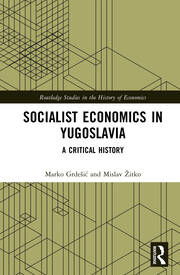
Book Review by Branko Milanovic´
When on 28 June of 1948 Joseph Stalin wrote a latter on behalf of the Cominform to ask Yugoslavia’s communists to get rid of the “Titoist clique” and to return to the “right path”, the problem for Yugoslav communists who rejected Stalin’s letter was not only how to survive without Soviet support but how to explain to themselves and to the world what they are doing. For Communists, ideology was extremely important (my next Substack will deal with that topic in the context of today’s China). Communist policies, in economics or any other social sphere, could never be seen as simple policies. They always had to be justified by a higher end.
Thus, if the only center of Communist movement was Moscow, what were Yugoslav communists doing at all? They began to solve that problem three to four years after the initial shock of the letter had worn off. Instead of state ownership and central planning, they decided that socialism (the first stage of a new Communist society) was, in accordance with Marx’s predictions, characterized by the withering away of the state and by ownership, or at least management, of factories by workers’ collectives. This gave sense to the movement: it was not merely a different Communist regime, but it was a regime of the future much closer to Marx than the Soviet system.
The gradual implementation of labor management, the creation of workers’ councils etc. began in the early 1950s. This led to several obvious questions: if workers make the decisions on what to produce, how to price things etc., does the economy become a market economy and are collectives producing “commodities”, not just “goods”? Does the law of value hold? Their answer was that the Yugoslav system was the one of “socialist commodity production” which in neoclassical terminology means “socialist market economy”. But if the economy is market-based, what is the objective function of these enterprises? What do they try to maximize? Or in Marxist terminology, what is the normal price in such a system?
One did not have to wait long for a neoclassical answer. A young American economist Benjamin Ward who was on a Fulbright scholarship in Yugoslavia provided the answer in a seminal paper published in 1958. Companies were maximizing income per worker while paying a fixed rental for the capital stock that was officially owned by “society”. The rental was in reality a tax on the value of fixed assets used by enterprises. Ward’s paper led to a number of implications about the behavior of such cooperatives: they would employ fewer workers than an equivalent capitalist firm, they may react to an increase in price by reducing output (“backward-bending supply curve”), they would underinvest preferring to distribute income in wages etc. Eventually, an enormous literature, by Yugoslav and foreign economists (but predominantly the latter), emerged on the behavior of socialist (labor-managed) decentralized firm, studied within the standard neoclassical framework. The most ambitious was probably Jaroslav Vanek’s two-volume General Theory of Labor-Managed Market Economies, published in 1970. I have written about that literature previously on a Substack here, and when young I even (very modestly) contributed to it here.
Marko Grdešić and Mislav Žitko, two young Croatian economists and political scientists, in their excellent and extremely well-written and researched new book “Socialist economics in Yugoslavia: A Critical History”, are not interested in this strand of economic thought. Rather, their interest is in entirely different literature generally unknown to Western audiences. It is how Yugoslav economists, many of them quite close to power, visualized the Yugoslav system.
Yugoslav economists’, studied in Grdešić and Žitko’s book, point of departure was very different from the neoclassical labor-managed school that I just described. They saw Yugoslavia as a precursor of a new worldwide society. Yugoslavia was for them what England was to Marx and Engels. Their task was the same as Marx’s: to observe and analyze the new system, its “laws of motion” and to find out how the “commodity-producing socialist enterprises” behave. Their starting point was, in some sense, the transformation problem inherited from Marx’s Capital. The transformation problem arises when the economy moves from simple commodity producing system where prices reflect labor inputs to the capitalist system where the rate of profit is equalized across different branches of production, some more capital-intensive than others, and where Marx’s “prices of production” become the new equilibrium prices. (That “normal price” or “equilibrium price” is, by the way, the same as Marshall’s long-term price, but this is beside the point here.)
The Yugoslav economists thus asked themselves: “what is the new ‘normal price’ in our system in which the law of value applies as in capitalism, but the “deciders” are workers and not capitalists”? As Grdešić and Žitko write: “Does commodity production operate differently in…Yugoslavia, which has introduced social property and workers’ councils, a country… trying to turn wage labor into a community of associated producers?” (p. 30) How would Marx solve this new transformation problem?
Yugoslav economists’ discussion of self-managed socialism thus became entirely independent and unrelated to neoclassical economics (and also largely unrelated to the Marxist economics in the West that studied capitalism only). This is very well stated by Grdešić and Žitko who note the insularity of Yugoslav economic thought: not only were key Yugoslav economists uninterested in the Ward-Vanek-Meade approach, but both Lange-Lerner market socialism and Kornai’s later work attracted very little attention. Theirs was a continuation of Marxist economics now applied to the non-capitalist mode of production. This was not because the Yugoslav economists were ignorant of Western neoclassical developments. The principal authors of the two versions of the Yugoslav school (Milorad Korać and Zoran Pjanić) did their graduate studies in the United Stated and Great Britain. The point is not the knowledge of neoclassical economics; the point is that they regarded the Yugoslav system as a continuation of mankind’s transition to a more socially efficient and just system: there was feudalism, and then there is capitalism, and now democratic management of enterprises, as in Yugoslavia. It was a simple and powerful scheme: “we have to study this new system to find out how the world of the future will look like”. Or as Grdešić and Žitko write in their introduction: “we try to present an argument about the peculiar character of Yugoslav intellectual life, namely, its rather unusual sense of superiority. The Yugoslavs gradually developed a grand narrative –in Marxian term, to boot—that their society was the only beacon of socialist freedom in the world…Yugoslavia was the sole true heir to the Paris Commune and the initial Soviets of the Russian revolution” (p. 4).
Two main schools of thought emerged. The so-called “income price” school led by Milorad Korać, who in the 1970s, mimicking Marx, produced a three-volume treatise on the labor-managed economy, and Zoran Pjanić, who was the principal author of an alternative hypothesis of “specific price of production” as the “normal price”. From today’s perspective, it is often difficult to tell what were the exact differences between the two schools. Korać was perhaps logically more consistent but also more naïve and dogmatic. He argued that the objective function of producers in a decentralized socialism cannot be the same as the objective function of capitalist enterprises. Workers, in his view, maximize net income. Like other “commodity producers” they maximize a variable that reflects their position in the process of production but that variable is not the same as under capitalism. Schumpeterian capitalist-entrepreneur maximizes total profits; workers-entrepreneurs maximize company’s net income (i.e., income which remains after depreciation of capital).
In Korać’s view even the return on fixed assets (on which the state gradually no longer imposed a rental) belongs to the working collective. The income school’s general approach was “rather laissez-faire…most apparent when it came to the supposed trade-off between wages and accumulation. Many economists worried that workers would pay themselves high wages at the expense of accumulation…Korać spent manty years trying to disprove this claim”. (p. 57). In fact, the income school came very close to left-wing libertarian or anarchist position: whatever workers’ councils decided was right: it they decide to use the entire income to pay themselves high wages and to invest nothing, so be it. Some, like an influential politician, Svetozar Vukmanović-Tempo, suggested that there must not be any limit on how high wages can be and that taxation should be minimal. If collective’s income is the product of their work, why should it be diminished by taxation? Income school led, it could be said, to the “sacralization” or workers’ collectives. They could do no wrong.
In Pjanić’s view, however, workers’ collectives were not very different from capitalists: they sought to maximize “profits” after deduction for depreciation and payment of the rental. Hence Pjanić thought that the normal (long-run equilibrium) price in market socialism was a “specific price of production”, not different, in terms of factors that entered in its formation, from the price of production under capitalism. The profit school was (justifiably) worried about workers essentially deciding to give up investments and innovation, to pay themselves high salaries and go on holidays, to create cost-push inflation, all the phenomena that Yugoslav economy in fact exhibited, at times in very strong form (high inflation), in the 1960s and 1970s. They were thus also more interested in macroeconomic policy that the income school largely abandoned in favor of thinking that “workers” left to themselves would somehow solve all these problems.
Although I cannot discuss it here, the book reviews as well the positions of other prominent Yugoslav economists like Branko Horvat and Aleksander Bajt who did not belong to either of the two main schools. Horvat combined Marxism and left-wing Keynesianism and believed in strengthening federal government’s functions in order to provide a predictable framework within which enterprises could flourish—he indeed believed that labor managed economy would always outperform capitalist economy. Bajt was much more interested in macroeconomic management and through his famous monthly publication of economic trends, which continued for some thirty years, was probably the person who knew Yugoslav economy better than anyone else.
The entire debate between the “income” and “profit” schools was buried under the debris following the cataclysmic break-up of Yugoslavia, dismantlement of labor-management, return to capitalist economics, and thus total irrelevancy of whatever was so self-importantly debated from the 1960s to 1989. Grdešić and Žitko discovered that since 1989 nobody has borrowed from the library of the University of Zagreb any of the numerous publications where the two schools and many other Yugoslav economists crossed swords. The great virtue of the Grdešić-Žitko book is to have recovered these writings from the “gnawing criticism of the mice” (to use Engels’ expression) to which they were exposed during the past thirty-five years, to have subjected them to detailed, informed and fair critique and to have thus preserved a part of intellectual history of economics—that we might view today as largely obsolete but whose future might yet surprise us.
Socialist Economics in Yugoslavia – A Critical History by Marko Grdešić and Mislav Žitko
Publsiher: Routledge
ISBN: 9781041025535


Be the first to comment