
What lessons can be learned from the Ukraine-Russia war
Cross-posted from Cross-posted from Aurelien’s substack “Trying to understand the world” “Trying to understand the world”
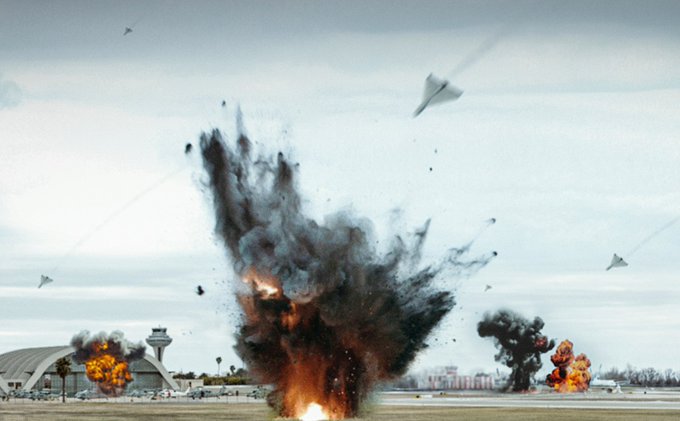
This is a photo from the Ali Khamenei website, which states in its footer, “All Content by Khamenei.ir is licensed under a Creative Commons Attribution 4.0 International License.”
I’ve written on several occasions about the wider conclusions that the West needs to draw from its political and military failure in Ukraine, and the consequent likelihood of having an angry and powerful Russia as a neighbour. As the conflict itself nears its conclusion, we are starting to see pundits talking about the “lessons” of Ukraine for the West, both political and military. But as I will demonstrate, drawing “lessons” from crises is never easy, and naturally enough people tend to draw lessons that comfort them and strengthen their belief in their own powers of anticipation, their current political position, or both. So I thought it might be useful to have a preliminary run over the ground today, and try to set out what I think the major issues actually are, and where the misunderstandings and political struggles are likely to be. As usual, I don’t see any point trying to make firm predictions.
We need to understand first of all that learning “lessons” from any political or military crisis is problematic for various reasons, to the point that some western countries have recognised that it is better to speak more modestly about “lessons identified,” rather than “lessons learned.” The reasons for this are obvious enough: the “lessons” may be impossible to follow through for resource, financial or political reasons, they may conflict with other equally powerful imperatives and, surprisingly often, there is no agreement even on what these lessons are. Moreover, the idea of “learning lessons” implies that they will be applicable, in whole or in part, to other crises that arise in the future (and that such crises will, in fact, arise), and so the lessons are worth learning. Otherwise there is no point. Thus proposals for “learning lessons” from Ukraine imply that crises at least partly similar will arise in the future, and, as we shall see, that isn’t necessarily going to be the case.
Some technical lessons have been historically straightforward to identify and implement. For the UK, the Falklands operation provided a number, which were essentially uncontroversial. For example, too much of the construction of ships was aluminium, which burns easily. Likewise, the superstructure of ships had lots of sharp edges, which increased the radar signature, and finally many of the deaths and injuries were smoke-related, and there was no system of preventing poisonous smoke from spreading. The British and other navies were able to tackle these problems either immediately, or in the course of refits and new construction. The British also realised that their crisis decision-making system was too diffuse and encouraged political struggles (it resembled somewhat the US system today) and introduced a much more centralised system a few years later.
But in most cases, the “lessons” are less technical and not so obvious, and their application even less so. It is as easy to over-interpret the “lessons” of a crisis as it is to ignore them. Just as the military are used to being simultaneously accused of not learning from experience on the one hand and always fighting the last war in the next, so the same criticism can reasonably be made of attempts by governments to learn lessons from crises more generally.
Because I’m not a military specialist, I’m going to skip over very technical questions, where there is anyway a great deal of disagreement. Moreover, the way in which these questions are posed is often not very helpful, and frequently involves weapons fetishists flourishing performance statistics at each other. In the end, whether the planned FX69 or the planned Su141 is a “better” fighter isn’t really the point, unless you take the overall scenario into account. If dogfights (albeit at very long range) will be a feature of future conflicts, and these planned aircraft are involved, then performance characteristics have their place. But we know, for example, that Russian doctrine for air superiority relies very largely on missiles and, even if the FX69 were in some senses “better” when it arrived in service, it might not get near enough to Russian aircraft for that superiority to be useful. The real lessons of crises and conflicts are always at a more general level.
Consider, for example, an attempt to predict the outcome of the Battle of Britain in 1940 just by comparing the performance characteristics of the aircraft involved. This would have left out the main reasons the British won: radar, a centralised operational command, strategic depth (since the RAF could move its fighters North), the fact that German pilots who survived being shot down were effectively lost whilst British pilots were not etc. etc. Nor should the political decision to rearm and to expand the RAF be forgotten. Some details of performance were relevant (such as the limited endurance of German fighters) but they were far from the whole story. And even if, say, the Russians had studied the Battle of Britain carefully (and there is no sign they did) the “lessons” would have been impossible to implement in the Soviet Union, where the situation was very different.
So with that out of the way, let’s turn to Ukraine, repeating the very important provisos that “lessons” are only of value if we can expect future conflicts with at least some of the same features, and if the “lessons” are likely to be reasonably enduring, given the huge cost and time involved in developing and adapting military equipment. So far as the first is concerned, we have to remember that Ukraine is a very specific type of conflict. For a start, it’s being fought over a large, relatively urbanised area with fortifications and with a substantial infrastructure inherited from the Soviet Union. It’s being fought across different types of terrain, in weather ranging from summer heat to winter snow. (Recall my remarks about Clausewitz and the importance of the “Country.”) It’s being fought between two advanced technology nations with indigenous defence industries, whose equipment is similar, and in some cases identical, and largely from the same technological tradition. It’s being fought between countries with a shared military tradition, and a capacity for large-scale land/air operations, (less influenced by the West in the case of Ukraine than is sometimes thought) and between countries where patriotism and a willingness to fight for one’s country are still political forces. And finally it’s being fought between the largest country in the world, mainly self-sufficient economically, and with the tacit acquiescence of China, and a smaller country backed financially and militarily by the entire western world.
So obviously the chances of exactly the same situation developing elsewhere are zero. The question, as always, is how far, if at all, the particularities of the Ukraine conflict are applicable to potential conflicts elsewhere. The first question is obviously whether we are going to see any more heavy-metal conflicts of this kind anywhere the world. There are a number of nuances hidden in that question: the war in Ukraine has gone on as long as it has because the two sides are capable of raising and training large armies (Ukraine with more difficulty, certainly) and supplying and equipping them from stocks and new production (transferred in the case of Ukraine.) This means that very large forces can fight each other continuously for years, and, in the Russian case, more than replace losses of personnel and material.
Now the obvious place for such a future war is Europe against NATO forces, but it’s doubtful whether the scenario is very likely. As I’ll explain in a minute, it’s very hard to imagine NATO forces reconfiguring themselves to absorb the lessons of Ukraine, and in any event it’s not necessary for the Russians to attack NATO nations with ground forces. They can destroy NATO forces from a safe distance with missiles and drones. Moreover, NATO forces are small, and are unlikely to get much bigger, and their stocks of ammunition and logistics will be exhausted in a matter of days. (Unlike Russia, and in spite of planned increases in stocks, NATO nations cannot replace their losses and consumption in real time, as Russia can.) So a direct military clash would be, as they say, nasty brutish and short, even if NATO “learned the lessons” of Ukraine.
It’s hard to imagine any wars of similar scale and intensity elsewhere in the world. One possibility is a ground war involving the two Koreas, where the level of technology, even on the Northern side, is generally high, although the terrain is very different. Moreover, whilst border clashes here and there in the world are obviously possible (India and Pakistan or China are illustrative examples) it’s hard to imagine a full-scale war of the type we are now seeing. Wars between Eritrea and Ethiopia have in the past been fought with high-technology weapons (albeit at a fairly low level of intensity) and countries such as Sudan and Algeria operate modern systems but have no obvious enemies meriting serious conflict. Thus, whilst it is reasonable to say that Ukraine has demonstrated the importance of logistics and ammunition stocks to fight a long, high-intensity war, it’s not clear how many wars like that there will actually be. (A putative war between the US and China over Taiwan, though, accepting that it could actually happen, would have in common the importance of sheer numbers and large stocks, even if the operational environment was very different.)
However, one thing that the Ukraine experience has demonstrated is the importance of these boring, mundane things like logistic support, resupply and sheer numbers of weapons. The West never really progressed from the Cold War mindset which envisioned a future war as very short, and so not requiring stocks beyond a certain level. But in addition, and largely out of public sight, budgetary pressures forced western nations to cut back on logistics and on logistic support. This has recently shown itself to be very important in the conflicts in the Red Sea, where large and expensive western surface combatants have had to be rotated out because they have used up all their defensive armaments, and because western navies now have little capacity to replenish their deployed vessels while they are at sea with basic requirements for living, much less with new munitions.
The idea that numbers are fundamentally important is scarcely new: proverbs about God being on the side of the large forces have been traced back to the eighteenth century and may not have been original then. Similarly, the idea that “quantity has a quality of its own,” misattributed to Marx, Clausewitz, Stalin and others, goes back a long way as well. But the idea was put into mathematical form a century ago by the engineer Frederick Lanchester, who showed that for technological forces, where combat was not just individual hand-to-hand, the fighting power of opposing forces was not proportional to their numbers, but to the square of their numbers. Thus, an illustrative tank engagement between 50 tanks on one side and 25 tanks on the other gives the larger side not a 2 to 1 advantage, but an advantage of 2500 (50*50) compared to 625 (25*25), or 4 to 1. Of course quality counts for a lot, but as this example shows, then as numbers vary, so effectiveness has to vary much more. In the simple example above, the smaller side has to be four times as effective to be equal to the larger side. During the Cold War, this was the tactic that the Red Army intended to deploy: fielding very large numbers of “good enough” equipments against NATO equipment that was qualitatively superior, but deployed in much smaller numbers. The echelon system of attacks, where the best forces were sent in initially, followed by less capable ones, was intended to wear down NATO forces such that by the time the weakest Soviet forces were deployed, NATO would have had nothing left.
The fighting in Ukraine has not really been like this, but what we have seen is the same principle applied asymmetrically to attack versus defence. The Russians have been able to launch massive raids by missiles and drones, often involving 4-500 platforms. Such numbers overwhelm the mathematical capacity of the defence systems to engage them. Air defence missiles can only engage one target at a time, and are frequently launched in pairs, and so the sheer number of Russian drones and missiles (including decoys) has turned into a qualitative advantage. And here, because an air defence battery can only fire at so many targets during a given period, it doesn’t actually matter, within reason, how good the missiles are, because many attackers will get still through. Put simply, if a city has air defence systems capable of each engaging three targets in succession out to a certain distance, and the ability to launch ten interceptors at once, then if the system is so wonderful that a hit with just a single missile is guaranteed every time, then thirty targets can be engaged and hit between the time they are detected and the time they arrive. And if the attacker sends a hundred drones and missiles ….You get the point. And indeed this is what seems to have happened off the coast of Yemen, and during the Iranian bombardment of Israel. Yes, you can buy more air defence systems, but your opponent can much more easily send more missiles and drones, and ultimately you will always run out of defensive systems before they run out of offensive ones.
Which brings us, I suppose, to drones, which is what everybody wants to talk about now. And again, the question of what experiences from Ukraine are transferable, and so what “lessons” there are, is much more complex than it might appear. It’s worth pointing out that drones did not feature much at the beginning of the conflict, but have now become a significant factor. (This is especially true for Ukraine, which would be in a much worse state without them.) But does this mean that, for example, there is now no protection, everything is visible, surprise is impossible and so forth? Again, you have to look at the wider picture. Russia has reconnaissance satellites, while Ukraine has access to data from western ones. This makes large-scale preparations for an attack, for example, difficult to hide from an opponent who has such technology, or can get access to it. But satellites have limitations, even those using non-visual reconnaissance technologies, and not everything that has happened in Ukraine has been detected in advance. For drones, the picture is rather different. To begin with, they are necessarily slow and vulnerable, and their performance is affected by weather, smoke and camouflage. The Russians have very recently been seen experimenting with smoke-producing drones to hide movement, and of course have been taking account of fog and rain to move undetected. The last is an interesting point, because it suggests that in other areas of the world, where climate conditions are different, drones might be much harder, or much easier to hide from (compare the sands of the Sahel with the jungles of Cambodia, for example.)
In addition, “drone” (Unmanned Air Vehicle until recently) is a very generic term. It’s clear, for example, that Russian drones that fly beyond Kiev are effectively pilotless aircraft, with significant destructive capability. At the other extreme, footage of a lot of Ukrainian drone attacks shows small, short-range craft dropping grenades onto small groups of soldiers. This leads us to one of the most important conclusions from the war so far: much depends on overall command and control and the ability to use capabilities together, as part of an overall plan. It is partly a question of scale: the Russians seem to be able to treat the whole of the campaign as a single operation (using diversionary attacks in one region to draw away Ukrainian forces for example) and this is a capability in itself, that the West does not have, which is one reason why “lessons” may not be easy to learn.
Exact numbers and deployments of Russian troops are unclear but it’s not disputed that the Russians have a number of Combined Arms Armies some 25,000 strong in Ukraine (in the West they would be called Corps) commanded by a senior General, and coordinated in turn by superior headquarters. The West has nothing remotely like this, and hasn’t had, really, since the end of the Cold War. Some western countries have retained “Divisions,” but not as manoeuvre units: they are essentially administrative formations, and the last time a Division was deployed on operations was by the US (alone) in Gulf War 2,0. The intellectual, doctrinal and infrastructure requirements for operating at that level just don’t exist any more in the West, and it’s doubtful whether they can be recreated. This in itself probably disposes of any idea that the West could “fight” a conventional war against Russia, but of course that doesn’t mean that its military would necessarily be ineffective in other scenarios and against other opponents.
The relevance of this to drones is that the Russians clearly have integrated drone warfare into all levels of their planning and operations. There is evidently an operational-level plan to achieve the strategic objective of destroying Ukraine’s ability to survive and fight, and Russia does not send 500-odd drones and missiles to attack targets all over Ukraine without a great deal of careful planning, and integration with the activities of land and air forces. It’s doubtful whether, for reasons of scale and doctrine, the West could do anything similar, especially because so many different countries with so many different types of equipment would be involved.
In spite of the current excitement, it seems unlikely that the West will adopt drones in the way that the Russians and Ukrainians have. There are all sorts of reasons for this, but the principal one is that those two countries are fighting a war, and in wartime innovation tends to impose itself as a priority. Both sides, and especially the Russians, were caught unawares by the nature of the war as it developed in 2022, and as a consequence innovation has been very rapid in all areas. There is no chance of this happening in the West: the political urgency is not there, the scenario is completely unclear and above all there is no doctrine for the actual use of drones: in simpler terms, if you actually had 100,000 drones of different types, exactly what would you use them for and how would you decide? It’s unlikely there will be an answer, not least because the western collective system of decision-making is so unwieldy. Effectively, either a NATO working group spends ten years trying to develop a concept, by which time the technology will have changed, or dozens of nations just decide to do their own thing. I always tell people not to write “NATO” followed by a verb, because NATO, as such, is long beyond the point where it can do anything institutionally, and any “decision” will be the least common denominator of a lot of different choices and pressures.
Before going on to potential “lessons” of Ukraine for conflicts outside Europe let me just return for a moment to the question of duration. That is to say, we don’t want to lightly assume the world has fundamentally changed only to find that this change starts to fade or even reverse after a few years. There are many examples of this happening, but two will suffice. A great deal of the fear and agitation about the manned bombing aircraft after World War 1 was because there seemed no obvious way of stopping it: the manned bomber was the equivalent of nuclear weapons in the popular and political imagination. But by the late 1930s, as I’ve just mentioned, high-speed monoplane fighters had been developed and radar and other innovations meant that bombers no longer had the air to themselves. Indeed, the British and Americans rapidly found that flying unescorted bombers by day over Germany—which after all had been the original idea—was suicidal, and were forced to convert to night bombing. Subsequently, air defence systems improved radically and now the question in some parts of the world is where bombers will survive at all.
Something similar happened with the tank. Originally it was intended to resolve the basic problem that infantry could no longer move unprotected over open ground to engage with the enemy without taking terrifying losses. (If you’ve watched videos from Ukraine, you will have noticed that some things never change.) When tanks were later used in deep penetration operations by the Germans at the start of World War 2, it seemed that a new and irresistible force had arrived. But such warfare soon proved to have limitations, as cheap anti-tank weapons were developed. Then the screw turned again as in the 1973 Middle East War, Israeli tanks were knocked out by man-portable anti-tank missiles. So this was the end of the tank. Actually it wasn’t, because the Israelis, in their arrogance, had simply neglected the principles of combined arms warfare, and sent tanks in on their own, unsupported. But this didn’t stop fantastic ideas propagating in the 1980s of western armies equipped just with anti-tank missiles. (Indeed, I remember one particularly mad scheme to hand out such weapons to every household in Germany, so that the Russians would never dare attack). As military experts pointed out immediately, in such a situation the Russians would just level the defences with artillery first.
But in any case, the threat from such weapons had been understood for a long time, and quite quickly thereafter the British unveiled special compound armour for their tanks, since copied by nations all over the world. And the Russians have led the way in developing active defensive measures of all types as well. Drone attacks on tanks are the latest iteration of a struggle between attack and defence which has been going on for fifty years and will no doubt evolve further. Defensive technologies are now being developed which may be able to disrupt and protect against drones to the point where so many would be needed to secure a kill that their use would be uneconomic. It would be unwise to write off the tank yet, and indeed unwise to jump to too many conclusions about drones.
As I said a while ago, it is questionable how many further conflicts like Ukraine there will actually be. But the obvious issue is whether there is an application (or not) of the same technologies to the kind of wars which are much more common: lower technology, less well-trained forces and very different terrain. Obviously any number of possibilities exist, but let’s look at two basic variants. The first is the potential for use of drones of different types by countries with intermediate technology. It looks as though this was a factor in the recent conflict between Armenia and Azerbaijan. Now here, we are talking about primarily individual drone operators, and drones that carry small explosive charges. Actually coordinating drone attacks requires an extensive infrastructure for identifying targets, ordering attacks and coordinating with ground forces. Although there is evidence, for example of the RSF in Sudan using drones, it is probably only at that individual level. You need a significant command and control capability to use drones in the way the Russians are, and of course to be sure that the targets you are attacking are the enemy’s and not yours.
The second is asymmetric warfare between high-technology militaries (often western) and irregular forces or militias, and that comes in two flavours. For a long time, militias and the like had a substantial logistic advantage over conventional forces. The rule of thumb in counter-insurgency warfare was always that then government, or the conventional side, needed a minimum of ten soldiers deployed on the ground for every guerrilla fighter. This was roughly the case during the Algerian crisis, where at one point half a million French troops were deployed in the territory. Likewise during the Northern Ireland emergency, up to 20,000 British troops were involved in deploying, pre-training or re-training again against an active IRA force that was never measured in more than hundreds. The experience of NATO and US forces in Afghanistan was similar. Much of the work of such troops was simple patrolling and guarding, and it may be that some of that effort can be diverted to drones, if there is a significant command and control capability as well.
We have some indication that high technology if used intelligently is already changing this balance if the conventional side decides to be proactive in seeking out and destroying the irregulars. This was most recently done by Israel against Hezbollah. Having penetrated their mobile phone network and made it useless, and having sabotaged the pagers that were used instead, they left Hezbollah with no possibilities for mobile communications. This forced Hezbollah to arrange a meeting of top commanders and sources inside the movement informed the Israelis of where and when, enabling them to be wiped out. The Israels have used drones, not in conventional combat for the most part, but to attack precision targets including individual commanders, weapons storage sites and so forth.
In the past, one of the logistic advantages that irregulars had was the cost and complexity of actually attacking them. In Afghanistan, it required expensive drones (essentially unmanned aircraft) flown by specialists to attack Taliban targets with expensive and complex missile systems. During the French intervention in Mali that began in 2013, it was calculated that every jihadist fighter killed cost around a million Euros, taking into account the missiles and the expense of conventional aircraft flying in from Niger. With drones and modern command and control systems, it may be that we are seeing the beginnings of a change in this balance. In Ukraine, small, simple drones have been used by the Ukrainians to target even individual Russian soldiers with grenades. If international forces return to the Sahel (and the African Union has already made statements suggesting they should) then in theory large numbers of relatively simple drones, centrally coordinated, could be used to locate jihadist groups, and perhaps engage them. But then we must always remember that western militaries have no experience of this kind of warfare, and that, outside major wars, innovation seldom happens overnight.
This may not be the case with irregular groups, militias, terrorists, call them whatever you like. One of the basic tactics of such group is attacks on static targets using cars or lorries filled with explosive. This was the tactic used to kill 63 people, mostly Lebanese, at the US Embassy in Beirut in 1983, when a lorry carrying 900 kilograms of explosive was able to enter the Embassy compound, and the driver blew himself up, destroying much of the Embassy in the process. Since that episode, and others in different countries, Embassies have increasingly become highly secure: US Embassies in particular, like the new US Embassy in Beirut under construction, have become fortified camps, often including a great deal of redundant empty space to stop bombers getting too close. But attackers still try to crash and blast their way through: in Iraq, the Islamic State made creative use of bulldozers packed with explosives, often using several in succession to demolish even heavily protected facilities.
All of these attacks, like attacks on government or Embassy vehicles on the road, are assumed to come at ground level. Vehicles can be unobtrusively reinforced with Kevlar armour, and carry no distinguishing marks, and the approaches to buildings can be made deliberately tortuous and elaborate to prevent high-speed attacks, and to enable a watchtower to open fire if necessary. However, even quite simple drones could change this picture radically, and it’s hard to think of any useful defence that could be mounted against them. Electronic jamming, although perhaps effective, would cause all sorts of collateral problems, and in any case the last thing you want is for a bomb-carrying drone to crash into a building near your Embassy and cause deaths or injuries.
For the moment, therefore, things are about as clear as they usually are at this stage of a crisis. Nonetheless, can we draw any (very tentative) conclusions? Let me suggest three for debate:
- First, public and punditary enthusiasm and excitement is likely to run well ahead of any real possibility of drawing useful conclusions, never mind making useful changes. Drone panics have already started, and will continue, not least because the average person has no idea what a military drone looks like, let alone how they differ from each other. It’s likely that there will be political pressure for highly expensive and probably useless “drone shields” over populated areas in the West, and equally expensive and useless countermeasures. Pranksters, political activists and just plain idiots will manage to close airports and airspace for long periods: a telephone call or a social media announcement may be enough to spread panic. Any aircraft accident will instantly and automatically be attributed to drones. Meanwhile, of course, actual hostile use of drones for things like close reconnaissance of sensitive installations will be lost in the noise.
- Secondly, the West will be slow to adopt the technologies that have been used in Ukraine (including, but not limited to drones) and will do so unevenly and in different ways, for financial, bureaucratic and political reasons. In turn, this will result in part from the fact that the “lessons” of Ukraine, as of other major wars and crises, will be contested and controversial, and will depend to some extent on what conclusions it is politically possible to reach and defend.
- Finally, the technologies introduced in Ukraine, and those still being developed, will find uses that for the moment no-one can foresee, some good, some bad. (Organised crime may find drone technologies useful for transporting drugs, for example.)
That’s all for now.


Be the first to comment