
Under German dictate the EU is on course for self-destruction
Ian Proud was a member of His Britannic Majesty’s Diplomatic Service from 1999 to 2023. He served as the Economic Counsellor at the British Embassy in Moscow from July 2014 to February 2019. He recently published his memoir, “A Misfit in Moscow: How British diplomacy in Russia failed, 2014-2019,” and is a Non-Resident Fellow at the Quincy Institute.
Cross-posted from Ian’s Substack “The Peacemonger”
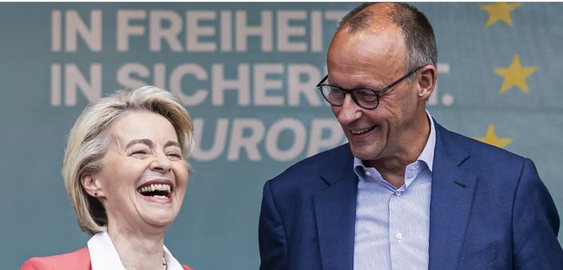
Photo: Screenshot ARD
For over two years, there have been loud and repeated calls for Russia’s immobilised assets in Europe – valued at around $245 billion – to be permanently seized. However, those assets had hitherto been immobilised under EU sanctions which required unanimous agreement every six months.
Not any more. Given Belgium’s sturdy resistance to using $165 billion in immobilised assets held in Euroclear, the European Commission has triggered an emergency clause in the Treaty on the functioning of the European Union to bypass the principle of unanimity on sanctions policy.
On Thursday of last week European Council Ambassadors agreed by majority to freeze indefinitely immobilised Russian assets in European banks. This proposal is separate from specific lending to Ukraine to cover its financial needs, which was subject to a separate proposal.
But, in fact, the two are connected. Because the separate proposal for a so-called reparations loan makes clear that Ukraine will only have to repay the loan if its receives reparations from Russia, whereupon Russia’s frozen assets will be returned.
The measure proposed by the EU uses as its legal basis the need to cover the economic risks to the EU from the ongoing war. However, the Economist has pointed this out as an example of ‘dodgy’ legal logic. But it’s worse than that; it’s in fact untrue. The money is not intended to support Europan economies, as it only represented 1% of European GDP. It will be used to back a reparations loan that is not intended for reparations, but rather to pay for Ukraine’s bloated budget.
And therein, the biggest flaw in the plan, setting aside issues of its legality, is that it is trying both to cover issues of reparations and address Ukraine’s short-term fiscal crunch with a single set of resources, which clearly will never work.
Reparations implies costs towards the reconstruction of Ukraine’s shattered country when the war ends. Yet, that is not the stated purpose of the proposed reparations loan which would be backed by the immobilised assets.
The loan itself would include $106 billion to cover Ukraine’s budget deficit over the next two years and $50 billion to write off the EU contribution to the G7 Extraordinary Revenue Acceleration loan agreed in June 2024. Any remaining Russian assets would be pumped into Ukraine’s defence industry.
So, all of Russia’s money – putatively set aside to rebuild Ukraine – will effectively be given to Ukraine to keep its finances afloat and build up its military industrial complex. In a bid to create the illusion that this money hasn’t, in fact, been stolen, the money would be provided in the form of a loan underwritten by those European banks that hold Russian assets. In this fantasy, Russia’s assets still exist, it’s simply that EU banks have lent their equivalent value to Ukraine.
Freezing the Russian assets indefinitely prevents the loan collateral being returned to Russia after any peace deal that leads to sanctions against Russia being lifted.
Let’s be clear, the earlier G7 Extraordinary Revenue Acceleration loan to Ukraine agreed in 2024 had a maturity of up to 45 years. Does Europe really intend to keep Russia’s assets immobilised for that period of time?
Either way, if the assets remain solely as collateral, then they are not available for reconstruction in Ukraine.
President Trump’s initial 28 point peace plan suggested that Russia’s immobilised assets be split three ways, between $100 billion invested in Ukraine by US firms, $100 billion overseen by Europe and the remainder co-invested by the US and Russia in its country. On that basis, and assuming Russia was agreeable, all of Russia’s immobilised funds would be used for genuine reconstruction efforts, both inside of Ukraine and those parts which Russia has occupied. President Zelensky has spoken this week about the possible setting up of a special economic zone in the contested parts of Donetsk oblast that would be demilitarised.
As I pointed out a year ago, Russia might be willing to give up its assets for some form of de facto recognition of territory, which the Trump administration has essentially proposed. The value of its unfrozen sovereign reserves – at $425 billion – now far exceed the sum still frozen in Europe and other jurisdictions including the US.
And it’s clear that Europe has absolutely no intention of giving Russia’s assets back anyway, so why not cut a deal that works best for Russia?
However, under the EU’s half-baked loan scheme, those assets are no longer available. They haven’t ceased to exist, but they have been spent.
So, what the Europeans want is to bake two cakes with one set of ingredients. Get Russia to pay for Ukraine’s day to day fiscal expenditures associated with war fighting. And get Russia to pay for Ukraine’s post-war reconstruction. That is clearly delusional.
No, don’t worry about that, European Commission officials assure us, Russia will get its assets back after it pays reparations to Ukraine. But who decides how much Russia should pay? At the end of 2024, the UN estimated that Ukraine’s total recovery and reconstruction needs amounted to $524 billion.
Russia will simply not agree to pay that sum when it has the stronger hand in peace talks. And, in any case, why would Russia agree to pay a sum of reparations that Europe adjudicates on from afar, all while the Americans have a more credible plan to use the immobilised assets?
President Trump is nudging president Zelensky and European leaders, kicking and screaming, closer toward a peace deal that they don’t want to sign up to. In the case of Zelensky, he has resisted agreement because it might bring his time in power to a juddering halt. In the case of Von der Leyen, it would mean she had to tell Member States how much they needed to stump up to pay for Ukraine. As well as being logically confused and ill-thought-through, the asset seizure idea also brings the added risk of preventing any ceasefire.
Despite this, Trump appears to have the bit between his teeth to force a peace deal through and, with Zelensky now appearing to give up on NATO membership, we appear mercifully to be nudging in tiny steps towards the end of this needless war.
Someone will still need to pay for Ukraine’s budget when that happens. Russia will rightly point out that Europe has expropriated its money in the biggest bank robbery in history. And likely bury Brussels in a blizzard of litigation which makes investors in the developing world think long and hard about whether to keep their money in Europe.
What is also clear is that, having not had access to its sovereign assets since the war started and have learned to live without them, the Russians have time on their side. If the Americans come knocking and ask who is going to pay for Ukraine’s reconstruction, they will undoubtedly point to Brussels and declare that Europe stole all the money.


What a wonderful offering from Ian Proud. The whole shemozzle is better than a Brian Rix farce. Thank you.