
The EU’s and NATO’s inexorable march towards Götterdämmerung
Johann Rossouw is a polyglot South African philosophy professor, who regularly comments geopolitical events in various outlets including Le Monde Diplomatique
Cross-posted from Emmanuel Todd’s Webstack
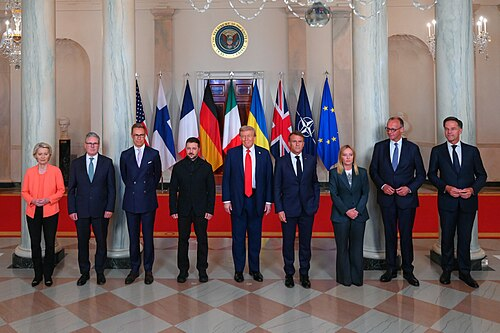
Photo: Wikipedia
The journalist and historian, Jan-Jan Joubert, rightly voices his concern over clouds of war currently gathering over Europe (the national afrikaans South African Sunday paper, Rapport newspaper, 2025/11/30; paywalled). The grounds on which he bases his concern do, however, raise questions.
Joubert’s article follows the arguments of Western European liberal mainstream media and politicians such as Emmanuel Macron, Friedrich Merz and Ursula von der Leyen.
It is all very well to offer this perspective like Joubert does, but anybody who would like to see peace in Ukraine should at least also take the Russian perspective on the conflict into account – as well as those of authoritative Western critics of the mainstream liberal European perspective.
The first problem with Joubert’s argument is that he – rather inexplicably for a historian – writes on the behaviour of Russia under President Vladimir Putin without the merest reference to the historical context within which the conflict in Ukraine emerged.
Prof. Jeffrey Sachs of Columbia University is probably the world’s pre-eminent development economist, who advises or has advised governments across the world – including those of Russia and Ukraine. In a speech that he gave on 21 January 2025 to the European parliament he discusses the contribution that the American-led West made between the collapse of the Soviet Union in 1991 and the Biden Administration end 2024 to the stoking of the conflict.
The most important facts that Sachs highlights are the following. While the Warsaw Pact was disbanded under the initiative of Russia in 1991, the USA decided to expand NATO further to the East with the aim of weakening Russia and to exclude them from a possible multi-polar world order.
In 1997 the influential former national security adviser of President Jimmy Carter, Zbigniew Bzersinski, publishes a book in which he explicitly advocates, as part of this strategy, turning Ukraine against Russia and bringing it under Western influence.
This strategy is subsequently followed by one US administration after the other, amongst others by destabilising various Ukrainian governments, first in the so-called Orange Revolution of 2004/5, and then in the so-called Maidan Revolution of 2014. Sachs refers to the latter as a coup, and this on the basis of the self-avowed role that high-ranking US officials such as Victoria Nuland played in the overthrow of the then democratically elected pro-Russian government of President Viktor Yanukovich. Shortly afterwards the new ultra-nationalist Ukrainian government prohibits Russian as official language – including in schools in the East of Ukraine, that is the Donbass, which is overwhelmingly ethnically Russian or Russian-speaking. Undoubtedly this contributes to the establishment of resistance movements in the Donbass against the Ukrainian government, which leads to a conflict in which more than 15 000 residents of the Donbass lose their lives by early 2022.
From the Russian perspective it is also in reaction to more than 25 years’ American-led Western aggression against Russia that Russia in 2014 annexes Crimea, which was Russian from 1783 to 1954.
Subsequently the Minsk agreements are negotiated, which, amongst other things recognise the rights of the ethnically Russian/ Russian-speaking minority in the Donbass. From the Western side France and Germany were supposed to ensure that the stipulations of the treaties were applied, but this did not happen.
In 2021 Russia asks for negotiations with the Biden Administration. Russia demands at the end of 2021 that Ukraine not be granted membership of NATO; demands as part of a proposed new security pact with the West certain limits on NATO activities; and requests a new security treaty with the USA. The Biden Administration rejects these proposals.
The philosophical anthropologist, René Girard explains in his 2007 book on the mimetic rivalry between Europe’s two great powers between 1800 and 1950, France and Germany, that in conflict between two rivalrous countries there is often an escalation of tension in which both countries consider the other as the aggressor.
This is precisely what happens in the build-up of both the Ukranian and Russian armies between 2014 and 2022, where both parties accuse each other of being the aggressor. From the Russian perspective the final spark to set off the powder keg was according to Prof. Beom-sik Shin of the Institute for Peace and Unification Studies of Seoul National University, in the weeks beforePresident Putin recognised the independence of the ethnically Russian/ Russian-speaking Donetsk and Luhansk republics of the Donbas and invaded Ukraine, the fact that the region was targeted by about 130 000 Ukrainian government soldiers. From the Russian perspective the invasion of Ukraine was thus to protect Russian sovereignty against the West, as well as to protect the ethnically Russian/ Russian-speaking minority against the Ukrainian government.
Joubert repeats another claim of the liberal Western European mainstream, namely that there exists a parallel between the concessions of Britain and France to Hitler in 1938, and that which is taking place today between Putin and Europe.
It is generally accepted that Hitler’s motivation for invading some European countries was to create a so-called Lebensraum for Germans in Eastern Europe, and to create a “racially pure” dispensation under German leadership for the “Germanic nations” of The Netherlands, Flanders and the Nordic countries.
Joubert, however, prefers to ascribe Hitler’s motivation to economic considerations, that is, a German shortage of resources, labour and minerals – and he speculates that Russia will in future attack Europe to obtain “assets and minerals”. This is truly a strange idea since Russia is rich in oil and several different types of minerals, including strategically important rare earth minerals.
Macron, Merz and Von der Leyen do not pass up any opportunity to claim that Russia will in due course attack Europe, but without ever providing verifiable evidence for this – or making clear what motives Russia would have for such an action. Moreover, after more than three and a half years (and not two and a half as Joubert states), Russia has not yet been able to reach its military goals in Ukraine – and this while Russia has the fifth largest army in the world. Estimations of Russian mortalities in the conflict with Ukraine vary from 600 000 to 1 million – how on earth would Russia be able to demographically afford attacking Europe?
The world’s leading thinker on realism in geopolitics, Prof. John Mearsheimer, as well as many others, point to the actual reason for claims from within European ranks that Russia plans to attack Europe, which is that they thus hope to keep the USA involved in the defence of Europe. The price at which this comes is the demonisation of Russia in Europe and the stoking of fear amongst European populations.
The leftwing German politician, Sahra Wagenknecht, warned at the end of August in an interview against a further serious risk of the European demonisation of Russia: while Europe and a European security architecture have always been important to Putin, the European alienation of Russia may lead to Putin one day being succeeded by a president that is much more hostile towards Europe, finally writes Europe off, and aligns Russia completely with China against Europe. Putin is undoubtedly already doing this to an extent, which does not predict anything good for the West.
This article was opened by agreeing with Joubert that clouds of war are indeed gathering over Europe. It is, however, for very different reasons than those argued by Joubert.
To begin with, the centre-left anthropologist, historian and geopolitical expert, Emmanuel Todd writes as follows about contemporary European Russophobia: “The construction of a post-national Europe is a delusional project when one considers the diversity of the continent. It has led to the expansion of the European Union, cobbled together and unstable, into the former Soviet space. The EU is now Russophobic and warmongering, with its aggression renewed by its economic defeat at the hands of Russia [due to the costs of European sanctions against Russia – Johann Rossouw]. The EU is trying to drag the British, French, German and many other peoples into a real war. But what a strange war it would be, in which the Western elites have adopted Hitler’s dream of destroying Russia!”
Further to this a conservative veteran of the French parliamentary standing committee for foreign affairs and former French minister, Pierre Lellouche, in a recent interview also questions the comparison with 1938, and argues that the comparison should rather be made with 1914, that is, the eve of the First World War when “a group of states that did not want a world war was through an error of judgment by one of them together with an architecture of mutual alliances dragged into a series of events that led to war. I say again: the longer this war lasts, the more it carries the seed of an escalation.”
In conclusion: the war in Ukraine is a classical example of how one great power, namely the USA, takes on another great power, namely Russia, by misusing a weaker state for this, namely Ukraine. In a sober analysis of the peace plan that is currently under negotiation between the USA, Russia and Ukraine, Anatol Lieven explains why it is now Ukraine’s best chance to emerge from the conflict as a relatively sovereign state with relatively good security guarantees.
If this does not happen, it is predictable that Ukraine will be off worse and worse, while avoidable clouds of war will be gathering over Europe.

Be the first to comment