
Washington also called for end to Afghanistan investigation and change to Rome Statute in return for lifting sanctions
Sondos Asem is a journalist and news editor at Middle East Eye in London. She is a specialist in international law, human rights and public policy in the Middle East and North Africa
Cross-posted from Middle East Eye
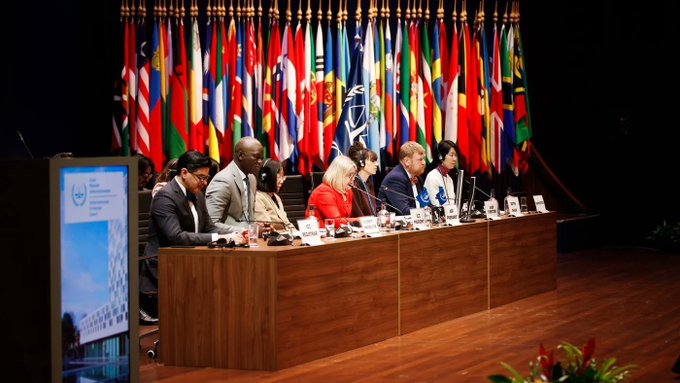
International Criminal Court officials pictured on the first day of the Assembly of States Parties, The Hague, 1 December 2025 (ICC gallery)
The oversight body of the International Criminal Court (ICC) has shunned US demands for the court to drop its investigation into Israeli war crimes and to amend its founding treaty to prevent the prosecution of nationals from countries that do not recognise the court’s jurisdiction, Middle East Eye can reveal.
In a statement issued on Wednesday after its annual meeting in The Hague earlier this week, the Assembly of States Parties (ASP) vowed to uphold the integrity of the Rome Statute and said it was “gravely concerned” by threats and coercive measures targeting the court.
The meeting took place in the shadow of US sanctions already imposed against a number of ICC senior officials, including judges and the chief prosecutor, Karim Khan.
Diplomats speaking on the sidelines of the event told MEE that the Trump administration had tried to exert further pressure on the ICC in the leadup to the ASP meeting by calling on the court to drop its investigations into war crimes in Palestine and Afghanistan as a condition for lifting sanctions.
The US also called on member states to amend the Rome Statute to prohibit prosecutions of citizens of non-signatory states, a move that would have effectively granted immunity to American and Israeli nationals. An amendment of that nature would also end the Ukraine investigation into alleged war crimes by Russia, a non-member of the ICC.
Based on briefings by three diplomats familiar with the matter, MEE can reveal that representatives of ICC member states were presented with the US demands by a diplomat from an EU state at a meeting last month.
One senior diplomat, who spoke to MEE on the sidelines of the ASP meeting, said the final statement adopted by consensus was a “refined version” of less unequivocal proposals made over the past month to try to appease the Trump administration.
“This declaration is a good compromise that conveys a strong message that states are supporting the court,” the diplomat, a member of the ASP, told MEE on condition of anonymity.
“Others were saying if we send a strong message of unity and defiance against the US sanctions, the sanctions will immediately be instituted.
“So, they said, why not open the door for engagement? Those who were proposing that weren’t necessarily saying ‘let’s agree to amend’, but they were trying to say: ‘don’t close all doors to the possibility of engagement, and let’s open the door for amendment’.”
The text of the latest ASP declaration had a single reference to dialogue with non-members, “to ensure the Court continues to be an effective and independent judicial institution”.
Such a reference was seen by the drafters as consistent with the court’s mission, said the diplomat.
“Dialogue with non-states parties is important, but it depends what the dialogue is about,” added the diplomat, pointing out that the purpose of dialogue should be primarily to invite other states to join the court.
“We don’t anticipate a dialogue that will be about changing the overall direction of the court or anything that would compromise its independence,” they added.
“There is a growing realisation that any amendment to the Rome Statute intended to appease those calling for sanctions would do more to destroy the court than the sanctions themselves,” the diplomat said. “Many states believe there would be little reason to remain within the court if that happens.”
“Either we fight or we die. Either we swim or we sink. There’s a determination to swim against the current.”
MEE has contacted the US state department for comment.
Countermeasures
The meeting of the ASP, which is made up of representatives from the 125 countries that have ratified the ICC’s founding Rome Statute, has taken place at a time of unprecedented threats to the court, prompted mostly by its investigation into Israel over alleged war crimes in Gaza and occupied Palestine.
Sanctions have also targeted judges who worked on the Afghanistan investigation, which since 2021 has deprioritised investigating US nationals and has instead focused on Afghan nationals.
ICC judges are currently examining an Israeli challenge into its jurisdiction on the Palestine situation, and a separate Israeli complaint, filed on 17 November, seeks to disqualify the prosecutor over alleged lack of impartiality. Khan has been on voluntary leave of absence since May pending a UN-led investigation into the allegations, which he strenuously denies.
Since February, US President Donald Trump’s administration has imposed financial and visa sanctions on the chief prosecutor, his two deputy prosecutors, six judges, the UN’s special rapporteur on Palestine and three Palestinian NGOs.
The US has also threatened sanctions against the court itself.
The sanctions have upended the daily lives of the nine ICC officials, banned them from travel to the US, and effectively cut them off from much of the global financial system, including within Europe.
Meanwhile, ICC officials have confirmed the court is implementing countermeasures to protect the court from the sanctions, but they will remain confidential to ensure their effectiveness.
The declaration adopted by the ASP this week denounced the use of coercive measures, including sanctions, against elected officials or those cooperating with the court, including civil society organisations. There was no mention of the US, however.
The ASP session comes almost a year after ICC judges issued arrest warrants for Israel’s Prime Minister Benjamin Netanyahu and former defence minister Yoav Gallant on a range of charges centred on the use of starvation as a weapon of war in Gaza since October 2023. It was the first time in the court’s history for arrest warrants to target western-allied officials.
The decision last year to apply for warrants by the court’s chief prosecutor Khan has prompted threats to him and to the court by the US and its allies, including the UK.
MEE revealed this summer that on 23 April 2024, as Khan was preparing to apply for warrants for Netanyahu and Gallant, the then British foreign secretary David Cameron threatened in a phone call with the prosecutor that the UK would defund and withdraw from the ICC if the court issued the warrants.
ICC officials have also been subjected to extraordinary pressure and threats from US officials over the past year. In a virtual meeting with ICC officials in May 2024, US Republican Senator Lindsey Graham threatened sanctions against them if Khan applied for the warrants.
Likewise, US state department legal adviser Reed Rubinstein warned in July that “all options remain on the table” unless all arrest warrants and the investigation into alleged Israeli war crimes are dropped.
‘The court is independent’
But the diplomats, judges and experts who spoke to MEE this week ruled out that the ICC would drop the investigation or that US threats would force an end to the Palestine or Afghanistan investigations.
“There are things that do not fall within the ambit of states parties. The court is independent of us as states parties,” one diplomat said.
“That’s why I don’t see how decisions made by the court can be reversed.”
One senior ICC expert also ruled out that ICC judges would accept Israel’s challenge.
“Israel is more likely to uphold the ceasefire than the Appeals Chamber is to invalidate the arrest warrants,” the expert said, sarcastically.
Three sanctioned judges, speaking to MEE this week on the sidelines of the ASP, also confirmed they will not be deterred by the sanctions.
The US and Israel are not state parties to the Rome Statute, the treaty that established the ICC in The Hague in 2002.
Both states have opposed the court’s investigation into the situation in Palestine, first launched by the ICC’s previous prosecutor Fatou Bensouda in 2021.
The court’s jurisdiction has been based on the accession of the State of Palestine to the Rome Statute in 2015. Accordingly, the court can investigate Israeli individuals for crimes committed in occupied Palestine, which includes the Gaza Strip, the West Bank and East Jerusalem.
But Israel and the US have challenged the court’s jurisdiction, saying they do not recognise Palestine as a state, and that Israel is best placed to investigate itself under the principle of complementarity as set out in Article 17 of the Rome Statute.
The two countries have also rejected the jurisdiction of the court, based on Article 12 of the Rome Statute, claiming the court should have no jurisdiction over their nationals because they haven’t ratified the treaty.
The ICC is the world’s only permanent international court with the power to prosecute senior officials for international crimes. It is currently investigating a dozen situations, including in Palestine, Ukraine, Afghanistan, Darfur (Sudan), Libya, the Democratic Republic of the Congo and the Philippines.


Be the first to comment