
Europe is increasingly dependent on American LNG, but what gets little discussed is the damage this LNG production is doing to the health of Americans and the environment they live in.
Luca Manes is an Italian journalist.
Cross-posted from Green European Journal
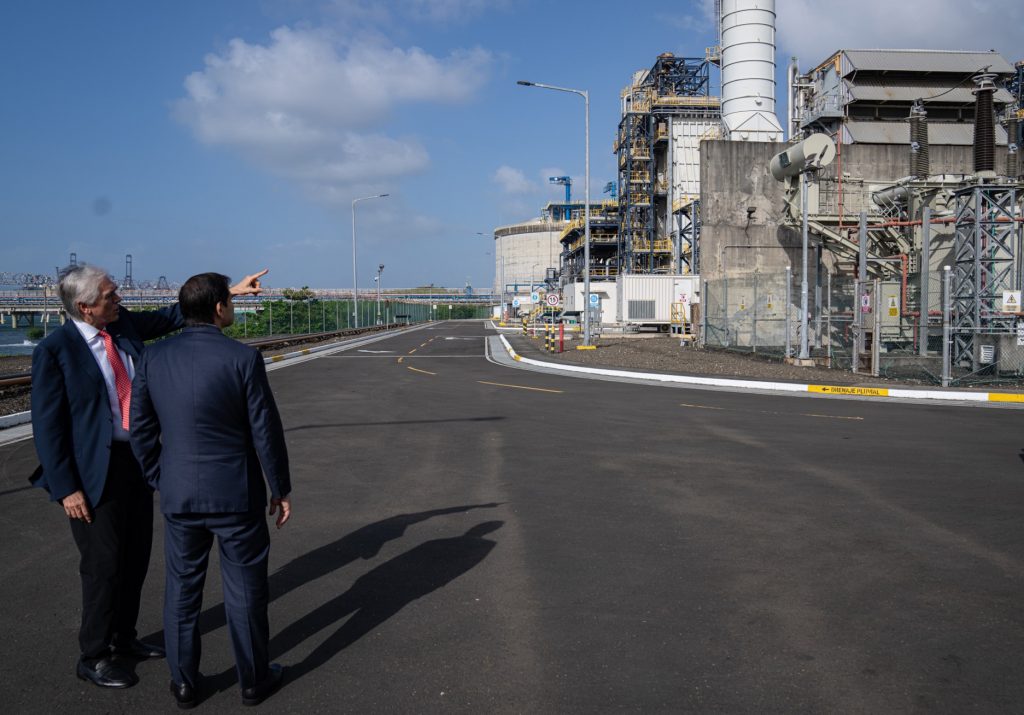
On the stretch of US coastline along the Gulf of Mexico between Texas and Louisiana, there stand some of the most important terminals for the export of liquefied natural gas (LNG). Several LNG export plants are currently undergoing expansion, while at least five major new terminals are under construction and others are in advanced planning stages. Here, Donald Trump’s “Drill, baby drill!” slogan is being put into action, transforming the natural landscape and the lives of its inhabitants.
Extracting more oil – and the associated gas that sits over it – means not only focusing on increasing domestic consumption of fossil fuels, but also allocating a large portion of production to international markets. In particular, the European market, which has reduced its reliance on Russian fossil fuels since 2022.
For this reason, the Gulf Coast area (which Trump renamed “Gulf of America”) – already home to one of the largest concentrations of oil, gas, and petrochemical infrastructure in the United States – is now being further industrialised with new LNG facilities. The LNG is then loaded onto giant ships that travel around the world.
The politics of extraction
Cameron Parish, on the south-western coast of Louisiana, is one of the places where the LNG expansion is most concentrated, both in industrial terms and in terms of impact. The fossil craze invades an area of wetlands, canals, and coastal communities already exposed to erosion, hurricanes, and decades of previous extraction. With a capacity of approximately 10 million tonnes per annum (MTPA) of LNG, the Calcasieu Pass terminal is operational, but a few hundred metres away, dozens of cranes testify that work has already begun on Calcasieu Pass 2 (CP2), a 28-billion-dollar mega-project.
Both terminals belong to Venture Global, a company with close ties to the current US president. It is the same company with which Italian energy giant Eni signed a contract in July 2025 to purchase 2 million tonnes of gas per year for the next 20 years. This has pleased both Donald Trump and Giorgia Meloni, the Italian prime minister.
Venture Global’s growth has been closely aligned with the expansion of LNG exports promoted under the Trump administration, and the company is among those that have benefited from accelerated approval processes and a more lenient regulatory framework. This political dimension came under scrutiny in a recent investigation by The Guardian, which raised serious questions about the relationship between company executives, politicians, and financial markets. According to the report, Venture Global co-founders Michael Sabel and Robert Pender purchased millions of shares in their own company a few days after meetings with senior Trump administration officials and immediately before the release of key authorisations for LNG expansion, including the Calcasieu Pass 2 project. The Democrats have also launched a Senate inquiry into the matter.
Construction timelines for CP2 are remarkably short: only 29 months. Construction is expected to employ up to around 7,500 workers at peak,before the workforce drops to just a few hundred once the plant becomes operational. “There are a lot of migrants, but we have never noticed a real ICE presence here,” says James Hiatt, founder and spokesperson for For a Better Bayou, a grassroots organisation that seeks to oppose the expansion of LNG terminals by any means, including legal action. In fact, the local group succeeded in stopping the project during the Biden administration, but everything changed with the new political priorities of the White House.
Cameron Parish has historically based its economy on fishing, aquaculture, and shellfish farming. During a field trip in the Gulf Coast area in February, I crossed the water basin next to the two Calcasieu terminals on a boat, with flocks of pelicans flying overhead. Our guide is Sky Leger, a fisherman who tells us that he is now one of the last active fishers in the area. When work began on the new terminal, he says, huge amounts of mud destroyed thousands of oysters, the pride of this region. The impact on the area’s many dolphins is still to be seen.
For residents, the expansion of the LNG plants means living with high-risk facilities where accidents are a regular occurrence. The latest one happened just a couple of days before my arrival. A natural gas pipeline linked to an LNG project exploded near Holly Beach, injuring a worker during what was described as routine maintenance operations. Holly Beach itself is a narrow strip of coastline dotted with stilt houses built to withstand flooding – a necessity in a region repeatedly hit by major hurricanes, including Rita and Ike in 2008, and Laura and Delta in 2020, as residents are reminded by markers still visible on trees.
Gas slated for shipment to Europe and Asia arrives in Cameron Parish from the arid plains of the Permian Basin, about 1,000 kilometres further north. However, oil remains the undisputed king in this windswept area of Texas. According to the latest official data for 2024, six million barrels are produced here per day, more than any other field in the world. The more oil is extracted, the more associated gas is produced and must be sent away, with Europe being a key destination. But the reality suggests that Europe doesn’t really need all this gas. Instead, it is doing a favour to its fickle ally across the Atlantic, while promoting the interests of the “usual suspects”.
In Italy, for example, according to 2024 data, the annual gas demand was approximately 61.8 billion cubic metres – a significant decrease of around 20 per cent compared to 2021. In the same year, LNG imports into Italy amounted to 14.7 billion cubic metres, down from 16.5 billion in 2023. LNG therefore accounted for about a quarter of total gas imports. According to the Institute for Energy Economics and Financial Analysis, this share could grow significantly by 2030: between 75 and 80 per cent of LNG imported into Europe could come from the United States – meaning Europe may shift from dependence on Russian gas to reliance on American gas.
A growing wasteland
It is no coincidence that when you land in Midland – which together with neighbouring Odessa forms the main conurbation of the Permian Basin – flares burning excess gas are visible on the horizon. “Paradoxically, it is less serious that there is flaring visible to the naked eye than hidden methane emissions,” explains Sharon Wilson of the local organisation Oilfield Witness. For decades, Wilson has been tirelessly mapping pollution levels in this area. She identifies the hidden emissions with an optical gas imaging camera, revealing massive discharge escaping from the energy infrastructure.
In reality, flaring is not legal either, but regulatory enforcement allows for certain thresholds that oil and gas companies – not closely monitored by local authorities – tend to exploit. Wilson notes that even in this area, ICE does not seem too interested in controlling the local workforce, most of whom are of Latin American origin.
Travelling across the immense Permian Basin is disorienting. Wells and extraction-related infrastructure are everywhere, with some – such as Pavilion Park in Midland – even located mere metres from residential areas. Across dozens of kilometres of land, there is little sign of the once-ample fertile farms, except for a few hectares of cotton fields stricken by the abnormal cold spell that hit the area a few days before my arrival. Like the emissions revealed by Wilson’s thermal camera, the tangle of underground pipes connecting the wells to the processing facilities is invisible to the naked eye. They form an immense web, marked here and there by signs: “Warning, this gas may be toxic.”
At times, the air is difficult to breathe, but nowhere more so than near Lake Boehmer, a reservoir formed by wastewater from oil processing located about an hour and a half’s drive from Midland. The area appears devoid of life, both within and around the basin. In some sections, the water bubbles unnaturally, giving the lake a disturbing, almost volatile appearance. Measurements indicate elevated levels of naturally occurring radioactive materials (NORM), a byproduct of oil and gas extraction that can accumulate in wastewater and residues.
A few kilometres from Lake Boehmer, there is an even more extensive tangle of pipes and facilities. This is the Waha Hub, the trading point for West Texas gas. In 2024, gas prices at Waha fell below zero for a significant portion of the year because production exceeded the capacity of the pipelines to carry gas out of the basin. At various times, producers faced negative pricing conditions, effectively paying to offload excess gas in order to continue oil extraction.
The final stop on my tour of this immense sacrifice zone is a deeply dystopian motorway service station: in front of the petrol station stands a 20-metre-high replica of a corn stalk. Inside, they sell caps with the words “Oil Field Mafia”, where the Italian term clearly has a positive connotation. Who knows if Trump has one in his own collection of caps?
Europe’s footprint
One European country that has been heavily involved with the US LNG industry is Italy. According to energy giant Snam, approximately 150 shipments arrived in Italy in 2024, with about one-third of the volume originating in the United States (another third came from Qatar, a quarter from Algeria, and the rest from other countries). In 2025, with the launch of the Ravenna floating storage and regasification unit (FSRU) – which brought Italy’s total regasification capacity to approximately 28 billion cubic metres per year – the pace of shipments remained high: a Snam press release dated 12 June 2025 states that 95 LNG shipments had already arrived in Italy since January 2025, “mainly” from the United States, Qatar, and Algeria.
But Italian involvement goes further than just purchasing gas. Large and expensive infrastructure, such as the terminals dotting the coasts of Texas and Louisiana, requires billions of dollars to build and maintain. It is no surprise that the bank Intesa Sanpaolo, whose financing for coal, oil and gas stood at 11 billion US dollars in 2024, has stepped in.
In 2024, the Turin-based credit institution financed the US gas company Cheniere with 158 million dollars. A year earlier, Intesa Sanpaolo’s gas investments had reached a record 1.3 billion dollars, most of which went toUS-based company NextDecade for the development of the Rio Grande LNG terminal in Texas. Investments updated in January 2024 show 1.1 billion dollars allocated by Intesa to the development of LNG terminals. According to an analysis carried out by the French NGO Reclaim Finance, Intesa Sanpaolo contributed approximately 3.8 billion dollars to financing LNG expansion between 2021 and 2023, making it the leading Italian bank involved. In addition to Rio Grande, it supported the construction of five other terminals.
Energy company Edison is also playing a major role as one of the first European buyers of LNG from Venture Global LNG, with a 20-year contract to purchase approximately 1.4 billion cubic metres annually from the Calcasieu Pass facility. However, technical delays at the terminal and the prolonged commissioning phase – a transitional stage before full commercial operations – led Edison, along with other major international customers, to initiate international arbitration proceedings against the US company for failure to meet delivery obligations. It was not until May 2025 that Edison received its first LNG cargo under the contract, later unloaded at the regasification terminal at the port of Piombino, Tuscany. The disputes involving Edison are part of a broader legal conflict that also includes energy giants like the Spanish Repsol, the Dutch Shell, and the British BP, and centre on Venture Global’s decision to sell LNG on the spot market during the commissioning phase instead of supplying long-term contracted buyers.
As these companies pursue their lawsuits, the Permian Basin and the Gulf Coast continue to bear the social and environmental impacts of relentless extraction. Their suffering, however, is often drowned out by the noise of mega-deals and endless drilling.
This report draws on a field visit to the United States conducted by the Italian non-profit association ReCommon between January and February 2026. The author of this article, Luca Manes, is in charge of ReCommon’s media relations and communications.


.jpg)
Be the first to comment